I've been thinking about grand strategy games recently, and it occurs to me that supply rules are a lot like encumbrance rules, in that they're a pain in the ass but also worthwhile because they convey the same concerns the character experiences up to the player. A dungeoneer worries about how much weight he's carrying; a general worries about how to keep his men fed. What's more, as Keegan's History of Warfare suggests, supply concerns dictated the largely-coastal structures of campaigns in the Hellenic era. Without supply, you get all kinds of crazy long-term unsupported actions in the enemy rear (this is a problem I have observed in, say, the Civilization series of games).
But the difference between supply and encumbrance is that we're reached a reasonablish compromise between complexity and realism in our encumbrance rules, with encumbrance by stone or with Traveller's low-kilos threshold. I don't know if supply is amenable to simplication... but until I find a set of rules for it which are really light-weight, I expect that it will remain one of those much-begrudged rules which is ignored by the players whenever I forget about it.
(Been thinking about wargame campaigns again, since I'm back in Collegetown and one of my main wargaming opponents / buddies is still around)

Showing posts with label Starmada Nova. Show all posts
Showing posts with label Starmada Nova. Show all posts
Sunday, August 17, 2014

Wednesday, February 19, 2014
A Return to Wargaming?
Jimdad suggested on the recent organizational resources post that it would make sense for me to do some test runs of all the tech before trying to run a full-blown campaign with it. This is sensible, but one-shots are unsatisfying as a rule. Unrelatedly, I've had VBAM and space wargaming on the brain recently for no apparent reason. But they do suggest an alternative means for tech-testing, in that wargames are primarily one-off affairs (at least in our group) which work well with a small and irregular player pool. Playing one-off wargame scenarios also leads nicely into campaigns, which might beget universe generation and lead to workable RPG settings.
I'm sort of looking back at the Starmada Summer of 2011 as a model, but hopefully with a less flexi-fragile system (or a gentleman's agreement that if something is broken, you use it to win once and then can it). I think Full Thrust in one of its several incarnations would probably serve us well, as it is a very simple core game with lots of optional things to experiment with (I for one would be curious to try Colonial Battlefleet's initiative system on top of FT's general mechanics; I'm just not a huge fan of pre-plotted movement). Full Thrust is also old enough and well-enough vetted that its exploitable flaws are known (documented and discussed in the expansion books) and can hopefully be avoided. It also has a nice-looking sample campaign in the back of the FT2E manual.
Other options:
I'm sort of looking back at the Starmada Summer of 2011 as a model, but hopefully with a less flexi-fragile system (or a gentleman's agreement that if something is broken, you use it to win once and then can it). I think Full Thrust in one of its several incarnations would probably serve us well, as it is a very simple core game with lots of optional things to experiment with (I for one would be curious to try Colonial Battlefleet's initiative system on top of FT's general mechanics; I'm just not a huge fan of pre-plotted movement). Full Thrust is also old enough and well-enough vetted that its exploitable flaws are known (documented and discussed in the expansion books) and can hopefully be avoided. It also has a nice-looking sample campaign in the back of the FT2E manual.
Other options:
- Starmada: Nova - we never really gave this one a fair shake, and the seeker rules are pretty neat. On the minus side, forum reports that stacking up weapon traits is still pretty broken.
- Colonial Battlefleet - sort of hampered by lack of good shipyard spreadsheet. I have one half-thrown together, but got bored. Good stealth and initiative rules, and the Raider type from the expansion book looks like fun. On the minus side, fairly heavy bookkeeping for shields.
- Battleshift - Fleet engagements with some cool tactical warp mechanics. If I recall correctly, though, it needs a pretty big playing area, and I've seen roll20 lag out under less.
- Space Hulk. The problem with Space Hulk is that it's unusually stressful, because there is some serious "oh god oh god we're all going to die" going on continuously (... holy cow, this must be what it's like to play in my ACKS games. No wonder they keep disintegrating! On the other hand, if you play ACKS well, it's less of a problem than if you play Space Hulk well, because the DM is slightly less actively malicious than the 'stealer player). Also the maps are deceptively expansive.
- BattleTech Lite - light to medium mechs from the earliest time period only, and perhaps no melee. Could be fun as long as you keep the total number of armor / structure points low.
- Domains at War: Battles - Our experiences so far suggest that DaW:B is too heavy unless there's some significant investment in the outcome (ie, a PC realm at stake). On the other hand, two games between inexperienced players is not a whole lot to go by. I've been meaning to write some scenarios for this - the system could definitely use one highlighting the fortification rules, and everybody loves Helm's Deep.
- Hell, a sample DaW:C campaign would be fun too, and if the battles were resolved using the Campaigns rules, it might work alright for one-off afternoon games (though I sort of expect a lot of overhead from the recon rules - TODO automate recon). I could steal something from Crusader Kings and keep the magic-and-wyvern-cavalry level historically low for ease of use.
- Anything in the 15-25mm infantry sphere - I have my doubts about how well roll20 would handle these, and Vassal suffers from limited plugins. Options include Stargrunt, Gruntz, WH40k, and many many others.
- Dirtside or other 6mm microarmor games - Again, I don't think this one would do well on roll20. Also chit-based damage.
Friday, November 9, 2012
One Last Starmada Post
Well, I happened by the Starmada forums recently just to see how things were doing with Nova. It looks like the community has diminished somewhat, which I'm sad to see. What's more, several of the threads I skimmed seemed to suggest that Nova has been having the same issues with weapon traits that Admiralty Edition did, namely people stacking all kinds of stuff on one gun and then destroying everything with it. Further, much as we suspected when Nova first came out, fighters have been weakened to the point where they're no longer an effective counter. And naturally, Expendable, Nova's one-shot replacement for Ammo, has been found to be broken as well.
I'm starting to see a pattern here. When you let people build their own weapons, things start getting really ugly really fast. It's like True Sorcery in D&D; you build all of your own offensive capabilitites, and if you know what you're doing, you can do ridiculous things. Except that in D&D, there's not a direct contest between players, so you can kind of get away with it, and you have a DM to kill you if you get out of line. In Starmada, where players are directly competing, arms races develop, global optimums are found, the design game is won, and the actual game is over.
But, the converse is that designing stuff is fun. So, says I, what wargame do I have sitting around that has buildy options but doesn't permit users to design their own weapons?
BattleTech. The 4th Edition Starter Box, to be specific, though missing mapsheets and minis :\
Granted, if I were to run some BattleTech around here, I think I would try to avoid the mistakes I made the last time I tried it, as well as some of the mistakes we made when we first tried to play Starmada and Stargrunt. First off, start people off with 2-3 light to medium mechs, rather than a single assault mech each (one thing Starmada and Stargrunt made apparent is that giving new players a single unit means that when that unit starts getting pounded, they get frustrated, then bored). And second, use a wet-erasable hex-map so there can be terrain (because, as is often said, terrain is an essential part of wargaming... though Matt has this mat, and is out of town ): . Pre-copying a great pile of mech sheets for the classes available beforehand is probably advisable as well, as is making copies of the reference tables (the Stargrunt reference card was fantastic enough that this seems a good plan). Then after a few games with 3025 stock mechs, open up the 3025 design rules with the same tonnage limits (for those unfamiliar, 3025 refers to a tech year in the BT universe, and is the lowest / simplest. There's also 3035, 3050, 3075, and probably more with which I'm not familiar, which add variant weapons and equipment like extended-range lasers, artillery cannons, and giant mech shotguns). And if that takes off, well then maybe we start picking up later tech years.
Am I actually going to get a chance to do this while running ACKS? Not sure. If a significant portion of players can't make it to ACKS one week and I have advanced notice, maybe. Now that we're in to the domain game, having people just disappear on a drinking binge for a couple months of game-time is no longer really workable...
I'm starting to see a pattern here. When you let people build their own weapons, things start getting really ugly really fast. It's like True Sorcery in D&D; you build all of your own offensive capabilitites, and if you know what you're doing, you can do ridiculous things. Except that in D&D, there's not a direct contest between players, so you can kind of get away with it, and you have a DM to kill you if you get out of line. In Starmada, where players are directly competing, arms races develop, global optimums are found, the design game is won, and the actual game is over.
But, the converse is that designing stuff is fun. So, says I, what wargame do I have sitting around that has buildy options but doesn't permit users to design their own weapons?
BattleTech. The 4th Edition Starter Box, to be specific, though missing mapsheets and minis :\
 |
| This mech has a cigar. This cigar is a laser cannon. Your objections are invalid. |
Granted, if I were to run some BattleTech around here, I think I would try to avoid the mistakes I made the last time I tried it, as well as some of the mistakes we made when we first tried to play Starmada and Stargrunt. First off, start people off with 2-3 light to medium mechs, rather than a single assault mech each (one thing Starmada and Stargrunt made apparent is that giving new players a single unit means that when that unit starts getting pounded, they get frustrated, then bored). And second, use a wet-erasable hex-map so there can be terrain (because, as is often said, terrain is an essential part of wargaming... though Matt has this mat, and is out of town ): . Pre-copying a great pile of mech sheets for the classes available beforehand is probably advisable as well, as is making copies of the reference tables (the Stargrunt reference card was fantastic enough that this seems a good plan). Then after a few games with 3025 stock mechs, open up the 3025 design rules with the same tonnage limits (for those unfamiliar, 3025 refers to a tech year in the BT universe, and is the lowest / simplest. There's also 3035, 3050, 3075, and probably more with which I'm not familiar, which add variant weapons and equipment like extended-range lasers, artillery cannons, and giant mech shotguns). And if that takes off, well then maybe we start picking up later tech years.
Am I actually going to get a chance to do this while running ACKS? Not sure. If a significant portion of players can't make it to ACKS one week and I have advanced notice, maybe. Now that we're in to the domain game, having people just disappear on a drinking binge for a couple months of game-time is no longer really workable...
Sunday, July 29, 2012
Starmada Sunday: OGRE Nova
 | |
| By way of Steve Jackson Games |
Way back in the ancient days of Starmada: AE, before my time with it, a crazy fellow did a conversion of OGRE to AE. A couple of weeks ago, I decided to convert his conversion to Nova. Note that I don't have a copy of, and have never played, OGRE itself, but man do I love the premise.
So, some units.
OGRE III-class Cybertank (277) (pictured above)
Armor: 6 5 * 4 3 * 2 1
Hull: 12 11 10 9 * 8 7 6 5 * 4 3 2 1
Thrust 3 2 2 1 1
Weapons 0 1 2 3 4
ECM 0
Shields 5 6 6 6 6
Weapons:
Main Battery (Dmg 3 Acc ) 3/6/9 FF0
1 1 1 0
Secondary Batteries (Dmg 2 Acc ) 2/4/6 FP2 FS2
4 3 2 1 | 1 1 | 1 0
AP Batteries (Acc Pnp ) 1/2/3 PH2 SH2
8 6 4 3 | 2 1 | 1 1 | 1 0
Missiles (Exp Gid Skr Acc Dmg 3 ) 10/20/30 FX2 FX2
8 6 4 3 | 2 1 | 1 1 | 1 0
Specials: Fire Control, Reinforced Systems
OGRE V-class Cybertank (436)
Armor: 9 8 7 * 6 5 4 * 3 2 1
Hull: 18 17 16 15 14 13 * 12 11 10 9 8 7 * 6 5 4 3 2 1
Thrust 3 2 2 1 1
Weapons 0 1 2 3 4
ECM 0
Shields 5 6 6 6 6
Weapons:
Main Battery (Dmg 3 Acc Prc ) 3/6/9 FF0
2 1 1 1 | 1 0
Secondary Batteries (Dmg 2 Acc ) 2/4/6 FP2 FS2
6 4 3 2 | 2 1 | 1 1 | 0
AP Batteries (Acc Pnp ) 1/2/3 PH2 SH2
12 8 6 4 | 3 2 | 2 1 | 1 1 | 0
Missiles (Exp Gid Skr Acc Dmg 3 ) 10/20/30 FX4 FX4 FX4 FX4
16 11 8 6 | 4 3 | 2 1 | 1 1 | 1 0
Specials: Fire Control, Reinforced Systems
HTK-class Heavy Tank (20)
Armor: 1 * 0 * 0
Hull: 3 * 2 * 1
Thrust 3 2 2 1 1
Weapons 0 1 2 3 4
ECM 0
Shields 5 6 6 6 6
Weapons:
Main Gun (Dmg 2 Acc ) 2/4/6 FX0
1 1 1 0
HWZ-class Howitzer (18)
Armor: 0 0 0
Hull: 3 * 2 * 1
Thrust 0
Weapons 0 1 2 3 4
ECM 0
Shields 0
Weapons:
Cannon (Dmg 2 Bls Skr ) 8/16/24 TT0
1 1 1 0
MTK-class Missile Tank (18)
Armor: 0 0 0
Hull: 3 * 2 * 1
Thrust 2 1 1 1 1
Weapons 0 1 2 3 4
ECM 0
Shields 6 6 6
Weapons:
Missile Pack (Acc Skr Slo ) 4/8/12 TT0
3 2 2 1 | 1 1 | 0
GEV-class GEV (15)
Armor: 0 0 0
Hull: 3 * 2 * 1
Thrust 7 5 4 2 2
Weapons 0 1 2 3 4
ECM 0
Shields 6 6 6
Weapons:
Main Gun (Acc ) 2/4/6 TT0
1 1 1 0
INF-class Infantry Platoon (12)
Armor: 0 0 0
Hull: 3 * 2 * 1
Thrust 2 1 1 1 1
Weapons 0 1 2 3 4
ECM 1 1 1 0 0
Shields 0
Weapons:
Small Arms (Acc Dif Sct ) 1/2/3 TT0
1 1 1 0
I have omitted the OGRE IV because with the huge number of missiles it carries, I was actually unable to fit things into its SU cap by hull with the conversion strategy I'd been using. The other main difference from the AE conversion rules is due to the change in the seekers rules - OGRE missiles, missile tank missiles, and howitzer rounds are now delayed-impact weapons, and can be shot down. I think this change mostly benefits the OGREs, which have dedicated point-defense weapons. I experimented with adding point-defense weapons to non-OGRE AFVs, but realized that they'd be mostly shooting at OGRE-launched missiles, which incurs a -5 modifier to firing (-1 for seekers, -1 for accurate, -3 for triple damage), meaning that they wouldn't've been able to effectively target them without increasing the base attack strength, which I didn't really want to do. There is, however, definitely room for a dedicated point-defense vehicle on the conventional side; currently infantry fills this role the best, allowing it to fulfill its traditional role in OGRE of guarding the howitzers.
Sunday, July 1, 2012
Starmada Ground Combat II: Nova Edition
Upon some reflection over the last couple of days, I'm actually starting to think that Starmada Nova might be a better fit for a ground combat game than Starmada Admiralty was. I had some preliminary thoughts on Admiralty as ground some time ago (uh, over a year ago now. Damn), but never got around to implementing it. This last spring I picked up a copy of Wardogs and realized that it basically was Admiralty ground, but there were a lot of things in there that I really wasn't a fan of. Melee was a big deal, there were rules for falling over, and the layout was poor and confusing. It was pretty clearly fanbrew, and I never really got around to experimenting with it or writing a review about it. I did kind of like what they did with the armor and damage system (they ditched S:AE's impact / shields mechanic for an interesting pseudo-ablative one), but I don't think it was quite enough for me.
But, along came Nova. Ablative armor as standard makes for a very BattleTech damage model, especially if you use the Bank-Specific Damage rule to model weapon hits in more of the BattleTech mode. Likewise, you could use Fragile Systems, with Shields for defenses, and low hull for units which more closely approximate the behavior of actual armored vehicles (namely that armor generally either stops the impact completely or is no use at all and you explode). ECM could provide some means of handling target signature, especially if you permitted negative ECM scores that provided a bonus for people firing at you (which would permit designing 'large' units). Overthrusters provide a nice, core Grumm Pivot mechanic, Flares could be used for smoke dispensers, seekers would make decent 'delayed landing' artillery strikes (with tractor beams as point-defense systems), the Expendable trait could be used for multi-tube rocket systems that are a pain to reload... The structure of the bonuses and penalties to attacks mean that having cover from terrain apply a penalty to attacks is simple to adjudicate and resolve. Basic Movement should more than cover the general case.
The main thing which doesn't convert well is fighters. SNE fighters are too fast, even at their lowest available speed, to be useful as infantry (though shuttles might work... ?). Likewise, coming up with reasonable rules for infantry, aerospace craft, and VTOLs under the Nova core might be tricky. Anything with alternate movement modes, really.
Anyways, might be fun to play around with.
But, along came Nova. Ablative armor as standard makes for a very BattleTech damage model, especially if you use the Bank-Specific Damage rule to model weapon hits in more of the BattleTech mode. Likewise, you could use Fragile Systems, with Shields for defenses, and low hull for units which more closely approximate the behavior of actual armored vehicles (namely that armor generally either stops the impact completely or is no use at all and you explode). ECM could provide some means of handling target signature, especially if you permitted negative ECM scores that provided a bonus for people firing at you (which would permit designing 'large' units). Overthrusters provide a nice, core Grumm Pivot mechanic, Flares could be used for smoke dispensers, seekers would make decent 'delayed landing' artillery strikes (with tractor beams as point-defense systems), the Expendable trait could be used for multi-tube rocket systems that are a pain to reload... The structure of the bonuses and penalties to attacks mean that having cover from terrain apply a penalty to attacks is simple to adjudicate and resolve. Basic Movement should more than cover the general case.
The main thing which doesn't convert well is fighters. SNE fighters are too fast, even at their lowest available speed, to be useful as infantry (though shuttles might work... ?). Likewise, coming up with reasonable rules for infantry, aerospace craft, and VTOLs under the Nova core might be tricky. Anything with alternate movement modes, really.
Anyways, might be fun to play around with.
Monday, June 11, 2012
Asymmetric Hidden Information
 |
| King of asymmetric hidden information |
So I got to thinking about Space Hulk while overseas (as often happens), particularly in light of this post at Solo Nexus (there's more to be said about this particular post, but Space Hulk first). Many competitive games feature hidden information; in Magic and other card games, you have the hand. In Starmada, you have plotted movement orders. In D&D, you have "what's in the next room". But in most cases, these sources of hidden information are the same for both players; in Magic, neither player knows the other's hand. In Starmada, neither knows the other's movement orders. D&D's an odd case, naturally, being many-and-one and an RPG and whatnot.
But Space Hulk's unusual here, in that there are two sources of hidden information, each of which is hidden only from one player. For those unfamiliar, Space Hulk is a 'dungeon crawler'-type boardgame with a squad or two of space marines trying to achieve their objectives in the face of a horde of fast, angry, and deadly aliens. The marines can attack at range and act during the alien turn, but are slow, few in number, very weak in melee, and almost always on the losing end of things. Thus, Space Hulk is already a strongly asymmetric game, even before you start adding elements of hidden information.
The marine player has access to a limited pool of off-turn actions, called Command Points. The size of this pool is determined at random each turn, and is kept hidden until the end of the alien player's following turn when it is re-rolled. Thus, the alien player never knows for sure if the marine has one last reaction left (until he's spent the maximum possible number that he could've drawn). The alien, however, has a much larger store of hidden information. In most scenarios, the alien starts with few forces on the board, but has them enter over time from the edges. Rather than having actual units enter, though, he instead draws 'blip markers', each of which has a number on the backside denoting how many aliens it's actually worth, which could be anywhere between 0 and 3 (or more with the expansions). He then deploys these face down; thus, his actual strength is hidden from the marine player, who is left to guess and speculate the strength of each marker until it is revealed (either voluntarily by the alien player so that he can attack with it, or when it comes into line of sight of a marine unit). The inclusion of zero-value markers is particularly worthwhile, I think - these pose a challenge for the alien player, since he has to bluff with them. There's a final, doubly-hidden form of information in the expansions by way of ambush counters, but I don't particularly want to go into those just now.
Why am I bothering to discuss this? Well, first and most personally, I'd kind of like to play more Space Hulk (perhaps with all kinds of crazy tweaks), but it's kind of a hard sell. Second, I think hidden information is part of why I'm supremely unmotivated to play Starmada: Nova. There is no hidden information in it; gone are movement orders, allocation of screens, and cloaking. About the only thing left is pre-declaring dual mode weapon mode for the turn, and that's... not enough for me. Third, I think this kind of asymmetric hidden information (and general lack of balance between sides) is something we could stand to see more of in games in general.
Wednesday, April 11, 2012
Starmada Nova: The Armor Trap
When I first read the Nova rules, I started wondering about armor. It looked like a nice, straightforward defense, so I ran a little math the next day to see how the shipbuilding numbers work out. I came to some conclusions that I thought it might be best to keep quiet. The forums (namely BeowulfJB and a few others) reached similar conclusions recently, so I figured I might as well share here.
In short: the trouble with armor is that it costs the same as buying more hull, but it provides you with very little benefit over just buying more hull. Having a larger hull provides you with more of those delicious SU, whereas armor actually costs you SU. As a result, if you want a ship that can take n hits, you're almost certainly better off going with just hull n rather than hull m and armor p such that n = m+p.
There are, however, two possible uses for armor that I can see. The first has to do with thrust. A hull n ship has a higher thrust factor than a hull m armor p ship. How much higher? Thrust factor scales as hull to the 1.7th power, so thrust t on a hull n requires 2*t*(n)^1.6 SU. If you look just at the case of a hull n/2 armor n/2, then the armor consumes 30*(n/2)^.7 SUs, though for the same thrust you'll likewise need to use 2*t*(n/2)^1.6. I did some tables in OOCalc, and I'm having trouble creating useful graphs of my findings since they're in three dimensions and relative, but it is possible to generate an SU savings via armor. The trouble is that the circumstances must be somewhat extreme; for example, if you really, really want a ship that can take 68 hits and has thrust 8, you can save 222 SU by making it Hull 34 Armor 34 compared to straight 68 hull. But, for 4, 8, and 12 hits, half-armor-half-hull generates no SU savings for arbitrary thrust. This is also true of any multiple-of-four number of hits less than 68 for thrusts less than 8.
The other thing armor does is that it lets you ever-so-slightly manipulate the way your systems degrade. For example, a hull 5 / armor 1 ship can take 3 hits before being damaged, then another 2 to crippled and 1 more to destroy, while a hull 6 ship takes 2 for each step of damage. Likewise, a hull 4 / armor 4 can take 4 hits before being damaged and 6 to cripple, while a hull 8 takes 3 and 6. This lets you front-load your damage, and retain fighting effectiveness for slightly longer at the price of a more rapid degradation once you hit damaged or crippled. However, as you move to larger hull sizes, this effect is diminished; you'll only ever be able to front-load one extra point, which is much more significant on small ships (where armor is basically guaranteed to not generate an SU savings on thrust). I think this may be a worthwhile use of armor on smaller vessels, though; may have to try it out. But for like... a ship that you want to take 16 hits and have thrust 5? Avoid armor. You could go hull 14 armor 2 for front-loading (6 to damage, 12 to cripple, 16 to destroy vs 6 to damage, 11 to cripple, 16 to destroy), though it's not clear if that's really advantageous, and but other than that there seems to be little to no advantage to be gained from it in the majority of cases. Flavor / conversion reasons naturally remain valid.
The really annoying thing is that this is, to some extent, true of ECM and shields as well. These both have actual advantages, though - ECM can turn long range fire into no fire, and shields can beat the odds if your dice like you. On expectation, though, both of these will likewise increase your effective hull by some fraction, but use up your SU, generating an effective hull n with less SU and higher potential for thrust than a hull n should have. I have yet to actually run the numbers on them, though.
In short: the trouble with armor is that it costs the same as buying more hull, but it provides you with very little benefit over just buying more hull. Having a larger hull provides you with more of those delicious SU, whereas armor actually costs you SU. As a result, if you want a ship that can take n hits, you're almost certainly better off going with just hull n rather than hull m and armor p such that n = m+p.
There are, however, two possible uses for armor that I can see. The first has to do with thrust. A hull n ship has a higher thrust factor than a hull m armor p ship. How much higher? Thrust factor scales as hull to the 1.7th power, so thrust t on a hull n requires 2*t*(n)^1.6 SU. If you look just at the case of a hull n/2 armor n/2, then the armor consumes 30*(n/2)^.7 SUs, though for the same thrust you'll likewise need to use 2*t*(n/2)^1.6. I did some tables in OOCalc, and I'm having trouble creating useful graphs of my findings since they're in three dimensions and relative, but it is possible to generate an SU savings via armor. The trouble is that the circumstances must be somewhat extreme; for example, if you really, really want a ship that can take 68 hits and has thrust 8, you can save 222 SU by making it Hull 34 Armor 34 compared to straight 68 hull. But, for 4, 8, and 12 hits, half-armor-half-hull generates no SU savings for arbitrary thrust. This is also true of any multiple-of-four number of hits less than 68 for thrusts less than 8.
The other thing armor does is that it lets you ever-so-slightly manipulate the way your systems degrade. For example, a hull 5 / armor 1 ship can take 3 hits before being damaged, then another 2 to crippled and 1 more to destroy, while a hull 6 ship takes 2 for each step of damage. Likewise, a hull 4 / armor 4 can take 4 hits before being damaged and 6 to cripple, while a hull 8 takes 3 and 6. This lets you front-load your damage, and retain fighting effectiveness for slightly longer at the price of a more rapid degradation once you hit damaged or crippled. However, as you move to larger hull sizes, this effect is diminished; you'll only ever be able to front-load one extra point, which is much more significant on small ships (where armor is basically guaranteed to not generate an SU savings on thrust). I think this may be a worthwhile use of armor on smaller vessels, though; may have to try it out. But for like... a ship that you want to take 16 hits and have thrust 5? Avoid armor. You could go hull 14 armor 2 for front-loading (6 to damage, 12 to cripple, 16 to destroy vs 6 to damage, 11 to cripple, 16 to destroy), though it's not clear if that's really advantageous, and but other than that there seems to be little to no advantage to be gained from it in the majority of cases. Flavor / conversion reasons naturally remain valid.
The really annoying thing is that this is, to some extent, true of ECM and shields as well. These both have actual advantages, though - ECM can turn long range fire into no fire, and shields can beat the odds if your dice like you. On expectation, though, both of these will likewise increase your effective hull by some fraction, but use up your SU, generating an effective hull n with less SU and higher potential for thrust than a hull n should have. I have yet to actually run the numbers on them, though.
Sunday, April 8, 2012
Starmada Sunday: Nova Clarifications / Errata
The MJ12 boards have been busy shipbuilding and theorycrafting, and a few revisions have been made. There were a number of fixes for some of the shipbuilding numbers which are fairly irrelevant to people just using tools to build spreadsheets, but a couple of important player-size clarifications have been made as well:
Cricket has also relented and created a shipbuilding subforum, so I have yet to determine whether to just post my BFG conversions there and link from here, or to double-post. Remains to be seen.
- Long-Range Sensors are going away. The math didn't work on them properly, and they were going to be the next "Just Too Good" thing.
- Carronade is going away. There was a fun hack with it that I found where you could use a range 9 carronade on a thrust 6 ship and have it actually cost less than a range 6 weapon, despite being strictly superior. There's no fix except a total rebuild of the ship pricing rules, and since dual-mode weapons can now have different ranges between their modes, its primary intended use in AE is gone. Hence, no more Carronade :(
- Double, Triple, and Cata damage have been clarified to not be any more effective against fighters than normal weapons causing the same number of hits (ie, one double damage hit against a fighter flight causes them to be damaged, not destroyed outright). This is analogous to AE impact / damage against fighters. These traits have gained a pricing discount as a result.
- Scouts upgraded - If you have one Scout per 400 points of fleet, all enemy ECM values are reduced by 1. This has the potential to reduce Scout's uselessness against a fleet with no Escorts, but is also useless if they have no ECM. Scout ships also become high-priority targets when used in this function, which is nice.
- New weapon trait - Pinpoint. Pinpoint weapons ignore the -1 penalty for firing at fighters, drones, mines, and seekers. It's the old anti-fighter trait, basically, but less expensive. Perfect for all your point-defense / CIWS needs.
Cricket has also relented and created a shipbuilding subforum, so I have yet to determine whether to just post my BFG conversions there and link from here, or to double-post. Remains to be seen.
Sunday, April 1, 2012
Starmada Sunday: Battleships of the Imperium
Well, Nova's been out almost two weeks now, and I still have yet to play a game. Cricket has a web interface for shipbuilding up called the Drydock. Unfortunately, it has save / load / view-other-peoples'-stuff functionality, so it's replacing the Bourbaki Basin subforum. I'm not a terrible fan of its input procedures, nor do I like having to be tethered to the web for my shipbuilding, so I rolled my own. As a result of the lack of a Nova Basin subforum and my dislike for the Drydock, my BFG to Nova conversions are going to be posted here (all ships intellectual property of Games Workshop). There is some debate over formatting for text-only outputs, since ship cards are one of the things Nova set out to accomplish, so I'm going to be using a variant of AE's Drake Notation. Should be pretty straightforward if you're familiar with either Nova or AE.
At this time, I have a strict conversion system for Imperials and Chaos. I tried the same on the Eldar, and, well... they looked like they needed some help (not that the Imperial preponderance of Range 6 weapons is great, mind you, but they needed some extra help). Not sure how to handle them yet; might want to play a few games first.
Anyway, conversions! Without further ado, battleships of the Imperium:
Emperor-Class Battleship (572)
Armor: 6 5 * 4 3 * 2 1
Hull: 18 17 16 15 14 13 * 12 11 10 9 8 7 * 6 5 4 3 2 1
Thrust: 3 2 2 1 1
Weapons: 0 1 2 3 4
ECM: 0
Shields: 3 4 5 6 6
[X] Batteries, 4 / 8 / 12. [PP4] [SS4] [FX2]
33 23 17 12 | 8 6 | 4 3 | 2 1 | 1 1 | 1 0
[Y] Turrets, 1 / 2 / 3, Acc. [TT0]
8 5 4 3 | 2 1 | 1 1 | 0
Special: Fighters (Slow; 8 flights), Marines (6)
Retribution-Class Battleship (440), TL1
Armor: 6 5 * 4 3 * 2 1
Hull: 18 17 16 15 14 13 * 12 11 10 9 8 7 * 6 5 4 3 2 1
Thrust: 4 3 2 1 1
Weapons: 0 1 2 3 4
ECM: 1 1 1 0 0
Shields: 3 4 5 6 6
[W] Batteries, 4 / 8 / 12. [PP2] [SS2]
36 25 18 13 | 9 6 | 5 3 | 2 2 | 1 1 | 1 0
[X] Lances, 4 / 8 / 12, Acc, Prc, Gid. [FX0]
5 3 2 2 | 1 1 | 1 0
[Y] Torpedoes, 6 / 12 / 18, Dfs, Skr, Slo, Prc. [FR0]
14 10 7 5 | 3 2 | 2 1 | 1 1 | 0
[Z] Turrets, 1 / 2 / 3, Acc. [TT0]
6 4 3 2 | 1 1 | 1 0
Specials: Directional Defenses (Forward), Marines (6)
Apocalypse-Class Battleship (440), TL1
Armor: 6 5 * 4 3 * 2 1
Hull: 18 17 16 15 14 13 * 12 11 10 9 8 7 * 6 5 4 3 2 1
Thrust: 3 2 2 1 1
Weapons: 0 1 2 3 4
ECM: 1 1 1 0 0
Shields: 3 4 5 6 6
[W] Batteries, 4 / 8 / 12. [FX0]
9 6 5 3 | 2 2 | 1 1 | 1 0
[X] Lances, 2 / 4 / 6, Acc, Prc, Gid. [PP2] [SS2]
18 13 9 6 | 5 3 | 2 2 | 1 1 | 1 0
[Y] Nova Cannon, 5 / 10 / 15, Acc, Bls, Gid, Prx, Prc, Cat. [FR0]
3 2 2 1 | 1 1 | 0
[Z] Turrets, 1 / 2 / 3, Acc. [TT0]
6 4 3 2 | 1 1 | 1 0
Specials: Directional Defenses (Forward), Marines (6)
Oberon-Class Battleship (463)
Armor: 6 5 * 4 3 * 2 1
Hull: 18 17 16 15 14 13 * 12 11 10 9 8 7 * 6 5 4 3 2 1
Thrust: 3 2 2 1 1
Weapons: 0 1 2 3 4
ECM: 0
Shields: 3 4 5 6 6
[W] Long Batteries, 4 / 8 / 12. [PP2] [SS2]
18 13 9 6 | 5 3 | 2 2 | 1 1 | 1 0
[X] Lances, 4 / 8 / 12, Acc, Prc, Gid. [PP2] [SS2]
6 4 3 2 | 2 1 | 1 1 | 0
[Y] Batteries, 3 / 6 / 9. [FX0]
15 11 8 5 | 4 3 | 2 1 | 1 1 | 0
[Y] Turrets, 1 / 2 / 3, Acc. [TT0]
8 5 4 3 | 2 1 | 1 1 | 0
Special: Fighters (Slow; 4 flights), Marines (6)
Here's what I've been doing:
Hull equals BFG hull times 1.5. Escorts have hulls down in the 4-6ish range; hull 1 just doesn't work.
Armor is equal to 1.5 times BFG shield rating.
Shields are equal to 8 minus the BFG shield rating (this maintains the same probability of damage). For the Imperial armored prow, I used Directional Defenses (Forward), which grants a -1 to incoming fire from the front and +1 to fire from other sides, and ECM 1, which inflicts a -1 to fire from all sides. This combines to produce a -2 to frontal fire, which is half effectiveness, and -0 to fire from other sides (until ECM degrades, at least). The difference between 5+ to damage and 6+ to damage is half effectiveness, so this models that nicely. If you feel like it, swap out the ECM 1 for Stealth 1, which does the same thing but doesn't degrade.
Thrust and ranges are converted at 5 cm to 1 hex. BFG's fighters are too slow to work in Nova on this scale, so I've given them the Slow trait; best I can do. I've also considered doing a "Fighters and Bombers as Slow-Firing Guided Seeking weapons with broad arcs" conversion; that might be in the future (possibly after I add Dual-Modes to my spreadsheet). One problem, though, is that since seeking weapons can't be fired at other seeking weapons, you'd be unable to use fighters to attack bombers. And that just seems wrong... More research is required.
Weapons have BAS of 1.5 (since we multiplied hull by 1.5), and a number of weapons equal to their firepower in BFG. Lances are Accurate, Piercing, and Guided (no range mods), since they ignore armor and range in BFG for 'always hits on 4+'. Torps are Slow-Firing, Diffuse (double range mods), Piercing Seeker weapons; this should model their variation in effectiveness over range nicely. The Nova Cannon is Piercing, Accurate, Ballistic (minimum range), Guided, Proximity (Area effect), and Catastrophic, with a BAS of 3. Be afraid. Very afraid. Turrets are range 3 and Accurate; not much to see there.
So that about covers everything needed for an Imperial or Chaos conversion... Orks should be pretty easy (Direction Defenses + ECM for defense, Volatile weapons), Tau and Tyranids will enjoy the new Seeker rules (but Tyranids are going to need longer-range weapons than the 3-6 they tend to use), Necrons should work OK but will be very expensive (Hyperdrive + Regeneration + Reinforced Hull + best shields... ouch), and Eldar still don't quite work when strictly converted. So it goes.
At this time, I have a strict conversion system for Imperials and Chaos. I tried the same on the Eldar, and, well... they looked like they needed some help (not that the Imperial preponderance of Range 6 weapons is great, mind you, but they needed some extra help). Not sure how to handle them yet; might want to play a few games first.
Anyway, conversions! Without further ado, battleships of the Imperium:
Emperor-Class Battleship (572)
Armor: 6 5 * 4 3 * 2 1
Hull: 18 17 16 15 14 13 * 12 11 10 9 8 7 * 6 5 4 3 2 1
Thrust: 3 2 2 1 1
Weapons: 0 1 2 3 4
ECM: 0
Shields: 3 4 5 6 6
[X] Batteries, 4 / 8 / 12. [PP4] [SS4] [FX2]
33 23 17 12 | 8 6 | 4 3 | 2 1 | 1 1 | 1 0
[Y] Turrets, 1 / 2 / 3, Acc. [TT0]
8 5 4 3 | 2 1 | 1 1 | 0
Special: Fighters (Slow; 8 flights), Marines (6)
Retribution-Class Battleship (440), TL1
Armor: 6 5 * 4 3 * 2 1
Hull: 18 17 16 15 14 13 * 12 11 10 9 8 7 * 6 5 4 3 2 1
Thrust: 4 3 2 1 1
Weapons: 0 1 2 3 4
ECM: 1 1 1 0 0
Shields: 3 4 5 6 6
[W] Batteries, 4 / 8 / 12. [PP2] [SS2]
36 25 18 13 | 9 6 | 5 3 | 2 2 | 1 1 | 1 0
[X] Lances, 4 / 8 / 12, Acc, Prc, Gid. [FX0]
5 3 2 2 | 1 1 | 1 0
[Y] Torpedoes, 6 / 12 / 18, Dfs, Skr, Slo, Prc. [FR0]
14 10 7 5 | 3 2 | 2 1 | 1 1 | 0
[Z] Turrets, 1 / 2 / 3, Acc. [TT0]
6 4 3 2 | 1 1 | 1 0
Specials: Directional Defenses (Forward), Marines (6)
Apocalypse-Class Battleship (440), TL1
Armor: 6 5 * 4 3 * 2 1
Hull: 18 17 16 15 14 13 * 12 11 10 9 8 7 * 6 5 4 3 2 1
Thrust: 3 2 2 1 1
Weapons: 0 1 2 3 4
ECM: 1 1 1 0 0
Shields: 3 4 5 6 6
[W] Batteries, 4 / 8 / 12. [FX0]
9 6 5 3 | 2 2 | 1 1 | 1 0
[X] Lances, 2 / 4 / 6, Acc, Prc, Gid. [PP2] [SS2]
18 13 9 6 | 5 3 | 2 2 | 1 1 | 1 0
[Y] Nova Cannon, 5 / 10 / 15, Acc, Bls, Gid, Prx, Prc, Cat. [FR0]
3 2 2 1 | 1 1 | 0
[Z] Turrets, 1 / 2 / 3, Acc. [TT0]
6 4 3 2 | 1 1 | 1 0
Specials: Directional Defenses (Forward), Marines (6)
Oberon-Class Battleship (463)
Armor: 6 5 * 4 3 * 2 1
Hull: 18 17 16 15 14 13 * 12 11 10 9 8 7 * 6 5 4 3 2 1
Thrust: 3 2 2 1 1
Weapons: 0 1 2 3 4
ECM: 0
Shields: 3 4 5 6 6
[W] Long Batteries, 4 / 8 / 12. [PP2] [SS2]
18 13 9 6 | 5 3 | 2 2 | 1 1 | 1 0
[X] Lances, 4 / 8 / 12, Acc, Prc, Gid. [PP2] [SS2]
6 4 3 2 | 2 1 | 1 1 | 0
[Y] Batteries, 3 / 6 / 9. [FX0]
15 11 8 5 | 4 3 | 2 1 | 1 1 | 0
[Y] Turrets, 1 / 2 / 3, Acc. [TT0]
8 5 4 3 | 2 1 | 1 1 | 0
Special: Fighters (Slow; 4 flights), Marines (6)
Here's what I've been doing:
Hull equals BFG hull times 1.5. Escorts have hulls down in the 4-6ish range; hull 1 just doesn't work.
Armor is equal to 1.5 times BFG shield rating.
Shields are equal to 8 minus the BFG shield rating (this maintains the same probability of damage). For the Imperial armored prow, I used Directional Defenses (Forward), which grants a -1 to incoming fire from the front and +1 to fire from other sides, and ECM 1, which inflicts a -1 to fire from all sides. This combines to produce a -2 to frontal fire, which is half effectiveness, and -0 to fire from other sides (until ECM degrades, at least). The difference between 5+ to damage and 6+ to damage is half effectiveness, so this models that nicely. If you feel like it, swap out the ECM 1 for Stealth 1, which does the same thing but doesn't degrade.
Thrust and ranges are converted at 5 cm to 1 hex. BFG's fighters are too slow to work in Nova on this scale, so I've given them the Slow trait; best I can do. I've also considered doing a "Fighters and Bombers as Slow-Firing Guided Seeking weapons with broad arcs" conversion; that might be in the future (possibly after I add Dual-Modes to my spreadsheet). One problem, though, is that since seeking weapons can't be fired at other seeking weapons, you'd be unable to use fighters to attack bombers. And that just seems wrong... More research is required.
Weapons have BAS of 1.5 (since we multiplied hull by 1.5), and a number of weapons equal to their firepower in BFG. Lances are Accurate, Piercing, and Guided (no range mods), since they ignore armor and range in BFG for 'always hits on 4+'. Torps are Slow-Firing, Diffuse (double range mods), Piercing Seeker weapons; this should model their variation in effectiveness over range nicely. The Nova Cannon is Piercing, Accurate, Ballistic (minimum range), Guided, Proximity (Area effect), and Catastrophic, with a BAS of 3. Be afraid. Very afraid. Turrets are range 3 and Accurate; not much to see there.
So that about covers everything needed for an Imperial or Chaos conversion... Orks should be pretty easy (Direction Defenses + ECM for defense, Volatile weapons), Tau and Tyranids will enjoy the new Seeker rules (but Tyranids are going to need longer-range weapons than the 3-6 they tend to use), Necrons should work OK but will be very expensive (Hyperdrive + Regeneration + Reinforced Hull + best shields... ouch), and Eldar still don't quite work when strictly converted. So it goes.
Thursday, March 22, 2012
Starmada Nova Review - First Impressions
As I mentioned on Wednesday, Starmada Nova just recently came out. I have picked it up, perused it, and started working on a ship construction spreadsheet for it (because hey, those are handy), but I haven't managed to get in a game of it yet. As a result, this review is necessarily incomplete, and will be supplemented by playtest reports in the future.
The game is definitely stripped-down from the Admiralty Edition. There's a significant emphasis on the use of markers on the board, which is somewhat problematic for us, actually, since we can't very well print on cardstock with the campus printers. Guess we'll have to tape more things to pennies.
The new firepower system is mathematically more sound than the old accuracy system, I believe - any given plus or minus one modifier to firing multiplies the effectiveness of the fire by a factor of sqrt(2), whereas previously your percent gain varied depending on where you started. This way is tricky to figure by hand, but easily done by programs beforehand. This also fixes the old Repeating problem. The defenses in shipbuilding also operate on multiples of square roots of 2; this is elegant, and makes pricing easy, but again we run into logarithms in shipbuilding. Of the new defenses, I'm rather enamored with Armor, since it's supremely reliable - you're guaranteed to negate exactly n points of damage if you buy n points of armor. ECM and Shields are less predictable (and can be circumvented by Fire Control and Piercing, respectively), and their effectiveness declines as you take damage.
Fighters got nerfed pretty hard; there are only six fighter traits, and they don't change the values that much. Fighter flights can also only take 2 hits. On the plus side, they're half the SU they were in AE. There are also guidelines for deploying them within a certain distance of their carrier, which is actually pretty nice. Independent fighters are not supported. Fighter movement is still after ship movement, but fighter firing is interleaved, which means you get a chance to fire point defense (or not), and may have to choose.
Strikers are gone. Seekers are still around under the guise of drones, which have been modified similarly to fighters. You can also build custom seeking weapons, but... they didn't operate quite how I expected. You launch them at a target in range, and they're placed on the board. Next turn, they impact. In the interim, they can be fired at - the ship they're aimed fires at them at short range, while other friendly ships use the targeted ship as the location of the weapons for purposes of arc and range. This means that dedicated point-defense ships in the center of a group are actually workable now, which is cool. The only thing that gets me here is the timing weirdness - if you fire a Seeking weapon at a target at close range and a target at long range, they both get hit at the same time (next turn). I suppose this is preferable to the "striker launch of doom that you can't dodge" that happened in AE, though, and functionally models projectiles which accelerate rapidly. Ammo weapons are still around, but they're one-shot rather than n-shot, and can't be combined with slow-firing (awww...). They might actually be balanced this time... remains to be seen.
A number of the new special equipments seem to have been included specifically for the SFU supplements, notably shuttles, probes, and tractor beams. Not a huge fan of any of these... The changes to marines are quite good, though; as I mentioned previously, deadweight defensive marines are a thing of the past. Flares are also a nice tactical addition; they let you create hexes of difficult shooting. They're going to be very handy for closing the range, I think.
Cloaking, unfortunately, has been nerfed really, really hard. It now basically models Traveller's black globe generators, sans flicker. While cloaked, your location is known. You can't shoot, and can't be shot at, but can still take hits from mines and asteroids. This is very disappointing to me... I may have to start homebrewing rules for decoy cloaking in Nova (I know I've seen such a proposal for AE on the boards, but I can't find it for the like of me...), because the current cloaking system generates no hidden information at all :(. Since there's no longer hidden plotted-order information either, this is especially sad, since hidden information adds depth. On the plus side, it's definitely easier to manage, and should still serve beautifully as a range-closer.
And I think we might need it. On the one hand, long range weapons are really expensive. On the other hand, the regulation board size is 24 by 18 hexes, and range 30 weapons are now considered core-valid rather than optional. Remains to be seen, and/or houseruled away. This is particularly concerning with the addition of the Long-Range Sensors equipment, which adds a fourth 'extreme' range band at an additional penalty to hit. Scary stuff.
Escorts may also help close the range, though. Line-of-sight blocking ships are in, and it should be pretty neat. The scout ability works specifically as a counter to escorts; it lets you ignore their LOS blocking under certain circumstances. Irksome, because it means that if the enemy fields no escorts, the points you spent on scouts are wasted (the deadweight marines problem again). Still, some interesting possibilities to explore there.
Minefields are smaller than in AE, and can't be deployed at range. They're going to be tricky to use. Overthrusters got a major upgrade, though - they're now a direct clone of the Grumm pivot ability from Hammer and Claw (that's a torso twist to you BattleTech fans). I expect it to see some use to serious effect.
Most of the optional rules aren't anything new, though the Long Shots rule is pretty neat, equipment can now be damaged in Core, and hexless play looks promising. Emergency Thrust now inflicts a guaranteed one point of engine damage, which will likely displease Matt, but it also generates more thrust on average (x1.4 rather than x1.33 expected under AE). Directed Damage is gone, but that's only sensible for this damage system. Plotted Movement is still around as an option, and there are also a bunch of alternate movement systems. Cinematic / basic, naval, and etheric return from AE, while Eldar-style Solar movement and true vector movement (which looks scary) are also included.
Not much in the way of changes to terrain... Asteroid fields look more dangerous, inflicting an average of 1 hull hit per hex moved through. Nebulae are gone, but Dust Clouds are still around. The six scenarios don't appear to have changes significantly, and I've already talked about ship construction (contains logarithms, but looks about right). Tech level is still a thing, but is set at like "X race builds their ships at TL1, end of story" rather than varying by type of thing. The end of the book contains rules for converting Admiralty designs (which were previewed), and a conversion of the fleets from the Imperial Starmada Sourcebook. I think that's a nice touch - while the ISS fleets are hardly the most balanced, and don't do the best job of showing off the new shinies like flares and long-range sensors, having a reasonable selection of ships included in the Core is definitely a good thing for new players compared to AE, where you'd have to either 1) find the MJ12 forums for the Bourbaki Basin and the spreadsheets, 2) grok the shipbuilding rules, or 3) drop more money for one of the fleet books before you could play a serious game. So, while the converted ISS fleets are a hefty chunk of the pagecount, I think that on the whole their inclusion is for the better.
So, overall, looks like a good game. Defenses are varied and strong enough that things should be interesting, and perhaps a little less of the quick-draw type battles we saw sometimes in Nova. Fighters and drones are weak enough that I'm not sure they'll see a lot of play... Gun fleets are likely to dominate our metagame, at least at the beginning, though the small craft are also significantly less expensive than they were in AE. Maybe we'll actually see escort carriers and missile frigates...
As I mentioned up above, I've started working on a spreadsheet for Nova, but it's not production-ready. It is, however, ready enough that I can probably start doing Battlefleet Gothic conversions. And let me tell you, this system looks like it's built for such conversions. Should be a good time, though there also isn't a Drake Notation equivalent established yet, and I'm not about to deal with statblocks that I can't put in text files, no matter how pretty the images may be. So I'll have to cook something up for that before I can start posting...
Edit: Spreadsheet's up
The game is definitely stripped-down from the Admiralty Edition. There's a significant emphasis on the use of markers on the board, which is somewhat problematic for us, actually, since we can't very well print on cardstock with the campus printers. Guess we'll have to tape more things to pennies.
The new firepower system is mathematically more sound than the old accuracy system, I believe - any given plus or minus one modifier to firing multiplies the effectiveness of the fire by a factor of sqrt(2), whereas previously your percent gain varied depending on where you started. This way is tricky to figure by hand, but easily done by programs beforehand. This also fixes the old Repeating problem. The defenses in shipbuilding also operate on multiples of square roots of 2; this is elegant, and makes pricing easy, but again we run into logarithms in shipbuilding. Of the new defenses, I'm rather enamored with Armor, since it's supremely reliable - you're guaranteed to negate exactly n points of damage if you buy n points of armor. ECM and Shields are less predictable (and can be circumvented by Fire Control and Piercing, respectively), and their effectiveness declines as you take damage.
Fighters got nerfed pretty hard; there are only six fighter traits, and they don't change the values that much. Fighter flights can also only take 2 hits. On the plus side, they're half the SU they were in AE. There are also guidelines for deploying them within a certain distance of their carrier, which is actually pretty nice. Independent fighters are not supported. Fighter movement is still after ship movement, but fighter firing is interleaved, which means you get a chance to fire point defense (or not), and may have to choose.
Strikers are gone. Seekers are still around under the guise of drones, which have been modified similarly to fighters. You can also build custom seeking weapons, but... they didn't operate quite how I expected. You launch them at a target in range, and they're placed on the board. Next turn, they impact. In the interim, they can be fired at - the ship they're aimed fires at them at short range, while other friendly ships use the targeted ship as the location of the weapons for purposes of arc and range. This means that dedicated point-defense ships in the center of a group are actually workable now, which is cool. The only thing that gets me here is the timing weirdness - if you fire a Seeking weapon at a target at close range and a target at long range, they both get hit at the same time (next turn). I suppose this is preferable to the "striker launch of doom that you can't dodge" that happened in AE, though, and functionally models projectiles which accelerate rapidly. Ammo weapons are still around, but they're one-shot rather than n-shot, and can't be combined with slow-firing (awww...). They might actually be balanced this time... remains to be seen.
A number of the new special equipments seem to have been included specifically for the SFU supplements, notably shuttles, probes, and tractor beams. Not a huge fan of any of these... The changes to marines are quite good, though; as I mentioned previously, deadweight defensive marines are a thing of the past. Flares are also a nice tactical addition; they let you create hexes of difficult shooting. They're going to be very handy for closing the range, I think.
Cloaking, unfortunately, has been nerfed really, really hard. It now basically models Traveller's black globe generators, sans flicker. While cloaked, your location is known. You can't shoot, and can't be shot at, but can still take hits from mines and asteroids. This is very disappointing to me... I may have to start homebrewing rules for decoy cloaking in Nova (I know I've seen such a proposal for AE on the boards, but I can't find it for the like of me...), because the current cloaking system generates no hidden information at all :(. Since there's no longer hidden plotted-order information either, this is especially sad, since hidden information adds depth. On the plus side, it's definitely easier to manage, and should still serve beautifully as a range-closer.
And I think we might need it. On the one hand, long range weapons are really expensive. On the other hand, the regulation board size is 24 by 18 hexes, and range 30 weapons are now considered core-valid rather than optional. Remains to be seen, and/or houseruled away. This is particularly concerning with the addition of the Long-Range Sensors equipment, which adds a fourth 'extreme' range band at an additional penalty to hit. Scary stuff.
Escorts may also help close the range, though. Line-of-sight blocking ships are in, and it should be pretty neat. The scout ability works specifically as a counter to escorts; it lets you ignore their LOS blocking under certain circumstances. Irksome, because it means that if the enemy fields no escorts, the points you spent on scouts are wasted (the deadweight marines problem again). Still, some interesting possibilities to explore there.
Minefields are smaller than in AE, and can't be deployed at range. They're going to be tricky to use. Overthrusters got a major upgrade, though - they're now a direct clone of the Grumm pivot ability from Hammer and Claw (that's a torso twist to you BattleTech fans). I expect it to see some use to serious effect.
Most of the optional rules aren't anything new, though the Long Shots rule is pretty neat, equipment can now be damaged in Core, and hexless play looks promising. Emergency Thrust now inflicts a guaranteed one point of engine damage, which will likely displease Matt, but it also generates more thrust on average (x1.4 rather than x1.33 expected under AE). Directed Damage is gone, but that's only sensible for this damage system. Plotted Movement is still around as an option, and there are also a bunch of alternate movement systems. Cinematic / basic, naval, and etheric return from AE, while Eldar-style Solar movement and true vector movement (which looks scary) are also included.
Not much in the way of changes to terrain... Asteroid fields look more dangerous, inflicting an average of 1 hull hit per hex moved through. Nebulae are gone, but Dust Clouds are still around. The six scenarios don't appear to have changes significantly, and I've already talked about ship construction (contains logarithms, but looks about right). Tech level is still a thing, but is set at like "X race builds their ships at TL1, end of story" rather than varying by type of thing. The end of the book contains rules for converting Admiralty designs (which were previewed), and a conversion of the fleets from the Imperial Starmada Sourcebook. I think that's a nice touch - while the ISS fleets are hardly the most balanced, and don't do the best job of showing off the new shinies like flares and long-range sensors, having a reasonable selection of ships included in the Core is definitely a good thing for new players compared to AE, where you'd have to either 1) find the MJ12 forums for the Bourbaki Basin and the spreadsheets, 2) grok the shipbuilding rules, or 3) drop more money for one of the fleet books before you could play a serious game. So, while the converted ISS fleets are a hefty chunk of the pagecount, I think that on the whole their inclusion is for the better.
So, overall, looks like a good game. Defenses are varied and strong enough that things should be interesting, and perhaps a little less of the quick-draw type battles we saw sometimes in Nova. Fighters and drones are weak enough that I'm not sure they'll see a lot of play... Gun fleets are likely to dominate our metagame, at least at the beginning, though the small craft are also significantly less expensive than they were in AE. Maybe we'll actually see escort carriers and missile frigates...
As I mentioned up above, I've started working on a spreadsheet for Nova, but it's not production-ready. It is, however, ready enough that I can probably start doing Battlefleet Gothic conversions. And let me tell you, this system looks like it's built for such conversions. Should be a good time, though there also isn't a Drake Notation equivalent established yet, and I'm not about to deal with statblocks that I can't put in text files, no matter how pretty the images may be. So I'll have to cook something up for that before I can start posting...
Edit: Spreadsheet's up
Wednesday, March 21, 2012
Starmada Nova Released!
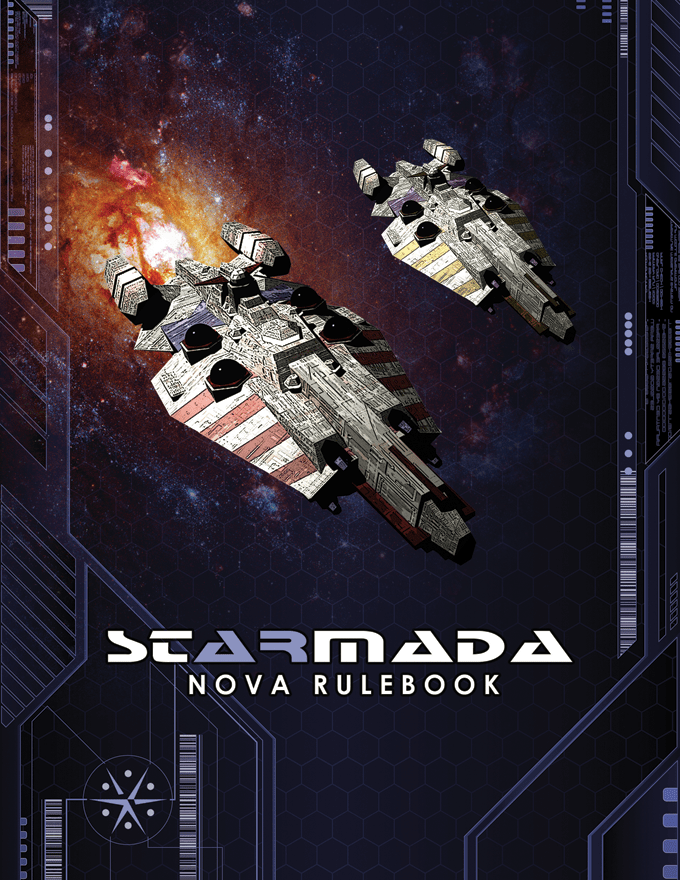
At long last, Cricket has announced the pre-release for the printed version of Nova, and pdf downloads have become available. Under normal circumstances, I'd be all over that... but I have a nasty programming project that I'm already burning late days on. Not going to download until I have written journal rollback for ext3 filesystems... Have to have incentives for success. Expect a review (hopefully) by next week.
Saturday, March 17, 2012
Mailbag 5: Starmada and Traveller
starmada nova, starmada nova review, and starmada nova release: I've been getting a lot of hits for these, perhaps because not a whole lot of other people are talking about Nova... bodes well :\. Latest news is that preorders for the paper book and downloads for the pdf should be up this week. Soooon. Until then, not much I can do about a review.
mongoose traveller combat: Overall, I'd say that I liked Mongoose's combat system. It's quick, which is great. It's dangerous, but not unduly so; heavy anti-armor weapons like laser rifles kill lightly-armored PCs, but most of the time you're looking at 3d6ish damage (average 10.5), armor 6ish, and 21 HP, so you can take 3 hits to unconscious, another two to dead. This gap between unconscious and dead is pretty big, which is nice because often you're left with survivors (who can be interrogated, but who you also have to take care of), and because PCs aren't necessarily killed outright either. I'd also say that there are "enough" legal actions in combat; attack, move, change stance, aim, use leadership, and 'other shenanigans'. It's neither "All I can do is move and attack", nor "I have a full 52-card deck of combat powers." Their grappling rules are also nice and simple compared to d20's. The range tables are a pain to keep track of, the vehicle combat rules are a bit more complex, and I'm not entirely happy with their implementation of Reactions, having seen Trailblazer's, but overall, it's a pretty damn good combat system.
traveller campaign blog: Well, I'm not sure of any off the top of my head that do play-by-play session reports, but if there were such a blog, it would be found in one of three places. Obsidian Portal has a large list of Traveller campaigns; some of them may have active blogs. Citizens of the Imperium has a number of blogs, I believe, but I haven't explored it fully. Finally, Spinward Scout has a great heaping pile of Traveller resources, some of which are attached to blogs. If you don't mind the fact that it's audio, the Close the Airlock podcast might also work.
mongoose traveller campaign management: I found the best way to manage mine was a combination of an Obsidian Portal wiki for things the players knew about the universe, a printed and scribbled on hexmap of a subsector, and a huge pile of text files. I believe Alex used the Portal and a bunch of spreadsheets for his. You might also find the Starfarer's Kit useful (or at least entertaining).
mongoose traveller combat: Overall, I'd say that I liked Mongoose's combat system. It's quick, which is great. It's dangerous, but not unduly so; heavy anti-armor weapons like laser rifles kill lightly-armored PCs, but most of the time you're looking at 3d6ish damage (average 10.5), armor 6ish, and 21 HP, so you can take 3 hits to unconscious, another two to dead. This gap between unconscious and dead is pretty big, which is nice because often you're left with survivors (who can be interrogated, but who you also have to take care of), and because PCs aren't necessarily killed outright either. I'd also say that there are "enough" legal actions in combat; attack, move, change stance, aim, use leadership, and 'other shenanigans'. It's neither "All I can do is move and attack", nor "I have a full 52-card deck of combat powers." Their grappling rules are also nice and simple compared to d20's. The range tables are a pain to keep track of, the vehicle combat rules are a bit more complex, and I'm not entirely happy with their implementation of Reactions, having seen Trailblazer's, but overall, it's a pretty damn good combat system.
traveller campaign blog: Well, I'm not sure of any off the top of my head that do play-by-play session reports, but if there were such a blog, it would be found in one of three places. Obsidian Portal has a large list of Traveller campaigns; some of them may have active blogs. Citizens of the Imperium has a number of blogs, I believe, but I haven't explored it fully. Finally, Spinward Scout has a great heaping pile of Traveller resources, some of which are attached to blogs. If you don't mind the fact that it's audio, the Close the Airlock podcast might also work.
mongoose traveller campaign management: I found the best way to manage mine was a combination of an Obsidian Portal wiki for things the players knew about the universe, a printed and scribbled on hexmap of a subsector, and a huge pile of text files. I believe Alex used the Portal and a bunch of spreadsheets for his. You might also find the Starfarer's Kit useful (or at least entertaining).
Sunday, March 4, 2012
Starmada Nova Update
Just a small blurb - Cricket has recently pushed conversion rules from AE to Nova and alternate movement systems for Nova, available here and here respectively.
The conversion rules are the most interesting part, probably.
Looking at these traits, I should be able to convert the Eldar pretty handily; x1.5 hull, easy firepower conversion since most of my stuff was RoF1 IMP1 DAM1 anyways, ECM3 from Point Defense + Countermeasures, and Cloaking still in. Sounds like a party.
As for the movement, three simple variants: Cinematic, Etheric, and Solar. Cinematic is pretty much what we've been using. Etheric is simple enough, and Solar looks very Eldar, and also very good for modeling naval engagement in the Age of Sail. Huzzah!
But yeah... the rate at which Cricket's been leaking material has increased again, which leads me to hope that it will actually be released soon. Stay tuned.
The conversion rules are the most interesting part, probably.
- Hulls are 1.5 times as large as they were in AE. This is sensible, since all hits are now hull hits.
- Shields degrade really quickly now... worrisome. Thrust ratings look the same as ever.
- Anti-fighter batteries are now real weapons range 3 and higher accuracy, though their firepower is still fairly low.
- Boarding pods and teleporters are now included in the cost of marines, which suggests that marines will now serve as some kind of specialized short-range weapon. This is neat, because now just putting defensive marines on your ships is no longer a thing (it was an annoying gamble in AE; you didn't want to get boarded and not have marines to defend, but people rarely boarded).
- Carrier capacity is measured in flights, which appear to be equal in utility to one of the 50-point AE standard flights. Bad news for the fighter jocks, perhaps... though I'd also be very surprised if customized fighters disappeared entirely. No mention of seekers or strikers specifically.
- Cloaking is confirmed! O frabjous day!
- Facets and screens are rolled into standard shields for the time being, though Cricket has mentioned on the forums that faceted at least will be in the ADB Armada sourcebooks.
- "Flotillas cannot be converted using these rules." Never have I seen a happier sentence. Well, maybe not never, but definitely rarely.
- Fire Control still exists, and probably serves its same purpose.
- Hyperdrive's still around. No notes on function.
- Mines are also still in, but you get fewer of them.
- Point Defense is no longer a trait, being subsumed into ECM. Same for Countermeasures. Armor Plating has been converted to armor boxes on the hull track.
- Stealth is still a thing, but it was mentioned on the forum previously that it works like ECM, except that it can't be damaged, and is therefore more expensive. None of that weird ranging stuff that it did in AE.
- Accurate (Anti-Fighter)
- Ballistic (Minimum Range)
- Carronade
- Catastrophic (oh boy)
- Double Damage (also comes from plain old high-damage weapons)
- Diffuse (Double Range Mods)
- Expendable (Ammo)
- Focused (Inverted Range Mods)
- Guided (No Range Mods)
- Piercing (one level of piercing for all your shieldbreaking needs; hooray!)
- Proximity (Area Effect)
- Repeating (I think Dan will actually fix Repeating this time, though)
- Scatter (Range-Based Foo traits)
- Slow (Slow-Firing)
- Telescopic (Inverted Range-Based Foo traits)
- Triple Damage (from DMG 4 and 5 weapons)
- Volatile (Variable Foo traits)
- Continuing Damage
- Crew Killer
- Fire-Linked
- Increased Hits
- Increased Impact
- Halves and Ignores Shields (now are a multiplier to firepower and Piercing)
- No Hull Damage
- Non-Piercing
- Piercing +n (also a multiplier and Piercing)
- Starship-Exclusive
Looking at these traits, I should be able to convert the Eldar pretty handily; x1.5 hull, easy firepower conversion since most of my stuff was RoF1 IMP1 DAM1 anyways, ECM3 from Point Defense + Countermeasures, and Cloaking still in. Sounds like a party.
As for the movement, three simple variants: Cinematic, Etheric, and Solar. Cinematic is pretty much what we've been using. Etheric is simple enough, and Solar looks very Eldar, and also very good for modeling naval engagement in the Age of Sail. Huzzah!
But yeah... the rate at which Cricket's been leaking material has increased again, which leads me to hope that it will actually be released soon. Stay tuned.
Sunday, February 26, 2012
Release Updates (also Iron Heroes)
From the list of releases I'm watching for:
Starmada Nova: Cricket publicly released a finalish-looking draft of the first 11 pages of rules of the new edition. It's very similar to the early draft that I mentioned previously, but there are some interesting differences. In particular, on page 5 under Sequence of Play, there's a note that if one player outnumbers the other by 2 to 1 or more, they move or fire with two ships for each one that the outnumbered side fires with. OK, nothing new there. What is new, however, is that if you get to activate two or more ships per activation, your opponent chooses one of the ships for you to activate. That's a hell of a tactical wrinkle under alternating movement and with damage being resolved during firing rather than at end of turn.
There's also an interesting note about Partial VP on page 11; it's like the crippling rules we used during our campaign, but better - you need to take a ship down to 2/3 hull to get half its value, rather than 1/2 hull. Also nice that it's just a standardized rule now, rather than something we hacked on.
Finally, we got a confirm from Cricket down-thread that fighters will have their own reactive movement phase. Oh well; probably for the better. The new enemy-forced activation rules would really mess with fighters by allowing them to force you to activate your fighters early during ship movement, which would be quite a waste.
Mongoose Traveller Campaign Guide: Released to pdf this last week, the Campaign Guide looks pretty interesting, actually. It's about as long as the Core, but full of random tables and whatnot for GMs. I'm tempted to pick up a copy and do a review.
5e: No official news via EnWorld in the last two weeks. However, this last week Monte &co spent most of their blog space talking about "high-level play", and how it always breaks down in previous editions. Arguably in 1e/2e it was least bad, but casters were king (but, they had earned it by positively sucking for the first, oh... long time). In 3e, it was way too complicated and combats took six hours, despite the fact that they were only two rounds of game time. My understanding is that 4e core high-level / epic combats also take a long damn time because monsters have ridiculously high HP and AC (er, defenses). So, I say to Monte and Company: Get thee to a playtest! That's been the issue with both iterations of Wizards D&D (as opposed to TSR D&D before 3e) - high-level play was horribly under-playtested.
Unfortunately, that doesn't seem to be what they're focusing on; rather, they're looking at whether the play experience should change at high levels. Me, I'd love to see kingdom building and ascension to deityhood as things on the high-level agenda. "Epic dungeon crawls" make very little sense to me, and frankly seem somewhat dull. Unfortunately, that seems to be what they're looking at; it's all about the artifacts and the plane-hopping. While planar travel might not initially sound like code for dungeon-crawling, it pretty much is. What is the Abyss but an infinite dungeon, full of an infinite number of high-level monsters with corresponding treasure, in addition to serious environmental trap-like threats? It's the biggest dungeon ever.
And artifacts. Argh. So many artifacts these days are just big shiny swords with more bonuses than you could normally get. 3.x exemplars of this problem are the Hammer of Thunderbolts and the Saint's Mace. While these are very nice weapons, they don't feel like Artifacts with a capital A. Artifacts, to me, must bear an element of risk or sacrifice. The Hand and the Eye of Vecna, the Sphere of Annihilation, and the Deck of Many Things all feel like artifacts. Powerful evil intelligent weapons (Blackrazor / Stormbringer, for example, or our own instantiation of the trope, Mavrilith) definitely qualify, too. The Orbs of Dragonkind also have the nice drawback that all dragons now hate you. That's pretty acceptable, as far as drawbacks go. But those shiny +6 keen goblinoid-bane throwing dwarven waraxes? Not so much.
Trailblazer Monster Book: Not a whole lot of progress on this front. Still working on lycanthropes and layouts, I guess. I found their gnoll art, though; it's pretty sweet. The werehyena's good, too.
VBAM 2e: Still in editing. They did post an update a while back with some draft supply, facilities, and loyalty rules, but I have not yet perused them. Going to wait until they put out a combined playtest draft, I think.
ACKS: Not actually something I'm waiting for a release on, but something I'm seriously tempted to pick up, especially given reasonable pdf prices. Their mapping system has been getting some attention in the blogosphere of late (at Grognardling, with a series in responses at Untimately), and from Untimately's review (part 1 and part 2), it sounds a lot like "Traveller Meets 1e", with the 1e side favored in the mechanics. I also got quite the Iron Heroes setting vibe off of the publisher's website:
If nothing else, I should probably pick up copy of ACKS to compare against Fields of Blood, which is what I'd probably use for high-level 'realmy' play presently. Though now that I think about it, Iron Heroes + Fields of Blood would fix / ignore a lot of FoB's high-level caster problems... hmm...
Some of the token mechanics would get weird in mass combat, but it would probably be OK. If the Armiger, the Berserker, or the Weapon Master engage in mass combat, they come out with piles of tokens. Heck, this would be the best time to play a Weapon Master; usually combats are too short for them to build up to their finale / combo moves. The Archer would convert well, since it's just based on aiming time, and mass combat turns are long. Executioners and Hunters would do the worst of the token classes, I think. Hunters could do OK via Tactics / Lore feats to provide wide-areas bonuses to their units, but their class abilities are too small-scale. Executioners could do the same unit support stuff via Lore, but they're really most useful for engaging single high-value targets like enemy generals and heroes. Harriers just get the running-around bonuses all the damn time, and Men-At-Arms are as versatile as ever. Thieves... not so much for the battlefield, but the Social feats would make them master spies. And Arcanist power is sufficiently limited and sufficiently dangerous to use that applying it is actually a question, rather than "Yeah, I'm a 9th-level wizard, I'll go stop the invading army single-handedly, be right back *teleport*."
Upon further reflection, though, IH characters have huge numbers of abilities geared towards small, discrete bonuses in skirmish combat which cease to be applicable or are otherwise too granular for mass combat. Granting an extra flanking bonus to an ally via War Leader, for example. The scale on that is just far too small to be useful in mass combat. One tempting option, however, would be to provide a second scale of tokens. Mass Combat $TYPE Tokens are earned as normal tokens of their type via more-or-less equivalent actions in mass combat. They can then be spent to provide bonuses on that scale to units which the PCs are secunded to. The berserker works his men into a frenzy, the archer directs the volleys of his bowmen with great precision, the armiger organizes a shield wall, and the hunter exhorts his troops to capitalize on fortuitous terrain.
Weapon Master and Executioner get kind of stuck here, though - sheer weapon skill is hard to provide to people, and martial units tend not to be particularly sneaky, nor deft at backstabbery. It might be reasonable for certain types of units, or for units which are officially under the command of the WM / Exec; if you're a light scout unit and your commander is the Lord Assassin, you might pick up a few tricks. Likewise, the 4th Northbridge Pikemen, having been drilled extensively under the harsh tutelage of the Pikemaster, might be able to pull off some impressive feats of pikesmanship (quiet, spellchecker).
Frankly, though, I'm not really sure I have a problem with Executioner, Berserker, and Weapon Master not being ideal line-unit commanders. They seem more likely to be best for either cutting swathes through enemy units on their own (Berserker and WM), or seeking out and disabling or dueling enemy leaders (Exec and WM). Armiger, Hunter, and Man-at-Arms all gain Tactics Mastery, and are frankly not as suited for one-on-one confrontation with strong enemy leaders as the more offensively-powerful classes, nor to cutting though massed troops unsupported like the Berserker. Archer and Harrier are tricky; they make most sense as commanders of specialist units (archers and cavalry, respectively). And Thieves... saboteurs, infiltrators, and general-purpose commanders, I suppose. They certainly have the skill points to put into Command, even if it isn't a group skill. Honestly, the Thief shines in diplomacy, not on the battlefield.
One additional promising avenue of research here would be to convert the Fields of Blood prestige classes (where applicable) into mastery feat trees or class abilities. Warlord's abilities fall under Tactics mastery (possibly merging Warlord and Warcrier into one mastery feat), Master Mason's under Siege Lore, Living Legion's under Power or Armor, and Hordemaster's look a lot like Berserker rage abilities.
Finally, if I were to attempt such a game, I think I would likely use Hong's Hack, which fixes a great many things in Iron Heroes (though not the armor problem, which is frankly less of a problem in mass combat. Neat).
And so we see that I don't actually need any more books, as long as I can be still be inspired by the advertising copy. Why am I writing a post about new and upcoming releases again?
Starmada Nova: Cricket publicly released a finalish-looking draft of the first 11 pages of rules of the new edition. It's very similar to the early draft that I mentioned previously, but there are some interesting differences. In particular, on page 5 under Sequence of Play, there's a note that if one player outnumbers the other by 2 to 1 or more, they move or fire with two ships for each one that the outnumbered side fires with. OK, nothing new there. What is new, however, is that if you get to activate two or more ships per activation, your opponent chooses one of the ships for you to activate. That's a hell of a tactical wrinkle under alternating movement and with damage being resolved during firing rather than at end of turn.
There's also an interesting note about Partial VP on page 11; it's like the crippling rules we used during our campaign, but better - you need to take a ship down to 2/3 hull to get half its value, rather than 1/2 hull. Also nice that it's just a standardized rule now, rather than something we hacked on.
Finally, we got a confirm from Cricket down-thread that fighters will have their own reactive movement phase. Oh well; probably for the better. The new enemy-forced activation rules would really mess with fighters by allowing them to force you to activate your fighters early during ship movement, which would be quite a waste.
Mongoose Traveller Campaign Guide: Released to pdf this last week, the Campaign Guide looks pretty interesting, actually. It's about as long as the Core, but full of random tables and whatnot for GMs. I'm tempted to pick up a copy and do a review.
5e: No official news via EnWorld in the last two weeks. However, this last week Monte &co spent most of their blog space talking about "high-level play", and how it always breaks down in previous editions. Arguably in 1e/2e it was least bad, but casters were king (but, they had earned it by positively sucking for the first, oh... long time). In 3e, it was way too complicated and combats took six hours, despite the fact that they were only two rounds of game time. My understanding is that 4e core high-level / epic combats also take a long damn time because monsters have ridiculously high HP and AC (er, defenses). So, I say to Monte and Company: Get thee to a playtest! That's been the issue with both iterations of Wizards D&D (as opposed to TSR D&D before 3e) - high-level play was horribly under-playtested.
Unfortunately, that doesn't seem to be what they're focusing on; rather, they're looking at whether the play experience should change at high levels. Me, I'd love to see kingdom building and ascension to deityhood as things on the high-level agenda. "Epic dungeon crawls" make very little sense to me, and frankly seem somewhat dull. Unfortunately, that seems to be what they're looking at; it's all about the artifacts and the plane-hopping. While planar travel might not initially sound like code for dungeon-crawling, it pretty much is. What is the Abyss but an infinite dungeon, full of an infinite number of high-level monsters with corresponding treasure, in addition to serious environmental trap-like threats? It's the biggest dungeon ever.
And artifacts. Argh. So many artifacts these days are just big shiny swords with more bonuses than you could normally get. 3.x exemplars of this problem are the Hammer of Thunderbolts and the Saint's Mace. While these are very nice weapons, they don't feel like Artifacts with a capital A. Artifacts, to me, must bear an element of risk or sacrifice. The Hand and the Eye of Vecna, the Sphere of Annihilation, and the Deck of Many Things all feel like artifacts. Powerful evil intelligent weapons (Blackrazor / Stormbringer, for example, or our own instantiation of the trope, Mavrilith) definitely qualify, too. The Orbs of Dragonkind also have the nice drawback that all dragons now hate you. That's pretty acceptable, as far as drawbacks go. But those shiny +6 keen goblinoid-bane throwing dwarven waraxes? Not so much.
Trailblazer Monster Book: Not a whole lot of progress on this front. Still working on lycanthropes and layouts, I guess. I found their gnoll art, though; it's pretty sweet. The werehyena's good, too.
VBAM 2e: Still in editing. They did post an update a while back with some draft supply, facilities, and loyalty rules, but I have not yet perused them. Going to wait until they put out a combined playtest draft, I think.
ACKS: Not actually something I'm waiting for a release on, but something I'm seriously tempted to pick up, especially given reasonable pdf prices. Their mapping system has been getting some attention in the blogosphere of late (at Grognardling, with a series in responses at Untimately), and from Untimately's review (part 1 and part 2), it sounds a lot like "Traveller Meets 1e", with the 1e side favored in the mechanics. I also got quite the Iron Heroes setting vibe off of the publisher's website:
Enter a world where empires totter on the brink of war, and terrible monsters tear at the fragile borderlands of men; where decaying cities teem with chaos and corruption, nubile maidens are sacrificed to chthonic cults and nobles live in decadent pleasure on the toil of slaves; where heroes, wizards, and rogues risk everything in pursuit of glory, fortune, and power. This is a world where adventurers can become conquerors – and conquerors can become kings.See, 5e devs, that's what high-level play should sound like.
If nothing else, I should probably pick up copy of ACKS to compare against Fields of Blood, which is what I'd probably use for high-level 'realmy' play presently. Though now that I think about it, Iron Heroes + Fields of Blood would fix / ignore a lot of FoB's high-level caster problems... hmm...
Some of the token mechanics would get weird in mass combat, but it would probably be OK. If the Armiger, the Berserker, or the Weapon Master engage in mass combat, they come out with piles of tokens. Heck, this would be the best time to play a Weapon Master; usually combats are too short for them to build up to their finale / combo moves. The Archer would convert well, since it's just based on aiming time, and mass combat turns are long. Executioners and Hunters would do the worst of the token classes, I think. Hunters could do OK via Tactics / Lore feats to provide wide-areas bonuses to their units, but their class abilities are too small-scale. Executioners could do the same unit support stuff via Lore, but they're really most useful for engaging single high-value targets like enemy generals and heroes. Harriers just get the running-around bonuses all the damn time, and Men-At-Arms are as versatile as ever. Thieves... not so much for the battlefield, but the Social feats would make them master spies. And Arcanist power is sufficiently limited and sufficiently dangerous to use that applying it is actually a question, rather than "Yeah, I'm a 9th-level wizard, I'll go stop the invading army single-handedly, be right back *teleport*."
Upon further reflection, though, IH characters have huge numbers of abilities geared towards small, discrete bonuses in skirmish combat which cease to be applicable or are otherwise too granular for mass combat. Granting an extra flanking bonus to an ally via War Leader, for example. The scale on that is just far too small to be useful in mass combat. One tempting option, however, would be to provide a second scale of tokens. Mass Combat $TYPE Tokens are earned as normal tokens of their type via more-or-less equivalent actions in mass combat. They can then be spent to provide bonuses on that scale to units which the PCs are secunded to. The berserker works his men into a frenzy, the archer directs the volleys of his bowmen with great precision, the armiger organizes a shield wall, and the hunter exhorts his troops to capitalize on fortuitous terrain.
Weapon Master and Executioner get kind of stuck here, though - sheer weapon skill is hard to provide to people, and martial units tend not to be particularly sneaky, nor deft at backstabbery. It might be reasonable for certain types of units, or for units which are officially under the command of the WM / Exec; if you're a light scout unit and your commander is the Lord Assassin, you might pick up a few tricks. Likewise, the 4th Northbridge Pikemen, having been drilled extensively under the harsh tutelage of the Pikemaster, might be able to pull off some impressive feats of pikesmanship (quiet, spellchecker).
Frankly, though, I'm not really sure I have a problem with Executioner, Berserker, and Weapon Master not being ideal line-unit commanders. They seem more likely to be best for either cutting swathes through enemy units on their own (Berserker and WM), or seeking out and disabling or dueling enemy leaders (Exec and WM). Armiger, Hunter, and Man-at-Arms all gain Tactics Mastery, and are frankly not as suited for one-on-one confrontation with strong enemy leaders as the more offensively-powerful classes, nor to cutting though massed troops unsupported like the Berserker. Archer and Harrier are tricky; they make most sense as commanders of specialist units (archers and cavalry, respectively). And Thieves... saboteurs, infiltrators, and general-purpose commanders, I suppose. They certainly have the skill points to put into Command, even if it isn't a group skill. Honestly, the Thief shines in diplomacy, not on the battlefield.
One additional promising avenue of research here would be to convert the Fields of Blood prestige classes (where applicable) into mastery feat trees or class abilities. Warlord's abilities fall under Tactics mastery (possibly merging Warlord and Warcrier into one mastery feat), Master Mason's under Siege Lore, Living Legion's under Power or Armor, and Hordemaster's look a lot like Berserker rage abilities.
Finally, if I were to attempt such a game, I think I would likely use Hong's Hack, which fixes a great many things in Iron Heroes (though not the armor problem, which is frankly less of a problem in mass combat. Neat).
And so we see that I don't actually need any more books, as long as I can be still be inspired by the advertising copy. Why am I writing a post about new and upcoming releases again?
Saturday, February 18, 2012
Mailbag 1: Starmada and BFG
As I was checking my search terms, I realized that some of them were fairly entertaining, and others were questions and might entail answers or responses. So, here are some of my favorites, biased towards the ones that appear most often:
"starmada fire arcs": Yeah, these are tricky for beginners. In AE, you have six primary arcs - A, B, C, D, E, and F. There's also a second set, but they're for munchkins and rules wankers (the G arc is too damn good). Each arc covers 60 degrees of... well, arc. If you take a ship's heading to be 0, directly right to be 90, directly behind to be 180, and directly left to be 270, the arcs cover angles as follow:
"battlefleet gothic firing arc templates": These I don't have readily memorized (though I thought they were just forward, aft, port, starboard...), but Games Workshops' BFG resources has something which might work.
"starmada admiralty edition review": Huh, maybe I should write one of those. A bit late in the game's lifecycle, though, since Starmada Nova should launch in the next month or so. Speaking of which, most recent news on that front is that the rules are complete, but they're deciding what should go in the core book, and doing layout / formatting. Also, they have cover art, and it has better texture than in previous versions.
"battlefleet gothic conversion": Let me tell you, when Starmada Nova launches, it's the first thing on my to-do list (possibly after constructing a spreadsheet for accelerated shipbuilding, depending on how fast OldnGrey and the other spreadsheet guys on the forums are about it). I did do a lot of conversion work on the Battlefleet Gothic ships to Admiralty Edition, too (about 5 revisions of Imperials, Chaos, and Eldar, as well as one version each of Tau and Orks)... but the files were lost in the great Laptop Catastrophe of Fall '11. They may be on a backup drive somewhere, but I honestly don't know anymore. There are three relevant threads on the Starmada forums, here, here, and here. The first of those has most of my version 1 work, as well as parts of v3 and my v3.5 Imperials.
"simplest campaign system": It's a simple campaign system for Starmada: Admiralty, originally published in the Imperial Starmada Sourcebook, and republished in the Options Annex. As the name would suggest, it is in fact very simple. You have a fleet registry (where hull damage persists across combats), and a pool of resource points which you can use to repair or buy new ships. After each combat, the winner gets a victory point towards campaign victory, but no resource points, while the loser gets resource points, but no victory points. First one to n victory points wins, for pre-determined n. It's known for creating really torn-up fleets by the end of the campaign. For a series of after-action reports from a game run using a slightly tweaked version, I recommend Blacklancer's posts here. It starts getting good on page 3, particularly this post. Note to self: try running Simplest with >2 players and watch the chaos.
"starmada d12 roll": Huh. Well, there was a forum thread a while back on d10 Starmada. Never tried d10 or d12, myself; I certainly don't have enough d12s for it, and while I have enough d10s, you'd need to do some serious work on the probabilities and the point costings. If somebody writes a conversion to make that happen, let me know.
"starmada fire arcs": Yeah, these are tricky for beginners. In AE, you have six primary arcs - A, B, C, D, E, and F. There's also a second set, but they're for munchkins and rules wankers (the G arc is too damn good). Each arc covers 60 degrees of... well, arc. If you take a ship's heading to be 0, directly right to be 90, directly behind to be 180, and directly left to be 270, the arcs cover angles as follow:
- A: 300 through 360; forward-left
- B: 0 through 60; forward-right
- C: 240 through 300; left broadside
- D: 60 through 120; right broadside
- E: 180 through 240; rear-left
- F: 120 through 180; rear-right
"battlefleet gothic firing arc templates": These I don't have readily memorized (though I thought they were just forward, aft, port, starboard...), but Games Workshops' BFG resources has something which might work.
"starmada admiralty edition review": Huh, maybe I should write one of those. A bit late in the game's lifecycle, though, since Starmada Nova should launch in the next month or so. Speaking of which, most recent news on that front is that the rules are complete, but they're deciding what should go in the core book, and doing layout / formatting. Also, they have cover art, and it has better texture than in previous versions.
"battlefleet gothic conversion": Let me tell you, when Starmada Nova launches, it's the first thing on my to-do list (possibly after constructing a spreadsheet for accelerated shipbuilding, depending on how fast OldnGrey and the other spreadsheet guys on the forums are about it). I did do a lot of conversion work on the Battlefleet Gothic ships to Admiralty Edition, too (about 5 revisions of Imperials, Chaos, and Eldar, as well as one version each of Tau and Orks)... but the files were lost in the great Laptop Catastrophe of Fall '11. They may be on a backup drive somewhere, but I honestly don't know anymore. There are three relevant threads on the Starmada forums, here, here, and here. The first of those has most of my version 1 work, as well as parts of v3 and my v3.5 Imperials.
"simplest campaign system": It's a simple campaign system for Starmada: Admiralty, originally published in the Imperial Starmada Sourcebook, and republished in the Options Annex. As the name would suggest, it is in fact very simple. You have a fleet registry (where hull damage persists across combats), and a pool of resource points which you can use to repair or buy new ships. After each combat, the winner gets a victory point towards campaign victory, but no resource points, while the loser gets resource points, but no victory points. First one to n victory points wins, for pre-determined n. It's known for creating really torn-up fleets by the end of the campaign. For a series of after-action reports from a game run using a slightly tweaked version, I recommend Blacklancer's posts here. It starts getting good on page 3, particularly this post. Note to self: try running Simplest with >2 players and watch the chaos.
"starmada d12 roll": Huh. Well, there was a forum thread a while back on d10 Starmada. Never tried d10 or d12, myself; I certainly don't have enough d12s for it, and while I have enough d10s, you'd need to do some serious work on the probabilities and the point costings. If somebody writes a conversion to make that happen, let me know.
Tuesday, January 10, 2012
Quotes from 5e Devs, and Starmada Next Fighter Firing
A few aftershocks of the D&D 5e announcement. EnWorld has a news aggregator up here; this is pretty standard for them with new editions (the site was initially created as a news site for 3e during its development, then developed forums during the Third Age which persisted through its coverage of 4e). Currently it's mostly little soundbites from the lead devs, but a couple of them look fairly promising (all credit to EnWorld for gathering these):
Ignoring role and function is also a neat idea, and something we've seen to a limited degree in our Traveller games; sometimes you go "Man, we need an engineer badly", but then when you try to roll an engineer, you often get someone who can engineer, but is also an awesome hacker or ninja too (or all three plus sniper, in the case of Jared's character last campaign). You're not constrained to your class / career, and everyone from the same career is just a bit different from everyone else. Contrast with D&D, where if you're the fighter, pretty much all you can do is fight. Classes in D&D serve as hard limits on the things you can do; in Traveller, careers serve as soft guidelines, where it's not hard to pick up some pretty oddball skills (Thief Remote Ops? Really?).
In non-5e news, got a confirm from Underling on the sequence of actions in the next edition of Starmada here. When I read the alpha core review rules, which contained no mention of fighters, the change to "all damage is applied immediately during sequential firing" immediately suggested to me that fighter firing could be rolled into the ship firing phase, with an activation being usable either for a squadron of small craft or a single ship. Turns out I was correct, and Underling also confirms that under alternating movement, an activation can likewise be used on either a ship or a fighter squadron (which makes great sense, when you make alternating movement the default). I believe that the primary advantage of fighters now will be their ability to move without regard for the Newtonian thrust rules; combined with their (expected) short range weapons, this means you'll probably want to move them last-ish. This again mixes up the traditional order of movement employed in alternating movement games, as I discussed previously, that you usually want to move your fast, light things first and then move your slow, heavy hitters last.
The most important thing about this change is that it makes point-defense weapons / anti-fighter batteries potentially useful. If the entire enemy fleet is fighters, and you only have ships with AFBs, you're no longer SOL like you were in AE, where you'd get mauled by the fighters before you had a chance to fire. Now, they'll attack you, and you'll get a chance to attack back before more of their fighters get to attack. This also creates an interesting tactical problem when you have a mixed fleet of ships and fighters - do you fire with the fighters first before the enemy gets a chance to fire their AFBs at them, or do you use your ships first? Probably situational, but it's an extra wrinkle in a system where this wasn't even a question before.
So, I like this change a lot. First, it simplifies the rules by removing the fighter phase. Second, it solves the much-maligned AFB problem of the previous edition. Third, it introduces an interesting choice or series of choices, which the game really needs more of. Finally, I like being right in my predictions. When I said back in December that I expected the new edition to fix fighters, this is exactly what I had in mind, and MJ12 has not disappointed.
"The new edition is being conceived of as a modular, flexible system, easily customized to individual preferences. Just like a player makes his character, the Dungeon Master can make his ruleset. He might say ‘I’m going to run a military campaign, it’s going to be a lot of fighting’… so he’d use the combat chapter, drop in miniatures rules, and include the martial arts optional rules." - Mike MearlsThis is a nice idea, though one that might make life difficult for the players during character creation. It does, however, suggest that the supplement treadmill may be stoppable by DM fiat; if he doesn't choose rulebases from other supplements, then you're good. It may also eliminate the Grapple Problem - the existence of gross, annoying subsystems that nobody really wants to deal with. Make 'em optional, and then they're not problems. Final point here is that miniatures / grids may be optional, rather than required (as they were in 4th and basically were in 3rd for adjudicating AoOs). Sweet.
"I don't think 'requiring someone to be a healer' is a sacred cow, but having healers in the game is. I wouldn't want to see D&D do away with healing, but I don't think there's anything keeping us from exploring a version of D&D where players can simply play anything they want, ignoring concepts like role and function when putting together their party. To do so, we would need to take a serious look at the way player resources are allocated in D&D, and make some adjustments to the assumptions behind the design of everything from adventures to encounters to monsters." - Rodney ThompsonThis reminds me a lot of Iron Heroes, which was another Monte Cook / Mike Mearls project. In IH, you had a pool of Reserve Points with a cap equal to your max HP, and you could convert a reserve point into a hit point with one minute of resting. This creates a dynamic similar to healing surges, but not in-combat and somewhat more realistic. Healing, by skills or magic, added to your reserve pool, rather than to your HP, so it was useful in terms of extending combat endurance, but not a combat activity, and having a dedicated healer was not a necessity. Healing was something that you could choose to pursue, but that 1) you didn't have to, and 2) you didn't have to make your sole specialty if you did. And that was cool. I hope they draw on IH for inspiration here. 'course, that was what I said during 4e development, too (also by Mearls), and look how that turned out...
Ignoring role and function is also a neat idea, and something we've seen to a limited degree in our Traveller games; sometimes you go "Man, we need an engineer badly", but then when you try to roll an engineer, you often get someone who can engineer, but is also an awesome hacker or ninja too (or all three plus sniper, in the case of Jared's character last campaign). You're not constrained to your class / career, and everyone from the same career is just a bit different from everyone else. Contrast with D&D, where if you're the fighter, pretty much all you can do is fight. Classes in D&D serve as hard limits on the things you can do; in Traveller, careers serve as soft guidelines, where it's not hard to pick up some pretty oddball skills (Thief Remote Ops? Really?).
"We'll have more information on the GSL as it relates to the next edition in the near future. Personally, I have a copy of 'The Cathedral & the Bazaar' on the shelf at work. From my days as a programmer and as a freelance RPG designer, the bulk of my work involved open platforms which did a lot for a game that relies so much on individual creativity." - Mike MearlsThis is good for two reasons. First, it looks like the devs at least are in favor of something resembling the OGL or opensourcing. Second, it's an interesting cross-cultural reference to we programmers. However, Mearls is being really vague here, and it wouldn't surprise me if WotC's legal department got the final say on this one. On the third hand, the era of D&D's greatest success was marked by the OGL, with the more restrictive GSL significantly decreasing third-party support and arguably sales, so maybe WotC legal will learn from it. Time will tell.
In non-5e news, got a confirm from Underling on the sequence of actions in the next edition of Starmada here. When I read the alpha core review rules, which contained no mention of fighters, the change to "all damage is applied immediately during sequential firing" immediately suggested to me that fighter firing could be rolled into the ship firing phase, with an activation being usable either for a squadron of small craft or a single ship. Turns out I was correct, and Underling also confirms that under alternating movement, an activation can likewise be used on either a ship or a fighter squadron (which makes great sense, when you make alternating movement the default). I believe that the primary advantage of fighters now will be their ability to move without regard for the Newtonian thrust rules; combined with their (expected) short range weapons, this means you'll probably want to move them last-ish. This again mixes up the traditional order of movement employed in alternating movement games, as I discussed previously, that you usually want to move your fast, light things first and then move your slow, heavy hitters last.
The most important thing about this change is that it makes point-defense weapons / anti-fighter batteries potentially useful. If the entire enemy fleet is fighters, and you only have ships with AFBs, you're no longer SOL like you were in AE, where you'd get mauled by the fighters before you had a chance to fire. Now, they'll attack you, and you'll get a chance to attack back before more of their fighters get to attack. This also creates an interesting tactical problem when you have a mixed fleet of ships and fighters - do you fire with the fighters first before the enemy gets a chance to fire their AFBs at them, or do you use your ships first? Probably situational, but it's an extra wrinkle in a system where this wasn't even a question before.
So, I like this change a lot. First, it simplifies the rules by removing the fighter phase. Second, it solves the much-maligned AFB problem of the previous edition. Third, it introduces an interesting choice or series of choices, which the game really needs more of. Finally, I like being right in my predictions. When I said back in December that I expected the new edition to fix fighters, this is exactly what I had in mind, and MJ12 has not disappointed.
Thursday, January 5, 2012
Starmada Next 4 and some Trav stuff
Not a whole lot of news on Starmada development; the devs have gotten kind of quiet in hopes of having some things in the book be surprises when it's released. They're doing final playtesting now, and it should still release in January, but we're not sure just when in January. The only interesting thing I've learned recently is that the Escort trait turns the ship possessing it into a line-of-sight blocker, meaning that escorts can screen more important vessels from enemy fire. At present, escorts also block friendly fire, however. They should still be useful under alternating movement, though, since you could move a capital ship, have an enemy move to attack it from out of its firing arcs (ie, somewhere where it cannot retaliate well), and then interpose an escort on a later move. They would be a clusterf*ck with pre-plotted movement, though.
This introduces an interesting subversion of the standard alternating movement protocol. In previous games my family played with alternating, the optimal strategy was to delay moving your heavy hitters until absolute last, with light ships serving as a pad so that your enemy would have to position their big ships before you did. This puts your heavy ships into the best places both to survive and to deal damage to the enemy, which saves you points and costs them. From what I understand, this is also the standard strategy in BattleTech, where alternating movement is also the rule. However, with Escort, there is now an incentive to move heavies earlier-than-last and to delay moving light ships, which is a neat twist.
Alex has also launched an Obsidian Portal site for his Traveller game next semester, so I've been doing Trav work again. Helped Drew roll up a character last night, and debugged a trade spreadsheet that I pulled down from the Mongoose Traveller Aids yahoo group. There was a bug which used the wrong indices for lookups of purchase and sale modifiers for speculative cargo. Fixed version is available here, and is also up on the MgTAids page. I also put together a (kinda ugly) spreadsheet to filter illegal items by government type, available here.
I've also been thinking about weapons. First, I'd really like to see a weapon modification system for Mongoose Traveller, which would allow you to take a base weapon (gauss rifle, say) and then alter it in more-or-less balance-preserving ways, where each gain has commensurate loss. For example, +ammo capacity, +weight (large, heavy assault drum magazines), or +damage, -ammo (larger than standard calibre, but fewer shots per cartridge - this is actually the tradeoff between the Gauss Rifle and the MagRail Rifle in Mercenary). It'd be an interesting project, but a bit more work than I'm up for presently.
My other primary weapon thought is on shotguns, namely that Gun Combat (Shotgun) is... not fantastic. All other gun combat skills have at least two weapons available to them (more if you count TL variants of the same weapon), and most of those have some variation in law levels (except Energy Rifle; Energy Pistol has stunners vs. laser pistols, Slug Rifle has Accelerator Rifle vs Gauss Rifle, and Slug Pistol has pretty much everything vs Gauss Pistol, which is banned earlier due to auto). Shotgun has exactly one weapon. Not really OK. Since the base shotgun is legal up to law level 6, it looks like the shotguns category needs an early banned version. I present for your consideration the Assault Shotgun, based on the AA-12 and the Pancor Jackhammer.
Assault Shotgun: TL7, Range Class: Shotgun. Damage 4d6, Auto 4, Recoil 2. Mass 6 kg or 7kg with extended magazine. Magazine 12 or 24. Cost 1000 Cr, Ammo 20 or 40 Cr.
Recoil's really going to hurt on full auto... but it's a nice capability to have, and also renders the weapon illegal at LL4 as a light assault weapon. And another just for kicks:
Double-Barrel Shotgun: TL4, Range Class: Shotgun. Damage 4d6, Auto 2, Recoil 2. Mass 3kg. Magazine 2. Cost 100 Cr, Ammo 3 Cr.
That's right folks - Auto 2. No use for firing on full auto, but it does let you burst for +2 damage and +1 recoil. It might be realistic for the double-barrel to take two minor actions to reload... but let's be fair here. It's a pretty awful weapon, and you're going to be reloading a lot if you decide to use it. It really doesn't need the extra handicap.
This introduces an interesting subversion of the standard alternating movement protocol. In previous games my family played with alternating, the optimal strategy was to delay moving your heavy hitters until absolute last, with light ships serving as a pad so that your enemy would have to position their big ships before you did. This puts your heavy ships into the best places both to survive and to deal damage to the enemy, which saves you points and costs them. From what I understand, this is also the standard strategy in BattleTech, where alternating movement is also the rule. However, with Escort, there is now an incentive to move heavies earlier-than-last and to delay moving light ships, which is a neat twist.
Alex has also launched an Obsidian Portal site for his Traveller game next semester, so I've been doing Trav work again. Helped Drew roll up a character last night, and debugged a trade spreadsheet that I pulled down from the Mongoose Traveller Aids yahoo group. There was a bug which used the wrong indices for lookups of purchase and sale modifiers for speculative cargo. Fixed version is available here, and is also up on the MgTAids page. I also put together a (kinda ugly) spreadsheet to filter illegal items by government type, available here.
I've also been thinking about weapons. First, I'd really like to see a weapon modification system for Mongoose Traveller, which would allow you to take a base weapon (gauss rifle, say) and then alter it in more-or-less balance-preserving ways, where each gain has commensurate loss. For example, +ammo capacity, +weight (large, heavy assault drum magazines), or +damage, -ammo (larger than standard calibre, but fewer shots per cartridge - this is actually the tradeoff between the Gauss Rifle and the MagRail Rifle in Mercenary). It'd be an interesting project, but a bit more work than I'm up for presently.
My other primary weapon thought is on shotguns, namely that Gun Combat (Shotgun) is... not fantastic. All other gun combat skills have at least two weapons available to them (more if you count TL variants of the same weapon), and most of those have some variation in law levels (except Energy Rifle; Energy Pistol has stunners vs. laser pistols, Slug Rifle has Accelerator Rifle vs Gauss Rifle, and Slug Pistol has pretty much everything vs Gauss Pistol, which is banned earlier due to auto). Shotgun has exactly one weapon. Not really OK. Since the base shotgun is legal up to law level 6, it looks like the shotguns category needs an early banned version. I present for your consideration the Assault Shotgun, based on the AA-12 and the Pancor Jackhammer.
Assault Shotgun: TL7, Range Class: Shotgun. Damage 4d6, Auto 4, Recoil 2. Mass 6 kg or 7kg with extended magazine. Magazine 12 or 24. Cost 1000 Cr, Ammo 20 or 40 Cr.
Recoil's really going to hurt on full auto... but it's a nice capability to have, and also renders the weapon illegal at LL4 as a light assault weapon. And another just for kicks:
Double-Barrel Shotgun: TL4, Range Class: Shotgun. Damage 4d6, Auto 2, Recoil 2. Mass 3kg. Magazine 2. Cost 100 Cr, Ammo 3 Cr.
That's right folks - Auto 2. No use for firing on full auto, but it does let you burst for +2 damage and +1 recoil. It might be realistic for the double-barrel to take two minor actions to reload... but let's be fair here. It's a pretty awful weapon, and you're going to be reloading a lot if you decide to use it. It really doesn't need the extra handicap.
Tuesday, December 13, 2011
First Ship Designs for Starmada: The Next Iteration. Also Battlefleet Gothic Parallels
A few more points of Starmada news:
First public and official starship designs released (these images full property of Cricket / Dan Kast at MJ12):


As you can see, they're much stripped down from AE designs. The attack dice chart, while space-consuming, is fairly simple once you know what you're looking at. Also note the fixed size of systems damage tracks (only thrust here, but always 5 boxes regardless of hull. Surprised the weapons track was omitted). Also, 'shields' here are actually armor. Finally, no point values yet.
Underling also released a small fleet of point-costed ships built using playtest ship construction reviews, but accidentally created a fighter scare. He'd put weapons that launch Seekers on his ships and called them 'fighters', and there was much concern that this was how fighters were implemented by default in the new edition. Fortunately, this is not the case; fighters "will work much as they do in AE." I'm happy that seeker-launching will be an available weapon trait, though - it's something I've always wanted in AE. Other traits of note from Underling's stuff include Gid - Guided?, Exp - Expendable (yeah, ammo...), Pwr - Powerful?, Acr - Accurate (hits on 4+ rather than 5+, I suspect), Rpt - Repeating. As for ship traits, Marines look very similar to AE, but Escort and Scout are now also traits. Not sure what they do just yet. Anyways, the mods pulled his ships from the forums because they weren't technically rules legal (had some arc stacking and things, nevermind the fighter confusion), but if you want a look, I've re-hosted them here (likewise, property of Underling).
Finally, some data on Stealth. Stealth n will operate the same as ECM n (applying a column shift of -n to incoming fire), except that it is not subject to systems damage, but also costs more.
One thing that keeps striking me as I read some of the new Starmada material is how similar some of the changes are to Battlefleet Gothic's rules. Grouping of weapons in particular arcs into single banks of given firepower? Check. Firepower column shifting on a giant table based on situational modifiers? Check. Non-plotted movement? Check. Systems damage checks every so often based on fraction of hull destroyed? Yep. Armor and shields as separate defenses? Flipped from BFG where shields are HP and armor is saves, but essentially the same. Increased support for ECM, Stealth, and other holofieldy defenses? Awesome. Their fighter implementation is different, but for a sec there when I saw Underling's seeker-fighters, I went "Aha! Another similarity!"
Not accusing of borrowing; just kind of amused. I believe that MJ12 actually did develop a lot of this independently with Fleet Ops and Grand Fleets, but it's neat to see things converge. Should also make my BFG conversions a little bit easier... Heck, Underling mentioned playtesting using converted Eldar from Battlefleet. Support straight out of the box! Granted, he also mentioned that mobility-based fleets are rather weak currently (though that was true in AE too)... Challenge accepted.
On a completely unrelated note, no confirmation yet that Cloaking will still be a thing... I hope it's still a thing, for the Eldar's sake.
First public and official starship designs released (these images full property of Cricket / Dan Kast at MJ12):


As you can see, they're much stripped down from AE designs. The attack dice chart, while space-consuming, is fairly simple once you know what you're looking at. Also note the fixed size of systems damage tracks (only thrust here, but always 5 boxes regardless of hull. Surprised the weapons track was omitted). Also, 'shields' here are actually armor. Finally, no point values yet.
Underling also released a small fleet of point-costed ships built using playtest ship construction reviews, but accidentally created a fighter scare. He'd put weapons that launch Seekers on his ships and called them 'fighters', and there was much concern that this was how fighters were implemented by default in the new edition. Fortunately, this is not the case; fighters "will work much as they do in AE." I'm happy that seeker-launching will be an available weapon trait, though - it's something I've always wanted in AE. Other traits of note from Underling's stuff include Gid - Guided?, Exp - Expendable (yeah, ammo...), Pwr - Powerful?, Acr - Accurate (hits on 4+ rather than 5+, I suspect), Rpt - Repeating. As for ship traits, Marines look very similar to AE, but Escort and Scout are now also traits. Not sure what they do just yet. Anyways, the mods pulled his ships from the forums because they weren't technically rules legal (had some arc stacking and things, nevermind the fighter confusion), but if you want a look, I've re-hosted them here (likewise, property of Underling).
Finally, some data on Stealth. Stealth n will operate the same as ECM n (applying a column shift of -n to incoming fire), except that it is not subject to systems damage, but also costs more.
One thing that keeps striking me as I read some of the new Starmada material is how similar some of the changes are to Battlefleet Gothic's rules. Grouping of weapons in particular arcs into single banks of given firepower? Check. Firepower column shifting on a giant table based on situational modifiers? Check. Non-plotted movement? Check. Systems damage checks every so often based on fraction of hull destroyed? Yep. Armor and shields as separate defenses? Flipped from BFG where shields are HP and armor is saves, but essentially the same. Increased support for ECM, Stealth, and other holofieldy defenses? Awesome. Their fighter implementation is different, but for a sec there when I saw Underling's seeker-fighters, I went "Aha! Another similarity!"
Not accusing of borrowing; just kind of amused. I believe that MJ12 actually did develop a lot of this independently with Fleet Ops and Grand Fleets, but it's neat to see things converge. Should also make my BFG conversions a little bit easier... Heck, Underling mentioned playtesting using converted Eldar from Battlefleet. Support straight out of the box! Granted, he also mentioned that mobility-based fleets are rather weak currently (though that was true in AE too)... Challenge accepted.
On a completely unrelated note, no confirmation yet that Cloaking will still be a thing... I hope it's still a thing, for the Eldar's sake.
Friday, December 9, 2011
More Starmada Next Spoilers
Some new details from the forums on the next edition of Starmada for those of you who haven't been getting emailed every time it updates.
On movement:
On defenses:
There were also some statements in ADB Captain's Log #44 (which was actually the first source announcing the new edition) expanding on these "weapon banks":
So, more details, and things do indeed look faster.
(Also, whoo got a review copy of the new core, and it looks very, very good. Fast, simple, easy to teach, fixes several complaints with AE (fighters, arcs, rolling too many dice). Not leaking any details, but I can confirm that the above statements are correct.)
On movement:
"Each game turn you can only do one of three things:
1) Move straight
2) Make one 60 degree turn somewhere along your move
3) Turn up to 180 degrees worth (two or three turns) somewhere along your move.
How fast you're going when you make these turns determines your end speed for the turn.
If you're moving faster than your thrust rating, all you can do is move straight, accelerating or decelerating up to your thrust rating.
If you're moving your thrust rating or slower, you can choose a single 60 degree turn, and an ending speed of from zero to your thrust rating.
If you're moving your thrust or slower, you can choose 180 degrees' worth of turns, with an ending speed equal to your thrust rating minus your current speed."
On defenses:
"ECM removes attack dice. Weapon banks do NOT have a separate ACC value, but traits can have the same effect. Shields pretty much the same as before. Armor is "hit points"."
There were also some statements in ADB Captain's Log #44 (which was actually the first source announcing the new edition) expanding on these "weapon banks":
"Weapons are now grouped into “banks” which represent one or more individual weapon mounts that can fire into the same arc(s). Each bank is then assigned a starting number of attack dice. For example, in The Admiralty Edition, a ship might have had four weapons in the [AB] firing arc, each with a ROF of 2 and an ACC of 5+. In the new edition, these weapons would be combined into a single forward-firing bank with eight attack dice.
The number of dice rolled in a given attack is then modified based on factors such as range, target defenses, etc. For example, the weapon bank in our above example would roll 11 dice at short range, eight at medium range, and six at long range."
So, more details, and things do indeed look faster.
(Also, whoo got a review copy of the new core, and it looks very, very good. Fast, simple, easy to teach, fixes several complaints with AE (fighters, arcs, rolling too many dice). Not leaking any details, but I can confirm that the above statements are correct.)
Sunday, December 4, 2011
New Starmada Edition Announced for Release Jan 2012
Wandered by the MJ12 forums today (hadn't been there in a while) and was very surprised to see a topic announcing a new edition of Starmada. Data's pretty vague so far, but selling points include:
- Simpler vector movement system. Sounds nice, given that we never did manage to grok the vector movement in the Admiralty Edition...
- Less dice rolling per turn of combat. Halle-freaking-lujah.
- Three layers of defenses - ECM, Shields, Armor. This is the change I'm most conflicted about, but very little detail on how these work yet. It seems a sad departure from effects-based gaming ("I don't care whether it's fancy hyperdense neoadamantium armor, bolted on scrap armor, void shields, or close defense weapons - just give it a shield rating and be done"), but it does provide some excellent possibilities for modeling different fleets and sources. Eldar (oh, my precious Eldar...), for example, might have very good ECM, but no shields and weak armor, while Chaos and Imperial have decent shields and good / excellent armor respectively. This differentiation of defenses also provides a counterbalance in terms of options to the huge array of offensive traits - every weapon in S:AE has four stats (range, accuracy, impact, damage), plus usually some traits, while each ship has, defensively, only two relevant stats (hull and shields) and maybe a trait or two. Providing more defensive stats may make things significantly more interesting.
Subscribe to:
Posts (Atom)