Sunday, January 8, 2023

Goblins and Digging

Thinking back to tribal goblins, I still like the idea of having goblins operate primarily in the Morlock Model, hiding in underground dens during the day and then emerging to pillage the countryside at night.  This makes rooting out goblins clearly an adventurer activity rather than a problem you can throw mercenaries at - you can fight them in their holes or you can fight them at night, but either way you're gonna be fighting them in the dark.


But something I'm still fiddling with is how viable it is for goblins to get established.  Say you've got a warband of 30 goblins and you're sent by your chief to go start digging a warren near a human town.  How do the numbers work out in ACKS?  I'm not aiming for perfectly ACKS RAW-compliant here so much as plausibility-checking.

Per Domains at War: Campaigns page 81, digging 20 cubic feet of slapdash unpaved underground tunnel costs 1 gp in labor.  Depending on whether you factor in their poor encumbrance, goblins might have either 0 labor rate or 1sp/day, so optimistically with your 30 goblins and appropriate tools you can dig 3gp/day, or 60 cubic feet.  A 10' cube is 1000 cubic feet, so 16 days to dig one of those.  If you go with 5' ceilings instead and assume a sleeping goblin takes 12 square feet of floor space at a bare minimum, you need 360 square feet of floorspace, 1800 cubic feet, 90gp, 30 days to house just your lads very uncomfortably.  That's a long time to be sleeping in tents on the surface where random encounters can eat you, or where a nearby domain's garrison might discover you by reconnaissance rolls if you're in the same 24-mile hex.

We might consider the possibility that goblins are good at digging, or at least goblin pioneers are selected for their digging ability, and give them the Labor proficiency, bringing their individual construction rate up to 2sp/day or 6gp/day for the warband as a whole.  (If we give goblins Labor as stock, this also explains why orcs and hobgoblins like dragooning them into doing grunt work)  So then we're back down to about two weeks to dig a reasonable shelter.

What else could we do to bring the digging rate up?  The answer, naturally, is workbeasts.  The rules on using non-sentient workbeasts for construction projects in Domains at War aren't entirely clear.  One optimistic interpretation would let you use a workbeast as a number of unskilled laborers equal to its encumbrance over 5st, maybe with a handler.  So for example a mule is worth about four guys, which seems plausible if part of your work is hauling rocks and pieces of wood to use as supports.

But you know what has more carrying capacity than a mule, is more tolerant of low ceilings, fits goblin aesthetic, and eats garbage?  Giant beetles.  A giant fire beetle has 30 stone of encumbrance, so it's worth about six guys.  And adding some fire beetles to a goblin warband is not massively more terrifying for low-level PCs, like adding wargs, giant shrews, or ankhegs would be, if you want to use a goblin outpost under construction as an adventure site for 1st-2nd level characters.  Plus, having some beasts of burden to carry supplies from your point of departure makes a lot of sense; assuming goblins eat as much as a man, you're looking at 30 stone of supplies per week, which is conveniently the carrying capacity of a single beetle.  And it isn't totally implausible that you could train the beetles to do the actual digging, versus hauling dirt like you'd get with mules.

So let's say we add five fire beetles to our warband; a large encounter or a small lair, depending on how you look at it.  A trained fire beetle has a labor rate of 6sp/day based on its carrying capacity, so the five of them are another 3gp/day.  Even if we have to allocate a gobbo or two to supervise them, we have about doubled our digging power for a relatively small increase in required footprint (the beetles are only 2.5 feet long and being bugs may be able to rest in weird spots like on walls and ceilings.  Being 2.5 feet long, I imagine the pack saddles for carrying 300lb must be quite silly-looking, which, again, is pretty goblin).  With trained diggers and some beetles, we can get up around 9gp/day, which lets us dig a 10' cube every 5-6 days, and get a minimal shelter up in a similar timeframe.  In a second week, you could have cramped room enough for a second warband, and then they start digging too...  If you have a 6-warband village, you could have space for all your soldiers in a couple weeks, and then space enough for your noncombatants in a couple months.

Another interesting question, I suppose, is about linear distance.  If you wanted a long tunnel you could move 3 1/2'-tall troops through single-file, maybe you go down to 4' ceiling and 3' wide, so 12 cubic feet per foot of linear distance, or 0.6gp of labor.  Assuming you let that parallelize so they can bring their full power to bear on that 12 square foot surface, your digging crew with 9gp/day could dig about 15 feet of tunnel per day, or a 1-mile tunnel in a year.  So inter-hex tunnels probably aren't constructible in the timeframes of a typical campaign, even under the most charitable assumptions.  Maybe for a project like that, linking up to a well-established "city" type lair, you bring out the giant tiger beetles, with 250st carrying capacity and so 5 gp/day construction rate each.

In any case, I feel pretty OK with having goblins digging burrows and tunnels during the course of a campaign provided they have some helpful arthropods along.

Sunday, December 25, 2022

Reading Moldvay Basic

Looking at starting a campaign with some coworkers in the spring, and consequently looking again at OSE.  But I realized I already had B/X in pdf from DriveThru, and all the late-70s early-80s TSR rulebooks I've looked at so far have been interesting (ex: OD&D, the 1e DMG), so I figured it was worth a look.  Obviously mechanically there isn't going to be anything new here after having read OSE, so it's all about presentation and non-rules remarks.

I really like the writing style here.  It's not as rule-lawyerly as ACKS but the complete sentences are also...  warmer?  Quainter?  More comfortable to read? than OSE's brevity.  I have heard it said that OSRIC succeeds as a rules-clone but fails to capture the spirit of AD&D - I'm not yet certain whether the same should be said of OSE and the spirit of B/X but it seems like a live hypothesis.

I like that they do a good job of laying out definitions at the beginning.  What is a party?  What is a campaign?  What is a monster?  A clear explanation of the many meanings of the word "level".  Not too shabby for two pages!  (I guess OSE does this too, but there it's just another list)

I don't like some of the framing in the foreword and introduction around novels and stories and lack of winnability.  I do like that "Nor is the game "lost" when an unlucky player's character dies, since the player may simply "roll up" a new character and continue playing" establishes clear expectations - it isn't "if a character dies", but "when".

"Chaos (or Chaotic) is the opposite of Law. It is the belief that life is random, and that chance and luck rule the world. Everything happens by accident, and nothing can be predicted" is not a take on Chaos I had heard before.  Generally I'm not thrilled at the description of alignments here.

"Alignment languages are not written down" is a new one to me.

The inheritance rule ("This "inheritance" should only occur once per player.") continues to be puzzling.

"A sleeping creature may be killed (regardless of its hit points) with a single blow with any edged weapon" Emphasis mine.  No coup de graces for clerics I guess?

Fireball doesn't include an expand-to-volume clause.  Scary!

"SCALE MOVEMENT: If miniature figures are used, the actual movement of the characters can be represented at the scale of one inch equals ten feet. A movement rate of 60' per turn would mean that a miniature figure would move 6 inches in that turn. Scale movement is useful for moving the figures on a playing surface (such as a table)"  A puzzling paragraph, because it's clearly talking about exploration movement per turn, but also talking about doing that movement on a table, with a public-facing map on 1" scales.

Yow the art on page B20 is a bit...  nippy.  I really like the grumpy dude with the axe and the sack of treasure with a hole in the bottom though.

"It is recommended that the DM not allow beginning players to hire retainers. New players tend to use retainers as a crutch, letting them take all the risks. If a dungeon is very difficult, the DM should let players have more than one character apiece before using retainers, at least until players are more experienced."  He's...  not wrong.  Interesting.

"Retainers may be awarded more than their agreed upon portion of the treasure and thus gain more experience than normal."  Ha!  Finally, a precedent for my player-controlled XP allocation idea.

"ADJUSTMENTS TO XP: The DM may treat an unusually "tough" situation or monster as one category better (use the next line down). Situations might also allow the DM to give partial experience if the characters learned from the encounter without actually defeating the monster. The DM may also award extra XP to characters who deserve them (fighting a dangerous monster alone, or saving the party with a great idea), and less XP to characters who did less than their fair share ("do-nothing" characters). The DM should consider the character's alignment and class carefully, and should remember that guarding the rear is an important role in any party."  Hmm...  not a fan of adding subjectivity to scoring.  Though I suppose AD&D did it too, with class grading.

"PAIR COMBAT (optional): The DM may chose to roll initiative for each character and the monsters he or she is fighting instead of for each side. If this is done, character's Dexterity scores (see page B7) are used to adjust the initiative die roll."  Framing this as initiative for each pair / sub-engagement is really interesting and immediately suggests other possibilities between "whole party rolls initiative" and "each individual rolls initiative".

Really clean breakdown of potential actions by the party in response to an encounter on page B24, with good use of bolding.

One thing I'm not seeing in any of the combat rules is declaring anything before initiative for the round is rolled.  It is in OSE though.  Maybe it's in Expert but not Basic? 

Huh Morale is optional here (in both Basic and Expert) like it was in OSE.  I forgive you this, OSE.

"Since Silverleaf is the only member of the party who speaks Hobgoblin, the other characters elect him as their spokesman. The player who runs Silverleaf becomes the caller."  Emphasis mine.  Changing callers!  Wild!

"Silverleaf has already warned the others that he is going to throw a sleep spell if the hobgoblins attack, so the party moves to form a defensive line across the room (making sure that they do not get caught in the spell's area of effect)"  Friendly fire on sleep in the example of play?  Amazing. And kind of an example of pre-declaration but not quite?

"The DM warns Silverleaf that if he wants to cast any spells this round, the hobgoblins will be able to attack him before he can do so." also alludes to that being bad but it's still not really clear what the consequences of this are.  Very well, I concede OSE, maybe organizing the rules better is a worthwhile endeavor.

(Aha, it is in Expert, page X11 - " The caster can do nothing else in the round a spell is cast. The caster must inform the DM that a spell is being cast and which spell will be cast before the initiative dice are rolled. If the caster loses the initiative and takes damage or fails a saving throw, the spell is interrupted and lost.")

Honestly this whole example of combat is kind of a mess - it isn't really clear from this that the side that lost initiative gets to act at all in the round where they lost.

"EXAMPLE: A monster with 3 + 1 hit dice is a third level monster, and is most commonly found on the 3rd level of any dungeon."  That's odd, I'll have to check it against the tables later.  I'm used to seeing HD rise much more quickly than dungeon level.  (And indeed, the wandering monster tables have significant variance and seem to skew a little higher than this)

Huh, white dragons and blue dragons are neutral.

"(flying dragons are never asleep)" A very important note.  But what if dragons were like sea-birds that can half-sleep on the wing?

Reflecting on this further - what kind of madman includes stats for 10HD red dragons in a rulebook that only goes up to 3rd level?  What are you meant to do with those?

"The DM is advised to use gargoyles only if the player characters have at least one magical weapon."  Well where's the fun in that?

"Goblins hate dwarves and will attack them on sight.  There is a 20% chance that when goblins are encountered, 1 of every 4 will be riding a dire wolf."  Doesn't say "in the wilderness", just "encountered".  Brutal.
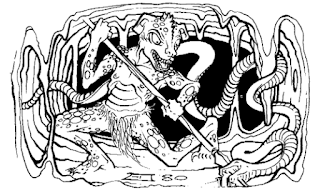
 

Now that's a kobold!


"In the D&D BASIC rules, a noble will always be a 3rd level fighter".  I guess if that's all the levels you've got...

Good looking troglodyte too.

Huh the "Adjustments to treasure" paragraph is interesting.  "An encounter with less than a full lair should yield less treasure. On the other hand if 1-4 is the "No. Appearing", even one will have the normal amount of treasure, and no adjustment is necessary."  There aren't any "% in Lair" lines in the monster statblocks, so it seems kinda up to DM fiat whether a group of monsters is or isn't a lair.  Unless all groups of monsters placed in the dungeon beforehand (ie, not-wandering monsters) are meant to be lairs?

"Sword +1, casts light on command (30' radius)" could easily be misinterpreted to letting you cast the spell Light and being useful for blinding people.  Which would be kinda cool actually but probably not something you want to give out at will.

It's interesting that with a shorter potions table, the odds of rolling a healing potion go up tremendously.  They're only 4% of potions in Expert, but 12.5% of potions in Basic.

"Two things must be done to use most magic items. First, the item must be held or worn properly. Second, the user must concentrate on the effect the item has. (Magic weapons, armor, and protection devices — such as a ring or elven cloak — will work without concentrating."  So no command words, interesting.

The art for potion of gaseous form is also excellent.

"A treasure map should be made by the DM in advance, and should show the location of some treasure hoard in the dungeon."  Emphasis mine.  So treasure maps were explicitly scoped within the same dungeon in which they were found.

Ahh, the DMing advice section, what we've all been waiting for.

A couple of interesting notes from the "Scenarios" table.  Several of these have implicit post-apocalypse - exploring areas formerly destroyed, reclaiming ruined settlements, visiting a shrine whose location has been lost, and making contact with a species who has been lost underground.  I also like that "going through a magic portal" makes the top-10 list of beginner adventure hooks.  Escaping Imprisonment is an unfortunate inclusion though, that never goes well.

The distinction between room traps and treasure traps exists here.

"Spray: Be sprayed with an unknown liquid that attracts Wandering Monsters; double chances for Id6 hours"  Pretty good trap.

Creating an NPC party: "The DM may want to roll for NPC ability scores, also".  Dang that's a corner I hadn't considered cutting. 

The duality of players:

DM: "Black Dougal gasps 'Poison!' and falls to the floor. He looks
dead."
Fredrik: "I'm grabbing his pack to carry treasure in."
Rebecca: "I'm giving Black Dougal the last rites of my church."

The introduction of the misguided "roll under ability score" rule does, at least, sound optional - "The DM may want to base a character's chance of doing something on his or her ability scores".  I much prefer the example in the previous paragraph of giving the player percentile odds for an action to succeed.

GRUDGES: Occasionally, a grudge develops between characters. A small grudge can often make the game more interesting, particularly if the grudge develops because the players are playing their character roles well. For example, a Lawful character might have a grudge with a Chaotic character who slew a prisoner after the Lawful character gave his word that the prisoner would not be harmed. If any grudge gets out of hand, the DM should try to subtly warn the players. If a grudge develops to a point where it is ruining the adventure, the DM may have a powerful creature interfere. The DM may plan an encounter with a gold dragon who tells the players that, unless the grudge ends immediately, severe steps will be taken (at most, the deaths of the offending characters).

Two interesting things here: One, that apparently having lawfuls and chaotics in the same party wasn't that unusual.  And two, dragon ex machina for an out-of-game interpersonal problem is terrible advice.

Conclusions: yeah I'm seeing some compelling reasons to use a retroclone that combines B and X into a single cohesive book rather than having eg conflicting accounts of spellcasting.  While I enjoyed the writing style here much of the DMing advice seems rather...  sus, as the kids say.  I'm kinda surprised this ruleset has had such legs; maybe Expert is really good or something?  Guess we'll see.

Tuesday, November 22, 2022

Calibrating Compasses

I've been opposed to having compasses in my D&D games for a good long while, on a couple of grounds.  They don't really fit into a Dark Ages or Ancients milieu, and it seems intuitively obvious to a suburbanite that they should sort of trivialize navigation.  The latter, I am learning, is not quite true.

I have been doing some pre-reading in the Annapolis Book of Seamanship for a coastal navigation course I'm taking this winter, and was surprised to learn that when installing a compass on a vessel, you need to calibrate it.  Ferrous metal fixtures on the vessel can interfere with the compass' accuracy, and that interference changes as the vessel changes heading.  There are some fine adjustments you can make to modern compasses, but those probably weren't available on compasses in the Bad Old Days, and even today these fine adjustments can sometimes be insufficient, in which case you end up writing up a table of adjustments to the heading the compass shows based on the heading of the vessel - a mapping from apparent magnetic heading to actual magnetic heading.  And making that table requires having precise bearings from where you're carrying out the calibration.  Apparently "compass adjuster" is something of a specialist profession.

And then magnetic north is off from true north, and the amount you have to compensate for that varies based on your location - if you're between the magnetic north pole and the actual north pole, the difference could be 180 degrees!

I was talking about compass deviation due to metal fixtures at work and an ex-army colleague mentioned that when he taught overland navigation, one of his pastimes was giving the compass to the squad's radioman and seeing how long it took the squad leader to figure out that the radio was interfering with the compass.  "Machine gunners were OK too, it's a big piece of metal."

There is also a note in the book that "Very few steerers [helmsmen] are good enough to keep a boat within 2 degrees of course in smooth water; in rough weather, steering errors of 5 to 10 degrees are common."  One side of a hex is 60 degrees wide, so a 10 degree error in rough weather is one hex side every six hexes or so...

All of this is to say that if you allow compasses in your games, they aren't necessarily an end-all-be-all for navigation.  Full plate may mess with your compass, magic items might mess with your compass ("magnet" and "magic" share a prefix, after all), magnetic "north" in your setting may be in an interesting spot or just move around a lot, and even if you have bearings there's still room for error in steering to lead to course deviation.  To say nothing of the quality of nautical charts and other maps in pre-modern times!

Sunday, November 13, 2022

Vermintide 2's Special Enemies and Encounter Design

Status: D&D related, possibly obvious

Vermintide 2 was free on steam the other weekend and my brother and I have been playing it together.  We've been trying to play it with the mechanics unspoiled to keep a bit of sense of wonder/surprise in it.

Something that stuck out immediately was the special enemies.  This is really a common design pattern in team horde FPSes - Left For Dead and Deep Rock Galactic both have analogs (and I like DRG's term for them - "disruptive" enemies).  These enemies either deny you terrain and visibility (with, for example, a big cloud of poison gas) or suppress/disrupt an individual player (for example by grabbing a character, preventing them from attacking, and dragging them away from the party) until either the target or the special enemy is killed.  They aren't especially tough and their damage output isn't enormous but they require pretty immediate action or they can seriously degrade the party's ability to fight the horde of fodder enemies who usually accompany them.

Vermintide got me thinking about this from the D&D angle for two reasons - first that unlike DRG it is low-ish fantasy, and second because it makes these special enemies very high-visibility.  The player characters call them out in game (at least on the difficulty we're playing), many have literally high-visibility glowy bits, and killing them is mentioned in the post-mission statistics screen, which makes it clear that they're thought of as a class or category of enemies.

(The other two called-out classes, Elites and Monsters, also bear consideration.  Elites we think are tougher versions of normal enemies; they may be better armored or hit harder and bear special consideration on those accounts but they're not especially disruptive to party cohesion / positioning.  Monsters are creatures much larger than a man like trolls or rat-ogres that, as least as far as we can tell, require pretty much the whole party to fight them concurrently, with lots of HP and a boss healthbar, and often a combination of multiple damaging attacks, throws, grabs, area denial, and other abilities that you might expect of a Special but on a much beefier frame)

Meanwhile, in OSR D&D, we have critters that have disruptive abilities like a Special but we're mostly not using them in combination with regular enemies.  Consider mummies.  Mummy paralysis is a big disruptive ability and anybody left with freedom of action has the onus on them to kill the mummy immediately (or at least bait an attack out of it) to end the paralysis.  But mummies are their own monster type with their own lairs and if you're stocking by the book you're never going to get an encounter with 15 zombies or skeletons and one or two mummies - the fodder+special combo.  Or, if mummies are too high-HD and durable and fall closer to the Monsters category, 15 zombies and two ghouls.  A gelatinous cube plus a bunch of skeletons would be an encounter to remember, but it won't ever come up in prep (though it could potentially happen in play through a combination of a fixed skeleton encounter and a lurking threat cube making its move as the party is dealing with the skellies).  The best we've got are witchdoctors and shamans with beastman lairs - and those are wilderness lairs, not dungeon encounters, and if you're rolling random spells for your witchdoctors they're usually either duds or TPK threats instead.  In beastmen too we have something like Elites in champions and chieftains.

But the fodder+special combo seems like the sort of thing you'd want to use if you were building dungeons to challenge your players.  And this whole line of thought also ties back to breaking up the phalanx - enemies who deny choke-points, grab front-liners, or bull-rush through them, all seem like good tools for diminishing the power of the shield-wall in the dungeon, but I haven't been thinking of them as a category.

Is this too 3e a thought?  Is this something 4e did explicitly?  Does this place too much emphasis on tactics of individual combats in OSR games where combat options are relatively scarce so parties may not really have any means to respond to disruptive enemies - games where the emphasis is generally on the expedition as a whole anyway?  Is this even worth considering in prep or is it good enough if it can happen randomly in play?  I really don't know.  But it might bear experiments, and seems like a useful schema / category with which to think about monsters in tabletop games.

Beastman chieftain abilities might be a really easy place to start with procedurally-generated fodder+special combos.  One could design abilities with the special/elite distinction in mind, and then push them down to subchieftains so that they start showing up in dungeon lairs.

Maybe another angle to consider is strategically-disruptive enemies: expedition-disruptors rather than single-combat-disruptors.  If the focus of the game is on the expedition and we're worried about there being too few in-combat options, maybe it makes sense to shift one level higher.  The Crypt Thing might be a really good example of this - its teleport doesn't just take a character out of a particular combat temporarily, but disrupts the expedition as a whole by scattering the party throughout the dungeon.

But what does combining expedition-disrupting enemies with fodder look like?  Maybe just random encounters being triggered by a disrupted party taking more time to recover.  Maybe nothing at all needs to be done and OSR D&D is just fine the way it is.

Wednesday, November 2, 2022

AD&D's Artifacts (or Relics?)

I'd been meaning to take a closer look at the 1e DMG's section on artifacts after noticing during my previous skim that there were a bunch of blank lines that looked like they were meant to be filled in by the DM.  I finally got around to it today and what I found was even wilder than I expected.

Surprise #1: you can roll artifacts on the random treasure tables.  A 17 on the d100 on table III.E.1, Minor Miscellaneous Magic Items, is "Artifact or Relic (see Special table hereafter)".  And then you roll a d% on table III.E.Special and an 01 is the Axe of the Dwarvish Lords and a 100 is the Wand of Orcus and everything in between is on that same level.  Since rolling on the main magic item table has a 3% chance of going to table III.E.1, any magic item roll has an 0.03% chance of yielding an artifact - about 3 in 10,000.

That doesn't seem like a crazy-high probability, and it's pretty awesome that you can roll them randomly at all.

There is a note that if you the DM don't want an artifact in your campaign you can instead replace it with a Bag of Beans, an actual minor magic item.  Which I'm sure many DMs did, but I imagine that letting the dice even suggest an artifact at random would probably increase how often we see them in play.  I also like this bit (emphasis mine):

Regardless of how any of these items come into your campaign, only 1 of each may exist. As each is placed by you or found by player characters, you must draw a line through its listing on the table to indicate it can no longer be discovered randomly— if the dice indicate an item no longer available, you may substitute a clue as to its whereabouts or simply ignore the result so that no magic item is found at all.

And in a big 1:1 timescale campaign game with patrons, "where it might be found" might well be with some other player's character.  The Teeth of Dahlver-Nar also seem much less insane when considered in a large-campaign context.  This is a set of 32 artifact-tier teeth and the more of them you collect the stronger the effects get.  Hunting down 32 teeth individually as a single cohesive party would be a huge slog, but if you have multiple adventuring parties operating in parallel across timespans of years, accumulating a significant number of these seems much more plausible.  This is probably true of the other "set" artifacts like the Regalia of Might and the Rod of Seven Parts as well.

Anyway, what's up with these blank lines with roman numerals in each item's description?

Because of the unique nature of each artifact and relic, their powers are only partially described. You, the Dungeon Master, must at least decide what the major powers of each item are to be. This prevents players from gaining any knowledge of these items, even if they happen to own or read a copy of this volume, and it also makes each artifact and relic distinct from campaign to campaign.

(Again, emphasis mine)  This too is awesome.  And then there are long lists of candidate entries for each roman-numeral type.  I and II are minor and major benevolent powers, III and IV are minor and major malign powers, V are prime powers, and VI are Side Effects.  The balance here seems a little uneven; some of the minor benevolent powers seems competitive with some of the major benevolent powers, and the Side Effects are a very mixed bag, with some rather brutal curses and some pretty neutral or maybe even useful effects if clever.  The prime powers are ridiculous.

Other possibilities include the ability to cast resurrection 7 times per week, meteor storm once per day, finger of death with no save once per day, wish once per day.  We're not in Kansas anymore.

The counterbalance to these are the Major Malign Powers, which trigger when a prime or major benign power are used.  These are also excellent.  "User is instantly killed but may be raised or resurrected", for example.  Many of these feel unreasonably punitive for some of the major benign powers (ex Speak With Monster 2/day), but for keeping Prime Powers in check, yeah, these seem appropriate.

Another interesting thing here is that these lists aren't rollable tables; they're labeled with letters (and then doubling up, X, Y, Z, AA, BB, CC, ...).  This has to be intentional.  Gygax doesn't want you rolling randomly a "wish 1/day" item.  Gygax also doesn't want you to roll an Axe of the Dwarvish Lords that kills you every time you use it to cast Speak with Monsters.  Gygax wants you to stop and think about these superweapons you're considering handing out.  Apparently this is where the line gets drawn for random generation.

The section on destroying artifacts is also pretty good.  Some of them involve killing gods or demon lords.  And since gods and demon lords have stats in the 1e Monster Manual and are on the random encounter tables, this could actually happen in play.

The term "artifacts and relics" is also interesting.  Relics in real life are "the physical remains of a saint or the personal effects of the saint".  "Relic" is a much tighter noun than "artifact", and captures the nature of a lot of the artifacts well (for certain values of "saint").  It's kind of a bummer that "artifact" caught on as the term here.

I think the relationship with sentient swords here is also significant.  These are sentient swords turned up well past 11.  Sentient swords zap you for damage if you're the wrong alignment; some of these relics will save-or-die you if you're the wrong alignment (or just low-level).  Some of them have ego and intelligence scores and will have personality conflicts with you just like sentient swords.  But they seem like they might have the same job as sentient swords, of giving non-spellcasters access to limited spellcasting capabilities, of helping balance high-level fighters with high-level MUs, but at the very high end.  The big difference is that sentient swords are lower power and balanced primarily by Ego to keep high-power swords out of the hands of low-level characters, while artifacts are all high-power so that Ego balancing mechanism falls by the wayside and is instead replaced with permanent costs/risks to the characters using them.  Which is also why you can get away with single characters using multiple artifacts when they could only use one sentient sword at a time - multiple artifacts give you more options, but you still have to pay the Major Malignant price each time you use one.

I'm now rather curious to go see if OD&D had artifacts.  I don't recall them from the LBBs or Greyhawk.  It sounds like they were in Eldritch Wizardry but their effects may have been underspecified.  I'll have to give it a look I suppose.

In conclusion: lots of good stuff to steal here.

Saturday, August 27, 2022

Notes from a Sailing Course

After many years of putting it off, I finally got around to getting some sailing lessons this summer.  Some D&D-relevant notes from instruction and the manual, in the style of Notes From a Hiking Seminar:

I was already familiar with points of sail so I'm not going to talk about that much here.  I have yet to go back and re-evaluate the water travel rules in light of what I have learned.


Land makes wind shadows.  This was very apparent when we were under sail; even small, unimpressive islands were doing it.  It made me wonder about figuring prevailing winds on a per-hex basis, or otherwise getting much more micro with climates than I usually think about.

Expected survival times in water of varying temperatures under varying actions.  Cold water is very bad for your health!  One of the things I read suggested that about half of all "drowning" victims actually die of hypothermia while floating, rather than dying of water entering the lungs.  And swimming to produce more body heat is actually disadvantageous a lot of the time, since your clothes are a crappy wetsuit that holds water that you've warmed next to your skin, but swimming tends to flush them.  In any case, assuming these times are for normal men with d6 HP, we might reasonably conclude that 35 degree water does a point of damage every 20 minutes, 55 degree water a point every hour, and 70 degree water a point every four hours or so.

Nautical charts - they're definitely maps.  I don't think I've ever seen an adventure that took a nautical chart and imposed a hex grid over it but it could be fun.  And there are plenty of them available for free from NOAA (granted, some in an obscure file format used by electronic chart plotters on ships).

"My [the instructor's] wife likes powerboating better than sailing - it's less mysterious".  In a bronze age setting where sailing is a new technology and mystery cults abound, a cult of the mystery of the sail would be fun.

An interesting definition of "seaworthy": "the vessel is competent to resist the ordinary attacks of wind and weather, and is competently equipped and manned for the voyage, with a sufficient crew, and with sufficient means to sustain them, and with a captain of general good character and nautical skill."  Bit of a "what is steel compared to the hand that wields it?" point of view.  And contra OSE's classification of vessels as seaworthy or unseaworthy independent of captain and crew.

On interpreting weather forecasts: "If a forecast calls for a 45% of high winds assume you will be sailing in heavy gusts 45% of the time."  Could have applications for generating weather during a given random encounter - sure you know the big picture of the day's weather, but maybe the encounter is during a lull.

Wednesday, July 20, 2022

GURPS Traveller: Far Trader

I've been told several times over the last decade that I need to read GURPS Traveller: Far Trader, because its trade model nicely solves the Golden Pair problem, where your PCs find two planets with complementary trade codes near each other and make a killing.  Which is silly, because why has nobody else picked up this hundred-thousand-dollar bill yet?

I'm only on page seven and this is already glorious.

Unlike the first two Imperiums and most planetary economies, the Third Imperium has no central bank. No one in the Imperial bureaucracy sets interest rates, acts as lender of last resort to failing banks, supervises check clearing or tries to reduce the impact of recessions. The Third Imperium feels that it has traded the promise of a smoother ride in the short term for a lower risk of financial catastrophe in the long term.

The Third Imperium has replaced the central bank structure with a monetary board. The members of the board are all retired bankers and economists, many of noble birth, but all chosen primarily for their hatred of anything that smacks of using monetary policy to meddle with the economy. Their task is to carefully control the long-term growth of the money supply so as to mirror the long-term growth of the economy...

Part of the task of the survey branch of the Scout Service is to provide up-to-date economic data for the monetary board to use in its long-range growth forecasts.


That's gonna make a great thumbnail image in the ol' RSS feed.

And this was written in 2004, well before the bailouts of '08 for example.

High-level summary of the simple trade system (correct me in the comments): for each world in your area of interest, figure out the size of its planetary economy and roughly how much total trade it does.  For each pair of worlds, compute a statistic for how much trade happens between the two of them.  There's a big table here for turning that statistic into a dollar-value per year and volumes of cargo, but we don't actually need that yet.  We do need to turn these links between worlds into trade routes and classify the routes by their total volume, and then there's a die roll multiplied by the total trade volume statistic of the pair of worlds to determine how much cargo people will pay you to move, and the price per ton is based on the route type and distance.

...  yeah we're not in Mongoose country anymore, Toto

One thing I don't like about this book is the forward references.  For example, a footnote on the big table of trade volumes on page 16 points forward to a heading on page 22. 

I am curious what these trade statistics and route types end up looking like under unusual subsector generation parameters, like Mongoose's "hard science" subsector generation option where bad atmos reduce population and low population reduces starport.  Also, what I'd have to change to apply them to HOSTILE's alternate FTL drive system.

The advanced trade system also takes those planetary economy sizes, openness to trade, route classifications, and trade-volume-by-planet-pairs as inputs, but the volume of available cargo for free traders is determined by the big table back in the previous chapter (with terms for random fluctuation and damping back towards average volume on the route), the market rate for shipping on each planet varies over time (random fluctuations plus a damping term), and there's a skill roll to see what fraction of the going bulk freight rate you get.  Also, cargo gets split into lots and it has traits like "biohazard" and "fragile" and some three-letter codes for...  conditions of delivery or something?  Also also, you can try to predict what the going rate for freight haulage will be in the future using skill rolls or asking brokers, and can try to learn what it was in the past in other markets by asking questions of crews coming from those places (and then making your own predictions from those estimates).

And this isn't for speculative cargo, where you buy high and sell low (wait no, the other thing).  This is speculating on how much you can get paid for hauling boxes of other peoples' stuff.

This definitely requires some book-keeping, because you need to know the 4d6 price volatility roll last week for the damping term in the computation of the new price and volume this week.  For each planet of interest.

No penalty is listed for failing to appear / deliver on a futures contract.

I do wonder how they figured the baseline costs per dton per parsec of haulage.  This would probably be relevant in a HOSTILE-like situation where jump works differently.

I am now on page 35 of 146 and my erec enthusiasm has subsided somewhat.

Skimming passenger stuff.  Passenger prices are less volatile than freight prices, and it's not too hard for free traders to eat the whole pie of available passengers on smaller routes.  It's not a very big pie though.

Page 36, on to speculative trading in cargoes.  Properties of speculative cargo are randomly generated independently (eg you roll for price on origin world and which planet codes have modifiers to buying price on separate tables) rather than from a single big table of types of goods.  You probably want to know a guy to find available speculative cargos.  You can try to predict one die of...  3d6? per destination market that you're considering hauling it to.

Huh.  So time series stuff is sort of discouraged in speculative goods trading.  Curious.

And it seems like the solution to the Golden Pair problem is a combination of "you can't consistently get any particular speculative cargo with the trade code modifiers that you want" and "the volume of contract cargo available for free traders on high-trade routes is limited".

We're now a third of the way through the book and we've covered pretty much everything that I expected to have covered.  What's left?

Incorporation, business plans, loans, stock market?, freight handling, traffic control, hiring crew, shipboard law, keeping a logbook, cargo manifests, filing flight plans, freight handling equipment, character options for GURPS, campaign models (tramp freighter, corporate, pirate, and smuggler), a subsector map and notes about its economy, lists of the trade stats for worlds in various published subsectors, some new starships (no deckplans though).

This feels like a reasonable cutting point, where there might or might not be a follow-on post about the rest of the book.