Looking at starting a campaign with some coworkers in the spring, and consequently looking again at OSE. But I realized I already had B/X in pdf from DriveThru, and all the late-70s early-80s TSR rulebooks I've looked at so far have been interesting (ex: OD&D, the 1e DMG), so I figured it was worth a look. Obviously mechanically there isn't going to be anything new here after having read OSE, so it's all about presentation and non-rules remarks.
I really like the writing style here. It's not as rule-lawyerly as ACKS but the complete sentences are also... warmer? Quainter? More comfortable to read? than OSE's brevity. I have heard it said that OSRIC succeeds as a rules-clone but fails to capture the spirit of AD&D - I'm not yet certain whether the same should be said of OSE and the spirit of B/X but it seems like a live hypothesis.
I like that they do a good job of laying out definitions at the beginning. What is a party? What is a campaign? What is a monster? A clear explanation of the many meanings of the word "level". Not too shabby for two pages! (I guess OSE does this too, but there it's just another list)
I don't like some of the framing in the foreword and introduction around novels and stories and lack of winnability. I do like that "Nor is the game "lost" when an unlucky player's character dies, since the player may simply "roll up" a new character and continue playing" establishes clear expectations - it isn't "if a character dies", but "when".
"Chaos (or Chaotic) is the opposite of Law. It is the belief that life is random, and that chance and luck rule the world. Everything happens by accident, and nothing can be predicted" is not a take on Chaos I had heard before. Generally I'm not thrilled at the description of alignments here.
"Alignment languages are not written down" is a new one to me.
The inheritance rule ("This "inheritance" should only occur once per player.") continues to be puzzling.
"A sleeping creature may be killed (regardless of its hit points) with a single blow with any edged weapon" Emphasis mine. No coup de graces for clerics I guess?
Fireball doesn't include an expand-to-volume clause. Scary!
"SCALE MOVEMENT: If miniature figures are used, the actual movement of the characters can be represented at the scale of one inch equals ten feet. A movement rate of 60' per turn would mean that a miniature figure would move 6 inches in that turn. Scale movement is useful for moving the figures on a playing surface (such as a table)" A puzzling paragraph, because it's clearly talking about exploration movement per turn, but also talking about doing that movement on a table, with a public-facing map on 1" scales.
Yow the art on page B20 is a bit... nippy. I really like the grumpy dude with the axe and the sack of treasure with a hole in the bottom though.
"It is recommended that the DM not allow beginning players to hire retainers. New players tend to use retainers as a crutch, letting them take all the risks. If a dungeon is very difficult, the DM should let players have more than one character apiece before using retainers, at least until players are more experienced." He's... not wrong. Interesting.
"Retainers may be awarded more than their agreed upon portion of the treasure and thus gain more experience than normal." Ha! Finally, a precedent for my player-controlled XP allocation idea.
"ADJUSTMENTS TO XP: The DM may treat an unusually "tough" situation or monster as one category better (use the next line down). Situations might also allow the DM to give partial experience if the characters learned from the encounter without actually defeating the monster. The DM may also award extra XP to characters who deserve them (fighting a dangerous monster alone, or saving the party with a great idea), and less XP to characters who did less than their fair share ("do-nothing" characters). The DM should consider the character's alignment and class carefully, and should remember that guarding the rear is an important role in any party." Hmm... not a fan of adding subjectivity to scoring. Though I suppose AD&D did it too, with class grading.
"PAIR COMBAT (optional): The DM may chose to roll initiative for each character and the monsters he or she is fighting instead of for each side. If this is done, character's Dexterity scores (see page B7) are used to adjust the initiative die roll." Framing this as initiative for each pair / sub-engagement is really interesting and immediately suggests other possibilities between "whole party rolls initiative" and "each individual rolls initiative".
Really clean breakdown of potential actions by the party in response to an encounter on page B24, with good use of bolding.
One thing I'm not seeing in any of the combat rules is declaring anything before initiative for the round is rolled. It is in OSE though. Maybe it's in Expert but not Basic?
Huh Morale is optional here (in both Basic and Expert) like it was in OSE. I forgive you this, OSE.
"Since Silverleaf is the only member of the party who speaks Hobgoblin, the other characters elect him as their spokesman. The player who runs Silverleaf becomes the caller." Emphasis mine. Changing callers! Wild!
"Silverleaf has already warned the others that he is going to throw a sleep spell if the hobgoblins attack, so the party moves to form a defensive line across the room (making sure that they do not get caught in the spell's area of effect)" Friendly fire on sleep in the example of play? Amazing. And kind of an example of pre-declaration but not quite?
"The DM warns Silverleaf that if he wants to cast any spells this round, the hobgoblins will be able to attack him before he can do so." also alludes to that being bad but it's still not really clear what the consequences of this are. Very well, I concede OSE, maybe organizing the rules better is a worthwhile endeavor.
(Aha, it is in Expert, page X11 - " The caster can do nothing else in the round a spell is cast. The caster must inform the DM that a spell is being cast and which spell will be cast before the initiative dice are rolled. If the caster loses the initiative and takes damage or fails a saving throw, the spell is interrupted and lost.")
Honestly this whole example of combat is kind of a mess - it isn't really clear from this that the side that lost initiative gets to act at all in the round where they lost.
"EXAMPLE: A monster with 3 + 1 hit dice is a third level monster, and is most commonly found on the 3rd level of any dungeon." That's odd, I'll have to check it against the tables later. I'm used to seeing HD rise much more quickly than dungeon level. (And indeed, the wandering monster tables have significant variance and seem to skew a little higher than this)
Huh, white dragons and blue dragons are neutral.
"(flying dragons are never asleep)" A very important note. But what if dragons were like sea-birds that can half-sleep on the wing?
Reflecting on this further - what kind of madman includes stats for 10HD red dragons in a rulebook that only goes up to 3rd level? What are you meant to do with those?
"The DM is advised to use gargoyles only if the player characters have at least one magical weapon." Well where's the fun in that?
"Goblins hate dwarves and will attack them on sight. There is a 20% chance that when goblins are encountered, 1 of every 4 will be riding a dire wolf." Doesn't say "in the wilderness", just "encountered". Brutal.
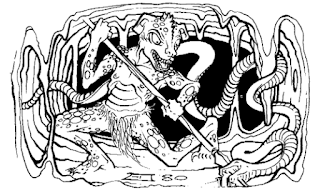 |
Now that's a kobold!
|
"In the D&D BASIC rules, a noble will always be a 3rd level fighter". I guess if that's all the levels you've got...
Good looking troglodyte too.
Huh the "Adjustments to treasure" paragraph is interesting. "An encounter with less than a full lair should yield less treasure. On the other hand if 1-4 is the "No. Appearing", even one will have the normal amount of treasure, and no adjustment is necessary." There aren't any "% in Lair" lines in the monster statblocks, so it seems kinda up to DM fiat whether a group of monsters is or isn't a lair. Unless all groups of monsters placed in the dungeon beforehand (ie, not-wandering monsters) are meant to be lairs?
"Sword +1, casts light on command (30' radius)" could easily be misinterpreted to letting you cast the spell Light and being useful for blinding people. Which would be kinda cool actually but probably not something you want to give out at will.
It's interesting that with a shorter potions table, the odds of rolling a healing potion go up tremendously. They're only 4% of potions in Expert, but 12.5% of potions in Basic.
"Two things must be done to use most magic items. First, the item must be held or worn properly. Second, the user must concentrate on the effect the item has. (Magic weapons, armor, and protection devices — such as a ring or elven cloak — will work without concentrating." So no command words, interesting.
The art for potion of gaseous form is also excellent.
"A treasure map should be made by the DM in advance, and should show the location of some treasure hoard in the dungeon." Emphasis mine. So treasure maps were explicitly scoped within the same dungeon in which they were found.
Ahh, the DMing advice section, what we've all been waiting for.
A couple of interesting notes from the "Scenarios" table. Several of these have implicit post-apocalypse - exploring areas formerly destroyed, reclaiming ruined settlements, visiting a shrine whose location has been lost, and making contact with a species who has been lost underground. I also like that "going through a magic portal" makes the top-10 list of beginner adventure hooks. Escaping Imprisonment is an unfortunate inclusion though, that never goes well.
The distinction between room traps and treasure traps exists here.
"Spray: Be sprayed with an unknown liquid that attracts Wandering Monsters; double chances for Id6 hours" Pretty good trap.
Creating an NPC party: "The DM may want to roll for NPC ability scores, also". Dang that's a corner I hadn't considered cutting.
The duality of players:
DM: "Black Dougal gasps 'Poison!' and falls to the floor. He looks
dead."
Fredrik: "I'm grabbing his pack to carry treasure in."
Rebecca: "I'm giving Black Dougal the last rites of my church."
The introduction of the misguided "roll under ability score" rule does, at least, sound optional - "The DM may want to base a character's chance of doing something on his or her ability scores". I much prefer the example in the previous paragraph of giving the player percentile odds for an action to succeed.
GRUDGES: Occasionally, a grudge develops between characters. A small grudge can often make the game more interesting, particularly if the grudge develops because the players are playing their character roles well. For example, a Lawful character might have a grudge with a Chaotic character who slew a prisoner after the Lawful character gave his word that the prisoner would not be harmed. If any grudge gets out of hand, the DM should try to subtly warn the players. If a grudge develops to a point where it is ruining the adventure, the DM may have a powerful creature interfere. The DM may plan an encounter with a gold dragon who tells the players that, unless the grudge ends immediately, severe steps will be taken (at most, the deaths of the offending characters).
Two interesting things here: One, that apparently having lawfuls and chaotics in the same party wasn't that unusual. And two, dragon ex machina for an out-of-game interpersonal problem is terrible advice.
Conclusions: yeah I'm seeing some compelling reasons to use a retroclone that combines B and X into a single cohesive book rather than having eg conflicting accounts of spellcasting. While I enjoyed the writing style here much of the DMing advice seems rather... sus, as the kids say. I'm kinda surprised this ruleset has had such legs; maybe Expert is really good or something? Guess we'll see.


