Showing posts with label Leisure Reading. Show all posts

Saturday, October 10, 2026

Chinook Jargon and the Limits of Common

I stumbled recently into reading about the Chinook Jargon, a pidgin language formerly widely used for trade in the Pacific Northwest, which drew vocabulary from native Chinook and Nootka languages as well as English and Canadian French.  Nominally it has/had about 700 words. 

An 1889 Chinook Jargon dictionary from Project Gutenberg is an interesting skim.  Lots of concrete nouns for animals (including pests like lice vs fleas).  Body parts.  Colors.  Social relations (like one's brother).  Kinds of people (I particularly love that "Boston" is a noun meaning "An American").  Weather.  Objects like combs and guns and money.  Verbs like want, go, give, come, dance, tell, injure, and lie.  Numbers.  Time, days and weeks and seasons.

Lots and lots of overloaded meanings.  Tum-tum is both the literal heart and the figurative will or opinion.  Skookum is both strength and ghosts.

Lots of meanings from assembling other words.  Hyas is high or big.  Puss-puss is cat.  Hyas puss-puss is a panther.  Halo is none or without; halo wind is without breath, eg dead.  East is comes-sun, west is sits-sun.  Skunk is stink-tail; rattlesnake is rattle-tail.

The connection to gaming is probably obvious.  If Common is a trade pidgin, your players probably shouldn't be having philosophical conversations with captured goblins in it.  I'm not saying you should write a list of 700 allowed words that your players can use when speaking Common, but...  I'm not saying you shouldn't do that either.  A limited vocabulary creating a need for figurative language could create lots of room for amusing miscommunications.

It could be pretty funny, and not entirely unprecedented - I seem to recall a caveman RPG that restricted the number of words that players had access to (Og, perhaps?). 

(Obviously, the reasonable thing to do would be to stop players when they try to use Common for abstract conversations, but where would be the fun in that?)

Friday, April 24, 2026

The Corruption of Power

I read The Man Who Was Thursday recently.  I'm still not sure what I think of its answer to the question of theodicy, but there was a bit that seemed ACKS-relevant:

The poor have sometimes objected to being governed badly; the rich have always objected to being governed at all. Aristocrats were always anarchists, as you can see from the barons’ wars. 

Whether you agree with Chesterton, it makes an interesting premise, particularly if one accepts his double-meaning of anarchy as not just rebellion against temporal governance, but against natural law.

What if power corrupted, in one's campaign world?  What if personal power and rulership tended to drive people to Chaos?  What if kings with the epithet "the Good" were rare exceptions for a reason?

Tolkien's answer to the question "why do we need adventurers?" in The Hobbit seemed like apathetic or negligent rulers.  But if the typical ruler is wicked, it is even less surprising that the plight of the peasants whose goats are being devoured by gryphons is ignored by the powers that be, and they are left to petition adventurers.  It also explains why in OD&D lords shake down adventurers for magic items, and archmages and high priests geas/quest them for the same.

It provides a great justification for PCs to overthrow existing rulers and take their stuff, while posing new hazards to be navigated.


The naturalistic take is that when people acquire power they gain the freedom to indulge their vices and to surround themselves with people who won't stop them.  There is also a Sword of Damocles angle, where rulership is insecure and so rulers tend to grasp at any and all means of holding on to power, including dangerous ones.  Selection effects and the Iron Law of Bureaucracy could play a part as well - those who rise to the top are those who are willing to use all means available to amass power, not those who are honest and just.

The McLeod Company Hierarchy also springs to mind 

To some extent we already see this happening to player characters without codifying it.  PCs have a notorious tendency for wanton disregard for NPC life and property.  Want of money is the root of all evil, and money gives XP, so...  the incentives line up.  We also see it a little as a side effect of the Tampering with Mortality table; gathering XP is dangerous and many PCs have close calls which lead to some spiritual deterioration.  And certainly I have seen PCs rule their domains with secret police and iron fist.

It's funny, that I think this was actually the first I ever heard of Seeing Like a State, and it was about strategy gamers behaving badly.

Mechanically, how might we rig the system such that rulers tend to be bad?  One simple approach is to flip ACKS' random alignment generator, which was on a d6, 1 Chaotic, 2-4 Neutral, 5-6 Lawful.  But maybe for rulers, you do 1-2 Chaotic, 3-5 Neutral, 6 Lawful.

Renegade Crowns' prince generation system tends to produce rather flawed characters.  It is possible to generate one who is a decent person, but rare.  Renegade Crowns' domain engine also turns domains into a source of trouble, hence into temptation to seek additional power to keep a lid on things, maybe without reading the fine print. 

If you like numerical corruption point accumulation systems, you could certainly wire one up so that leveling incurs corruption.  I don't like such systems, personally.

AD&D suggests a less dissociated alternative - for high-level assassins and druids, leveling is a zero-sum game, where you have to go topple the previous Master of Assassins or Arch-Druid in order to level up.  Zero-sum games always bring out the nastiest in people.  A very Damocles situation for the current Master, one in which he is strongly incentivized to accumulate as much power as possible to secure his position, and one in which challengers are likewise encouraged to play dirty.  Imposing similar diegetic requirements at lower levels could be an option.

(What else could we make zero-sum?  Spell acquisition, by removing copying?  Magic swords, by removing crafting entirely?)

Dark Sun and ACKS suggest another angle, with the ability to surpass the limits of human power by abandoning humanity through undeath, apotheosis into a dragon, etc.  If you lower the limits of human potential to, say, 9th level rather than 14th (or even down to 6th), committing crimes against the natural order to surpass human limits becomes much more pressing.

What does a world built with this idea as a premise look like?

Kings and princes are fearsome and dangerous and mostly view people as means, as tools to be used.  Their servants and courtiers and lieutenants may be complicit, or scheming and striving, or just doing what they have to do to get by, or believe that though what they do is repugnant, it is for the greater good.  Down at the bottom, the peasant, the pickpocket, the bartender, and the guard at the gate are basically decent.  They have no power, and so no corruption.  There is honor among thieves, as long as they are little thieves.  But if they get too big, then the knives come out.

Maybe loyalty score modifiers for hirelings based on level could use some changes to match these assumptions. 

But I think this is an important differentiator from grimdark.  In grimdark, even the little people are often basically bad - untrustworthy, cruel, vicious, spiritually ugly.  Needn't be so.

What do gods and churches look like in such a world?  If your high priests are cynical and power-thirsty, are the gods ambivalent about the moral qualities of their priests?  Or are the gods themselves caught in the same traps as high-level characters, perhaps even just ascended mortals?  Do even "good" gods demand great sacrifices of their worshipers to maintain their position against their divine adversaries?  Are they just so alien that they recognize neither natural law nor human morality?  Are they demiurges, tasked to maintain the work of a now-absent creator deity but falling away from their original purpose and natural law over eons of hard decisions and unsatisfiable constraints?

Thursday, April 9, 2026

Guilds and Freedom of the City

Today I stumbled upon wikipedia articles about the livery companies of the City of London and the notion of "Freedom of the City".

It's very fun, almost Pratchettian, that they have a guild for everything.  The Worshipful Company of Makers of Playing Cards?  The Worshipful Company of Human Resource Professionals?  You can't make these up.

I will confess that I have been pretty down on adventurers' guilds.  Does it make sense to have enough wizards in a city to warrant a guild?  Or for thieves to have an officially-sanctioned, chartered liveried company?  Does it make sense to have a single guild for all of the adventurers, despite their divergent interests and the danger to stability that concentrating all that firepower into a single organization has?  Maybe not (then again, maybe the thieves' guild just has a front company).  But it is probably fun, particularly if you have a city government where guilds elect the Lord Mayor and your wizards' guild candidate is running against the haberdashers' guild's candidate (backed by the thieves' guild, perhaps).  There's probably room for an amusing variation on ACKS' senate rules for guilds electing city leadership, if you're into that sort of thing.

The choice between guilds specific to a particular city vs cross-city guilds like the Hanseatic League is also an interesting one.  An inter-city guild provides for players wherever they may happen to be, while a single-city guild without reciprocal privileges elsewhere ties players to a particular place; it creates a home base.

This home basing effect ties somewhat obviously to halls and refuges.  Freedom of the city also ties nicely to some of the ideas from the halls post.  Someone (or a military unit) granted freedom of the city can do things like carrying arms in the city.

There are a number of rights traditionally but apocryphally associated with freemen—the right to drive sheep and cattle over London Bridge; to a silken rope, if hanged; to carry a naked sword in public; or that if the City of London Police finds a freeman drunk and incapable, they will bundle him or her into a taxi and send them home rather than throw them into a cell.  

Obviously a relevant and desirable status for adventurers!  And one which a city council might be careful to grant!  A good motivation for quests - "if we help Edmud the Haberdasher with his missing shipments, maybe we can secure his vote to get freedom of the city."  Basically: citizenship, but of a particular city.

This provides a potential non-mechanical form of progression or campaign progress.  As does progression from freeman to liveryman of a particular guild (with voting rights in city elections).  And then across cities.

This idea of medieval cities with independent governments whose freemen are not tied to feudal lords is also an interesting deviation from ACKS' assumptions about the relation between cities and high-level fighters, where cities are largely subsidiary to a particular domain.  An independent city council and Lord Mayor might come into conflict (open or otherwise) with adjacent feudal domains-holders.

Saturday, September 30, 2023

Poem a Day, Quantity Begets Quality

I read a (pdf warning) really interesting paper recently about writing a poem a day.  It got me thinking about quantity and quality in a lot of things in life besides just writing poems (though I did have a haiku-a-day habit for a while during the pandemic; it helped me mark the passage of seasonal time while basically locked in solitary confinement in an apartment).  One interesting passage:

In the book Art & Fear, they tell a story—which may be true, maybe not—of a university pottery class broken into two halves. One half was told their grades depended on the quality of the one pot they each handed in, and other was told their grades depended on the total weight of all their semester’s pieces. That is, each person in the first group would work however they wanted, but that person’s grade was determined by the quality of a single piece; each person in the second group would work all semester, and at the end each person would put all their pieces on a gigantic scale: 50 lbs and up was an A, 40–50 lbs was a B, etc. The best pieces of course all came from the group going for weight. The reasons are probably that the second group had no reason to fear the artistic process while they were learning craft techniques, and that they were practicing and experimenting through repetition.

But I think one of the most important reasons for their having the best work was that they could select the best piece rather than shepherd it along. You see, the first group could have worked this way too, but they all decided to just focus on making one perfect pot. Which is what we do as poets often.

I suspect that some DMs are tempted to do the same, trying to make one really good dungeon instead of ten dungeons, one of which is actually good.

It's interesting that he doesn't really couch it in the language of habit, though I suspect that once it does become habit the barrier to beginning on any given day is very low.  I kind of wonder if this is how eg Dyson works.  Dyson is incredibly prolific and it has to be a habit.  It also makes me wonder how Dyson picks which maps will get published where and what fraction he considers to be experiments that turned out mediocre / not worth publishing.

To a certain extent this is also the Dungeon23 approach, of making a habit of producing a little bit of a dungeon every day.  Dungeon23, though, seems to not really want to select / discard down to just the good bits at the end, instead throwing them all into a big megadungeon.

I am also reminded of evolutionary algorithms / reproduce-and-select, fuzzing, and distillation.  These are all kinda the same processes; produce lots of stuff, most of which isn't what you want, and then pick out the good bits and work from there.  Stupid generation processes that you do a lot of will still generate good stuff from time to time and it's just a question of separating it out.  And a human producing things will tend to increase quality of the mash over time, in a way that a pot still won't.

It's probably also true of sessions.  If you want to have great games, run lots of games, don't sit there prepping for the perfect game.  If you want to run great sessions, run lots of sessions - many will be mediocre but some will be great.  These are harder because you can't really throw away the bad ones; they still get inflicted on your players.

Possibly also of games/procedures/systems too.  Maybe this is an advantage of the rules-light / itch.io approach that I hadn't considered.  When you make lots of very small games, you get to iterate quickly, highlight the stuff that you think is the best, and sort of bury the stuff that turned out mediocre.  Arguably that's kind of how I blog!  Publish first, then link people to the ones that turn out to be relevant or that keep returning to mind, and the ones that nobody cares about just sit there doing very little harm.

Saturday, September 16, 2023

Mapping and Measuring - Paces

I recently picked up an old used copy of Sleightholme's Better Boat Handling.  I had some trouble with docking this summer and it seemed like it might be a worthwhile read over the winter to build up a set of drills to run in the spring.  I haven't sat down and read it yet but I flipped through and looked at some exercises.  On page 22 it suggested:

Exercise 3: Distance judging

Whenever you are out walking and the opportunity occurs, note objects ahead such as typical two-story buildings, people, cars, gates, etc.  Guess their distance and then count your paces.  It is not merely size of distant objects but detail that gives the clue to distance.  A window, for instance, loses its bars as distance increases, then its rectangular form, and then finally it becomes a dot.

Lack of intuition about distances is a serious problem I have had - many canonical-ish instructions in docking or man-overboard drills measure distances in boat-lengths.  I know how long the boat is in feet, but projecting that out multiple times across the water is more difficult.  So I took note of this exercise and have started playing with it; I can do it even if I can't put a crew together for a given day, or the weather's bad, or whatever.  It seems like it would also be useful for anyone running wilderness encounters.  How much detail can you make out about a group of people and/or orcs at, say, 50 yards with the naked eye? (see also this old post)

The mention of measuring distances in paces also got me thinking about the dungeon game.  If I tell the players that the room is 30' by 40', how did they determine that?  I have never stopped the game to ask my players how they want to measure a room.  The default dungeon exploration speed is low enough that I could definitely see pacing the length and width of the room being viable for getting pretty accurate measurements within the allotted time.  But doing this would also expose you to danger from traps or enemies in the room.  So now I'm wondering whether I just want to give descriptions like "big, longer away from you than it is wide" and "small room" up until they have paced it.  Or give them estimated distances in tens of feet, but with a roll for error, and then if they pace it they can get accurate distances?  idk.

I also think it would be fun to give room sizes and distances in paces instead of feet.  Just like using stone for encumbrance, it's a quaint and evocative unit with a little bit of slop.

As usual, this led down a shallow wikipedia rabbithole, with a couple of interesting findings:

  • Alexander the Great brought specialist pace-counters along with his army to measure distances, and their accuracy was so good that some now think they must have had an odometer.  How much does a specialist bematist demand in monthly wages, I wonder?
  • You know those wheels surveyors use to measure distances?  Another name for them is a "waywiser".  I love it - it's alliterative and very Olde English.  If you put them on your equipment table, definitely use that name.
  • Apparently pace-counting is still used by the military and they use beads on a string to help keep track of large counts.  I did find myself wondering if I were occasionally slipping up with counts up towards a hundred while I was walking my block this morning; these make total sense.

Saturday, April 29, 2023

Traveller and Cruising

It's possible I've been thinking about Traveller all wrong.  Maybe this is obvious to everyone else but here goes.

I've been reading some books about maritime cruising.  "Living for extended time on a vessel (yacht) while traveling from place to place for pleasure. Cruising generally refers to trips of a few days or more, and can extend to round-the-world voyages." There's a lot of discussion about how to do your own maintenance (one, because stuff breaks at sea, and two because hiring professionals to do it in port is really expensive) and how to do odd jobs to make some money on the side since you probably aren't regularly employed.  Some of those odd jobs and cruising stories sounded like the sort of things Traveller patrons would ask for, and here we are.

This lens makes a lot more sense for Traveller than "space trucking".  You don't have to explain the economics of small-scale shipping, because that's not really what is happening here.  Sure you might make a windfall on cargo every now and then (and cruisers attempt this too, with mixed success - "We were told that people in the Marquesas desperately needed reading glasses.  I bought 50 pairs in Mexico and still have all of them [because we were misinformed].") but that's not why you're traveling.  You're traveling for its own sake, and money is a means to the end of continuing to travel.  You're not out to get rich - just to keep funding the midlife crisis and not have to go back to a day job with a boss and a commute. This is why your "career" ends at the end of chargen.

It's interesting to compare with the similarly non-accumulative style of Appendix N, where the heroes adventure to get rich, only to spend it all and then need to adventure again.  Here too it's adventuring for money in order to maintain an unconventional, expensive but unencumbered lifestyle.

I think this view is consistent with the belief that money is supposed to be important in Traveller, but it also admits the Classic Traveller style where PCs having a ship is somewhat rare.  A Traveller without a ship can still work odd jobs in / for the "cruising" community and get working passage to wherever. Losing the money game doesn't end the campaign; it just changes it temporarily.  So the money pressure maybe shouldn't be as overwhelming as it might traditionally be with the starship loan (or you do what many budget cruisers do and get a really old vessel).  It's there to keep things interesting, to add a creeping danger that you can't just run from, not to be the focus of play.

This cruising lens also answers the question of "why do we have a baronet or an ex-admiral on this grungy little vessel?"  They're not loading cargo - they're just drifting.  Plenty of nobles are into sailing ("It seems that of any activity in the world, singlehanded sailors have the best odds of being knighted.") and the admiral retired and decided he just wanted to kick back in the tropics in a low-stress environment but can't help but get himself into trouble.

Some possible implications for DMing Traveller - NPCs from the cruising community.  Lots of cruising vessels have "buddy boats" or form regattas headed to the same place at the same time.  This is good for when something goes wrong.  The vessel at the next berth over in port isn't a rival small trader; they're drifting hippies with a hydroponic weed operation onboard, or a very trad religious husband who used to sell insurance with wife and four kids and a dog aboard, or a reclusive ex-programmer with a bunch of ship systems automated, or a husband/wife pair where the husband is a professional hunter and the wife is a xenobiologist (who is actually the better shot of the two), or...  There's just a ton of room for recurring, charmingly-eccentric NPCs here, who might fill the patron role when things are going well for them, or who might need rescued when something goes wrong.

Another implication for DMing Traveller regards building sandboxes.  When the players are out to do the "space trucking" thing, you have to be really careful to not set up Golden Pairs of planets with complementary economic tags where you can just go back and forth indefinitely and make tons of money.  But if the players are on board with the game being about drifting, you might be able to be less careful with this; it becomes a "sometimes food", because anything that resembles routine work is anathema.  It seems like a way of thinking about the game that would really encourage building a sandbox with lots of wild, interesting bits for your tourists to go see and mess with.  It could be much mellower than the highly-incentivized OD&D sandbox of "where do we go to make a ton of money, hence XP, as quickly and safely as possible?" which so often causes analysis paralysis for optimizers (as does the Space Trucker optimizing his routes).  But cruising Traveller admits satisficing; "sure that sounds like an interesting place to go, uhhh I wonder if they need any eyeglasses, maybe we can make a buck.  Any passengers headed that way to defray our costs?"

Saturday, February 11, 2023

Snakebites and Magic Rocks

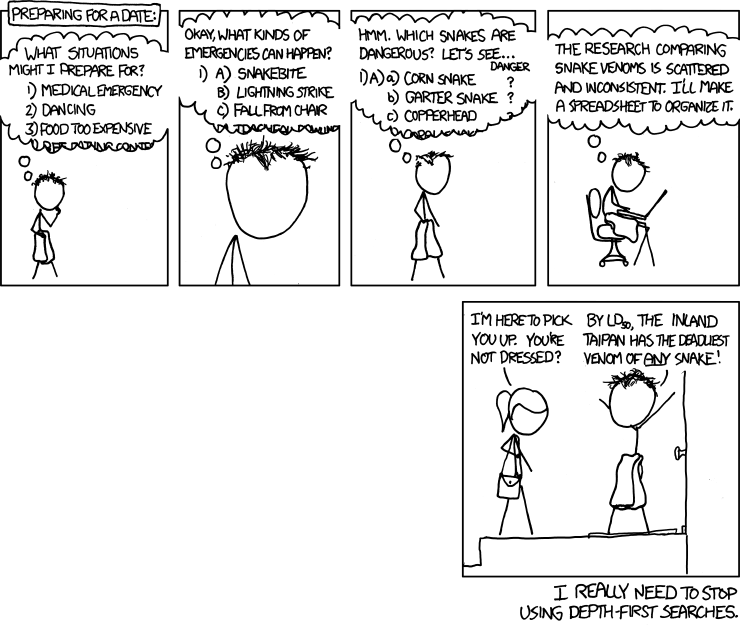
Or, I spent 15 hours reading wikipedia pages on venomous snakes so I guess I may as well make a post out of it.

https://xkcd.com/761/

I am not a herpetologist.  I am not your herpetologist.  Nothing in this post should be construed to be medical advice, nor expected to be perfectly accurate.  Everything here is gross generalizations for the purposes of gaming.

The two big families of venomous snakes dangerous to man are the elapids and the vipers (there are some dangerous ones in other families like the colubrid boomslang though)

  • Elapids
    • Include cobras, taipans, sea snakes, coral snakes, kraits, mambas, pretty much all of the various intensely venomous Australian snakes with unassuming names like the Western Brown Snake...
    • Often relatively long and thin body form 
    • Mostly have round pupils
    • Mostly lay eggs
    • Have relatively short, non-folding fangs at the front of the mouth
    • Venom is often primarily neurotoxic and kills by stopping respiration
    • In some cases, venom is almost entirely neurotoxic in action and causes no pain or swelling at the bite site, making it hard or impossible to tell if a bite was "dry" until onset of symptoms
    • The combination of short fangs and quick-acting venoms often lead to an attack pattern against their primary prey of wrapping around and biting multiple times to guarantee some good deep killing envenomations
    • Hunting pattern is often active - seeking out prey, going into burrows
    • In humans, time to kill from a wet bite is often 30 minutes to six hours
  • Vipers
    • Include rattlesnakes, copperheads, cottonmouths, adders, pit vipers, bushmasters, fer-de-lance, ...
      • Pit vipers are called this because they have a pit on each side of their head between the eye and the nostril which can sense infrared, not because they live in pits.  It's actually a pretty big category and includes most (all?) New World vipers
    • Often relatively stocky/girthy/thicc body form 
    • Many have slit-pupils like cats
    • Mostly give birth to live young
    • Have long, thin fangs that fold up against the roof of the mouth when not in use, and lower jaws that hinge out past 150 degrees to let them strike with the long fangs
    • Venom is often primarily toxic to blood and muscle tissue, causing clotting, hemorrhage, blistering, necrosis, kidney failure from rhabdomyolysis.  May require amputation of the bitten limb even if it doesn't kill you.
      • I have now seen some pictures of necrotized viper bites that I cannot unsee
    • Wet bites are typically very painful and swell up
    • Between the fragile but long-reach and deep-injecting fangs and the slow venoms, attack pattern against primary prey is often a single lunging bite and then backing off and waiting for the prey to die.
      • Some can track bitten prey by the smell of some components of the venom acting on the prey's blood
      • Often a passive hunting style, waiting in ambush for passing prey to tag
    • In humans, time to kill from a wet bite is often 10+ hours (overnight or the next day) unless the bite was onto a vein  

On reflection, it seems like regular-sized mundane venomous snakes are really more like traps than they are combat encounters.  You didn't poke the pile of leaves with a 10' pole before you stepped in it, save vs poison, and unless you roll a 1 you still have at least half an hour to get a Delay Poison or Neutralize Poison in before you keel over.  The necrosis angle on viper bites could be somewhat interesting, might play out a bit like ACKS' Dismember spell on a failed save.  2HD for a 5' pit viper that probably weighs 5 pounds seems really high.

Where you'd expect to see save-or-die poison with a pretty quick time to kill would be in snakes for whom humans are a common prey species.  I recall reading somewhere that most predators hunt prey that is something like a 10th of their own mass to minimize the risk of being injured by the prey.  I don't know how true this is but it sort of passes the smell-check; a mouse is much smaller than a cat, a mosquito is much smaller than a bat or sparrow, a seal is much smaller than a great white shark.  I would expect pack hunting, ambush, and venom to all shift those closer to 1:1, since these strategies reduce the risk of injury to the predator.

The Eastern Diamondback Rattlesnake is typically about 6 feet long and weighs about 5 pounds.  It commonly preys on cottontail and marsh rabbits, which weigh about 2-3 pounds.  Scaling up mass with the cube of any single dimension, we'd expect a 12 foot rattlesnake built to the Eastern Diamondback's proportions to weight about 40lbs, and a 24-foot rattlesnake to weigh about 320.  That seems a size at which hunting adult humans as a primary prey sounds plausible.  Incidentally, this is also about the size of a large reticulated python, which have been known from time to time to prey on humans, including adult male humans.  I think this length and mass would be a better match for the 4HD giant rattler stats than the 10' in its description.

Anyway, a few other fun snake "facts":

  • King cobras have a really low-pitched growly hiss apparently
  • The yellow-bellied sea snake can get about 33% of its oxygen needs by absorbing oxygen from the water through its skin
  • We're pretty sure sea snakes don't drink seawater, but nobody is really sure where they get fresh/brackish water.  It's theorized that they might drink the layer of brackish water at the top of the water column during heavy rains
  • The small-scaled burrowing asp can rotate its fangs sideways out of its mouth and uses this in confined spaces where it doesn't have room to bite.  It has also been observed to sting each rodent in a burrow containing multiple before stopping to eat any of them.  Next time your players meet a snake and complain that trying to bite each PC in turn was too smart, show them this.
  • Some venomous snakes which hunt by ambush use "caudal lures", where the tip of their tail look like a tasty worm or grub.  A dungeon-snake whose tail looks like some sort of unattended treasure would be pretty funny.

I also wandered into some articles on treating snakebite.  Antivenin is made by injecting large mammals like horses with small doses of venom and then harvesting their antibodies.  Antivenom can have some pretty significant side effects, called "serum sickness", from reactions to horse proteins.  These can take up to two weeks to appear and in rare cases can kill you.  In folk medicine, there's a whole genre of magic healing stones, some of which nominally work on snakebites (bezoar stones from inside of toads and snake-stones or black-stones often made from burnt animal bones) and some of which might be made by snakes (adder stones).  There were also madstones, which might not have been stones at all but body parts of albino deer used to try to treat rabies?  In conclusion I feel OK about having some non-magical treatments for snakebite that give you a second save but also entail bed rest afterwards.

Tuesday, November 22, 2022

Calibrating Compasses

I've been opposed to having compasses in my D&D games for a good long while, on a couple of grounds.  They don't really fit into a Dark Ages or Ancients milieu, and it seems intuitively obvious to a suburbanite that they should sort of trivialize navigation.  The latter, I am learning, is not quite true.

I have been doing some pre-reading in the Annapolis Book of Seamanship for a coastal navigation course I'm taking this winter, and was surprised to learn that when installing a compass on a vessel, you need to calibrate it.  Ferrous metal fixtures on the vessel can interfere with the compass' accuracy, and that interference changes as the vessel changes heading.  There are some fine adjustments you can make to modern compasses, but those probably weren't available on compasses in the Bad Old Days, and even today these fine adjustments can sometimes be insufficient, in which case you end up writing up a table of adjustments to the heading the compass shows based on the heading of the vessel - a mapping from apparent magnetic heading to actual magnetic heading.  And making that table requires having precise bearings from where you're carrying out the calibration.  Apparently "compass adjuster" is something of a specialist profession.

And then magnetic north is off from true north, and the amount you have to compensate for that varies based on your location - if you're between the magnetic north pole and the actual north pole, the difference could be 180 degrees!

I was talking about compass deviation due to metal fixtures at work and an ex-army colleague mentioned that when he taught overland navigation, one of his pastimes was giving the compass to the squad's radioman and seeing how long it took the squad leader to figure out that the radio was interfering with the compass.  "Machine gunners were OK too, it's a big piece of metal."

There is also a note in the book that "Very few steerers [helmsmen] are good enough to keep a boat within 2 degrees of course in smooth water; in rough weather, steering errors of 5 to 10 degrees are common."  One side of a hex is 60 degrees wide, so a 10 degree error in rough weather is one hex side every six hexes or so...

All of this is to say that if you allow compasses in your games, they aren't necessarily an end-all-be-all for navigation.  Full plate may mess with your compass, magic items might mess with your compass ("magnet" and "magic" share a prefix, after all), magnetic "north" in your setting may be in an interesting spot or just move around a lot, and even if you have bearings there's still room for error in steering to lead to course deviation.  To say nothing of the quality of nautical charts and other maps in pre-modern times!

Saturday, May 14, 2022

Red Nails

I don't read much fiction, but someone recently pointed out that several of Robert E. Howard's Conan stories are available for free from Project Gutenberg.  I had previously read The Hour of the Dragon, the most-downloaded of the lot, and found it alright but not great.  The seams of the serial structure in which it was originally published showed through pretty hard.  The next most-read on Gutenberg was Red Nails.

I enjoyed Red Nails quite a bit (with the usual caveats about '30s pulp fiction), but more important, this is really good inspiration for old-school style dungeoncrawls.  Without spoiling anything, there's a multi-level dungeon with competing factions, and those factions aren't monolithic, precisely in the way that dungeon factions are talked about in the OSR blogosphere.  There are also a couple neat ideas for magic items and dungeon set dressing pieces.  The dungeon bits of Hour of the Dragon don't hold a candle to this.

The Appendix N entry for Howard doesn't call out particular Conan stories, but I have to imagine that if it did, this one would've made the cut.

Sunday, January 16, 2022

Week as Wilderness Turn

Last post, I noted that the distances and times involved in wilderness travel in The Hobbit were so great that a game in that style might want to use 24-mile hexes as its smallest unit, and a week as its "turn" of wilderness travel.  What does it look like if you take B/X's or ACKS' rules for wilderness travel and rescale them this way?  What would you probably have to change and what could you leave alone?

If you're taking a week as your base unit of time, then you no longer have to worry about taking a rest day per week, and can just bake it in.  So you're scaling up your movement or actions per "turn" by a factor of 6, since you get six working days.  Using 24 mile hexes vs 6 mile, you're scaling up your unit of distance by a factor of 4.  So movement will be ~1.5x more hexes per turn.

Exploration movement speed : 24 mile hexes / week

  • 30' : 1.5
  • 60' : 3
  • 90' : 4.5
  • 120' : 6
  • 180' : 9
  • 240' : 12

So that's rather inconvenient, having to reckon in half-hexes.  I suppose we could do something like this, taking woods or hills as the default and multiplying everything by 2/3, so we get 1 24-mile hex per week per 30' of speed.  Which would be pretty clean, until you're on plains or road.

Nautical and aerial distances covered get quite large when you look at them on per-week timescales.  The lowly rowed canoe makes 4 hexes per week, while sailing ships with good winds might make nearly 8 hexes per day, or north of 50 hexes per week (assuming no weekly day of rest under sail).  Aerial travel gets pretty nuts when you multiply it all by 1.5 as well.  These modes of transport are fast enough that you probably don't want to track them hex-by-hex on a map on weekly timescales. You use sailing ships to move between maps.  You fly Eagle Airways for a couple of hours, not for a solid week (and still might get to move a hex or two).  Getting a personal, permanent flying mount is a phase-change event where you have outgrown thinking much about wilderness travel.

Since forced march is only one day of extra speed, followed by a day of rest and no speed, if we're dealing purely in weeks you might be able to just remove the option.  On the other hand, I like leaving this sort of option available to players; trading off now vs later is always interesting.  Maybe the right way to handle forced march on this scale is through something like strategic initiative in mass combat, where when you have a wilderness encounter, you can choose to forced-march to maybe gain a terrain advantage, bonus to escape roll, or surprise bonus at the expense of fatigue if brought to battle.

The right way to handle getting lost / failed navigation rolls is probably that they reduce your movement for the turn.  Maybe halve it; you spend a couple days wandering around within hexes that you were traversing, but going 24 miles out of your way is hard.  Could do hunting the same way; spend the whole week hunting, don't move at all, and get two rolls, or spend half the week hunting, get one roll, and half movement (and then if you also get lost that week, you end up still in the hex you started in).

Rations might actually get simpler, at a stone per man per "turn".  And fresh ration decay could be simplified too; you could just have all uneaten fresh rations go bad every turn.  Then hunting and foraging can work entirely within a single week; if you find a week's worth of fresh rations, that's a stone of iron rations that you can skip eating and carry over into next week.  So then you only need to track one number: the stone of iron rations you're carrying, which might also be thought of as your buffer against foraging failures.

As far as combat resources go...  for a Hobbity feel, you really want some refuges in the wilderness where you can recover hit points.  I still think recovering spells there too (not every night in the wilderness) makes sense, provided some reworking of mid- and high-level spells.  But I could see going the other way with it too, where you're pretty much always going to have full spells for any encounter.  This lends itself to very large encounters where you need lots of spellpower to bail the party out.

Wilderness encounter frequency definitely gets weird.  You probably don't want to have to roll a pile of d6s every "turn", and having multiple encounters per unit time is awkward.  I could see having one encounter per week, with the difference between terrain types being "roll n encounters and pick the scariest / biggest one".  Or just a quantity multiplier like dungeon level, where if you're in mountains you get 3x as many goblins as if you were in plains.  But this also doesn't quite square with the frequency of wilderness encounters in The Hobbit, where they can go a couple weeks without an encounter.  I could see having some <100% chance per week of an encounter, but when there's an encounter, it's always a lair - a kingdom of elves, a whole cave system of goblins, a big honkin' pack of wargs, a gang of trolls with accompanying cave full of magic swords of elven make.  On the time-and-space scales you're dealing with here, you might encounter a warband from a lair initially, but within a week they'll report back (or be noticed missing) and you'll be dealing with the whole village shortly.  Maybe winning surprise lets you only deal with one warband initially.

Domains get...  maybe a little messy.  Clearing a 24-mile hex is a lot of work.  You could do something like wilderness lords, where every wilderness hex already has a "lord" of a sort, and if you can knock him and all his monsters over that's good enough, the rest migrate or fall into line.  This is particularly plausible in a setting where everything talks, but might feel a bit strained after the third or fourth time, and maintaining relationships between all the "lords" of neighboring hexes is a lot of work.  Another approach might be clearing to capacity; if you want to build a village, you have to displace a number of HD of monsters comparable to a village of goblins.  This is what you might expect in a wilderness that is at capacity, saturated.  But this isn't the wilderness we see in The Hobbit, which is as post-apocalyptically empty of monsters as it is of men.

Maybe that's an answer - "clearing" a wilderness hex just means dealing with any already-known lairs in it, and then the real game is dealing with wilderness random encounters, which could have wandered in from nearby hexes, or could be from unknown lairs in the hex.  Taking land is easy; holding it is the hard part.  This creates a sort of "the dungeon is too big to be cleared" feeling, and is also consistent with the incomplete clearing of eg Mirkwood by the elves.  It pushes domain rulers into the same sort of reactive posture of incomplete control in game that they held in the fiction.

Switching to 24-mile hexes changes visibility somewhat, in that the edge of the hex is over the horizon.  You could spend a week exploring within a single hex, easily, and unless the next hex over is elevated, you might not know what terrain type it is until you enter it.  Finding a dungeon within a hex might take a while, but that's consistent with the fiction too, where they can't find the back door into the mountain.  They have trouble finding Rivendell too.

This mode of play doesn't seem terribly well-suited to 1:1 timescales, if most weeks you don't have an encounter.  I could see doing two turns per week of real time though, to make sure there's time to resolve wilderness encounters without too many more piling up.

Saturday, January 8, 2022

The Hobbit

I realized I hadn't read much in the last year, and that I had been dancing around Tolkien, reading his Catholic British contemporaries (Ker, Chesterton, and Lewis' Screwtape Letters), and decided I ought to just go revisit the man himself.  I'm pretty sure my mother read The Hobbit to me and my brother when we were small but I don't think I'd read it myself (certainly not since coming across OSR D&D).  I have not seen the film(s?) and do not plan to.

It may be worth noting here that I am taking the text of The Hobbit alone, ignoring the whole rest of the canon from elsewhere as best I can.  I think I like it better this way.  I will probably read The Lord of the Rings next, but for now I want to consider only what is written in The Hobbit.  And I want to get it written down, so that after the trilogy I can look back in on it.  This may not be the "correct" way to read the The Hobbit, but it may turn out to be a worthwhile way nonetheless.

I found it delightful.  I wish more D&D were in the model of The Hobbit than in that of The Lord of the Rings.

They're not out to save the world.  They're very explicitly not heroes.  The motives of most of the characters most of the time are Thucydidean - "fear, honor, and self-interest".

There it is: dwarves are not heroes, but calculating folk with a great idea of the value of money; some are tricky and treacherous and pretty bad lots; some are not, but are decent enough people like Thorin and Company, if you don't expect too much.

That [attempting to slay Smaug] would be no good, not without a mighty Warrior, even a Hero.  I tried to find one; but warriors are busy fighting one another in distant lands, and in this neighborhood heroes are scarce, or simply not to be found...  That is why I settled on burglary.

Of the dwarves, only Thorin gives a consistently decent account of himself in battle (hitting a troll in the face with a stick,  holding the goblins with Orcrist, and shooting the white hart).  They get stuffed in sacks, chained up by goblins, webbed by spiders, and imprisoned by elves without offering any effectual resistance.  They sing better than they fight.  Their courage fails at the foot of the mountain and only Bilbo prods them on.  They worked as blacksmiths and coal miners before this; Fili and Kili are young and inexperienced, Balin at least is old, and Bombur is very fat.  These are not Dain's elite heavy infantry, "strong even for dwarves".  These are dwarven vagabonds with a map, a key, desperate scheme, a hobbit, sometimes a wizard, and a good deal of luck.  They are, in short, exactly what we might expect of low-level dwarven PCs in OSR games.

The mere fleeting glimpses of treasure which they had caught as they went along had rekindled all the fire in their dwarvish hearts; and when the heart of a dwarf, even the most respectable, is wakened by gold and by jewels, he grows suddenly bold, and he may become fierce.

He did not reckon with the power that gold has upon which a dragon has long brooded, nor with dwarvish hearts.

And like my players of old, how loathe they are to give up what is theirs!  Though it be a great burden and a danger in itself!

The treasure is likely to be your death, though the dragon is no more!

How on earth should I have got all that treasure home without war and murder all along the way, I don't know.

And like a third-level character come suddenly into a great deal of treasure and a fortress, Thorin handles it ineptly and it is his doom - in contrast with Dain, who "dealt his treasure well". 

And like combat in the OSR, defeat is miserable and victory is pyrrhic.

I have heard songs of many battles, and I have always understood that defeat may be glorious.  It seems very uncomfortable, not to say distressing.  I wish I was well out of it.

"Victory after all, I suppose!"  he said, feeling his aching head.  "Well, it seems a very gloomy business."

And then the setting (or at least the parts much described) is the sort of howling emptiness implied by OSR systems.  But working from just this text, there isn't much of an apocalypse.  The Wild was not ruined by any central force, no great, shattering event, no unveiling.  Most of it was ruined by just...  neglect.  Decay.  Entropy.  Nobody is putting in the maintenance.  Certainly there are evil forces at work, but for the most part they're opportunists filling a vacuum, not part of some grand plan.

The marshes and bogs had spread wider and wider on either side.  Paths had vanished, and many a rider and wanderer too, if they had tried to find the lost ways across.  The elf-road through the wood which the dwarves had followed on the advice of Beorn now came to a doubtful and little used end at the eastern edge of the forest; only the river offered any longer a safe way from the skirts of Mirkwood in the North to the mountain-shadowed plains beyond, and the river was guarded by the Wood-elves' king.

There were many paths that led up into those mountains, and many passes over them.  But most of the paths were cheats and deceptions and led nowhere or to bad ends; and most of the passes were infested by evil things and dreadful dangers.

The old maps are no use: things have changed for the worse and the road is unguarded.  They have seldom even heard of the king round here, and the less inquisitive you are as you go along, the less trouble you are likely to find. 

An argument could be made, of course, that Smaug is the relevant apocalypse.  But that hardly explains the lawlessness of the Lone-lands between Hobbiton and the Misty Mountains, unless the reach of Dale was once very great indeed.  The giants have the power to shut up the exits of the goblins, but they don't (unless Gandalf is able to "find a more or less decent giant").  The wood elves waylay travelers, hunt the white hart, and get drunk on Dorwinion wine, and the spiders multiply.  The eagles seldom take notice of the goblins.  Beorn keeps his territory clear but only goes so far.  What has Elrond done lately?  The Lake-men have surplus enough to outfit and feed the dwarves but don't seem to be pushing out either, as the Master is content to maintain his little bubble of peace.  Dain waging war on the goblins of Moria seems to be very much the exception in that he is active (with Gandalf being the other active player for good, setting the trip in motion and working on the problem of the Necromancer while they're in Mirkwood).

No, the real cause of the ruin of the Wild seems to me to be apathy.  Not so grand as a Dark Lord, but much more true to life.

I love the passage of the seasons; it is something that I always want to evoke in my open-world games and something that I never seem to get quite right.  The distances are so great!  To run a campaign in this style, one might be well-served by 24-mile hexes as the smallest unit, and wilderness turns of a week.  I love that the place-names are plain English - Misty Mountains, Lonely Mountain, Iron Hills, Blasted Heath, Rivendell / Riven Dale, Mirkwood / Murk Wood, Long Lake, Wood River, River Rushing, Dale, and Lake-town.  Moria, Gondolin, and Dorwinion are proper names but only referenced, never seen; only at the end does Tolkien sneak in "Esgaroth" as a proper name for a place seen (Lake-town) in the style of the names of places in the trilogy.  

I love the talking of all the animals; everything bigger than a bat seems to have a voice and a language.  How often have I bemoaned that animal encounters on the wilderness encounter table are a waste of time for a mid-level party of reasonable size?  How much less of a waste would they be if they could talk?  If they could be bargained with, asked for information, deceived, taunted?

"O Thorin son of Thrain, and Balin son of Fundin," he [a raven] croaked (and Bilbo could understand what he said, for he used ordinary language and not bird-speech).  "I am Roac son of Carc."

In the middle of the circle was a great grey wolf.  He spoke to them in the dreadful language of the Wargs.  Gandalf understood it.  Bilbo did not, but it sounded terrible to him, and as if all their talk was about cruel and wicked things, as it was.

In the silence and stillness of the wood he realized that these loathsome creatures [spiders] were speaking to one another.  Their voices were a sort of thin creaking and hissing, but he could make out many of the words that they said.  They were talking about the dwarves!

 Weapons, too, have a touch of soul to them:

It burned with a rage that made it gleam if goblins were about; now it was bright as blue flame for delight in the killing of the great lord of the cave.

Arrow!  Black arrow!  I have saved you to the last.  You have never failed me and always I have recovered you.  I had you from my father and he from of old.  If ever you came from the forges of the true king under the Mountain, go now and speed well!

When was the last time a magic weapon in your game was delighted?  Sure, sentient swords are in the tables, but how often do you even bother rolling for them, so seldom rolled and then so inconvenient to sort out and keep track of when you do?

It's just...  grounded, I suppose.  There is no cosmic struggle here.  Magic when it appears is mostly small wonders, in talking birds and delighted swords and water that makes you sleep.  Dwarves can be wicked, eagles can be cruel, Beorn and the Elf-king are very suspicious of visitors, and Thorin and the master of Lake-town are overcome by avarice not because there is any agent of a dark power whispering in their ears but just...  because of a moral failing.

I have dodged entirely talking about the hobbit himself and whether his desire the whole time to be home in comfort is of a kind with the apathy that is the ruin of the Wild, or wisdom, or both.

The stars are far brighter
Than gems without measure,
The moon is far whiter
Than silver in treasure;
The fire is more shining
On hearth in the gloaming
Than gold won by mining,
So why go a-roaming?

Maybe Bilbo's peculiar virtue is that he can be moved to adventure in the first place, and that once begun, he remains to see it through to the end in spite of his want of comfort and normalcy (which I suspect is quietly shared by almost every other "good" character but the dwarves).  And that like Rary as played by Blume, he knows when the job is done, rather than having his appetite for treasure become insatiable once whetted.

In any case, I am glad to have read it, and apologize for the rambling post (initially I had planned a series of more tightly-focused posts, but oh well).

Tuesday, October 12, 2021

Gisli's Saga and Boot Hill

I read Gisli's Saga the other day and something about it reminded me of Chocolate Hammer's Boot Hill campaign.  It got me thinking about how one could set up a powderkeg for a saga quite similar to that, but perhaps smaller in number of characters.

Thorkel and Gisli are brothers from Norway who settle in Hawkdale in Iceland, and marry into Hawkdale families.  Gisli marries Auda, the sister of a man named Vestein, while Thorkel marries Asgerda.  It comes out that Asgerda fancied Vestein, leading to suspicions of infidelity and eventually the deaths of about a dozen men.

Asgerda's interest in (already-married) Vestein is a pre-existing fault line in the micro-setting that the player-character-like outsiders Thorkel and Gisli stumble (and then marry) into.  It doesn't seem like it would be too much of a stretch to build a tiny setting of 5-10 extended families with a bunch of such fault lines:

  • a long-simmering dispute over grazing-land or property lines
  • a contentious dividing of property among a man's heirs
  • a father who mislikes his daughter's favored suitor
  • a bastard child whose step-mother hates it
  • a badly-treated thrall
  • a wheel of cheese stolen in a hard winter
  • a good sword borrowed and never returned
  • a badly-given gift
  • a lad whose father was slain, who wants eventual revenge on his killer but can't get it yet
  • an insult in one's cups at the Althing some years back; cooler heads prevented bloodshed then but still it rankles
  • weregeld accepted for a relative slain but some family members still think the slayer should've been made an outlaw instead
  • a suspected cheater at sports or horse-fighting
  • a man envious of another's wealth, desirous of the priesthood / chieftainship
  • a rich man who is miserly to guests and alters deals, gets away with it because he has several strong brothers
  • a skilled duelist who runs roughshod and takes what he pleases, challenges those who object (returns from sea-roving mid-campaign to shake things up, presumably)
  • a suspected sorcerer feared by those outside his family
  • three town gossips poking their noses in everything and spreading news of dubious veracity
  • a skolding wife who urges her husband to unwise deeds
  • a husband who mistreated his wife, causing her to return to her family's house; a dispute over the dowry
  • a hot-headed young man, yet unproven in battle and eager for it (probably about ten of these, really)
  • a cool-headed young man, goaded by his father as unmanly for preferring words to violence
  • a wise man's foreboding prediction
  • an ominous dream

And then let some player characters loose into it to get into trouble over the course of a few years of game-time.

I don't know what system you'd use for such a game - Pendragon, Mythras, and Wolves of God all spring to mind, but they're not quite Boot Hill.  But it's an interesting thought.

... I suppose it would be amusing to hack up Boot Hill's ranged combat system to instead do high-detail, few-combatant, armorless melees of axes, bill-hooks, spears, swords, and shields...  "Grim cut off Skiolld's foot at the ankle-joint, but Helgi thrust him through with his spear, and he got his death there and then" seems like the sort of thing a derivative of Boot Hill's combat system would do well.

Thursday, July 29, 2021

Traveller's Terms and HBR's Tours of Duty

I had an interesting text-chat conversation with a former coworker recently (excerpted):

me: I suppose maybe that is a good argument for me going to XXX next rather than YYY...  Just to see if XXX is the way that I think it is (which was part of why I wanted to go to $CURRENT_EMPLOYER - to see it).  The tourist approach to career planning.
them: Ha, I like how you describe your career strategy!  Kinda reminds me of Reid Hoffman's tour of duty https://hbr.org/2013/06/tours-of-duty-the-new-employer-employee-compact

It's a pretty good article.

I have thought about careers and life in terms of Traveller's terms for quite some time; my blogger profile used to have what I estimate my Traveller stats at, including terms in various occupations.  When I'm at a new company, I think of staying a full four years as a good solid run; I've only done it once so far, and it was a pretty darn successful four years, definitely worth an extra benefit roll (with a shift in company direction in the final year or so which I did not think promising).  More commonly, after 18-36 months, if things are looking mediocre, I move on.  Not a failed survival roll, but more like a failed roll to promote.

So I think it's a little funny to see a serious publication like the Harvard Business Review take basically the same perspective, following in the footsteps of some geeks in the '70s trying to model careers.

Thursday, May 13, 2021

Chesterton on Letting the Dice Fall Where They May (but Unseriously)

Continuing with Orthodoxy (chapter 7):

I could never conceive or tolerate any Utopia which did not leave to me the liberty for which I chiefly care, the liberty to bind myself. Complete anarchy would not merely make it impossible to have any discipline or fidelity; it would also make it impossible to have any fun. To take an obvious instance, it would not be worth while to bet if a bet were not binding. The dissolution of all contracts would not only ruin morality but spoil sport. Now betting and such sports are only the stunted and twisted shapes of the original instinct of man for adventure and romance, of which much has been said in these pages. And the perils, rewards, punishments, and fulfilments of an adventure must be real, or the adventure is only a shifting and heartless nightmare. If I bet I must be made to pay, or there is no poetry in betting. If I challenge I must be made to fight, or there is no poetry in challenging. If I vow to be faithful I must be cursed when I am unfaithful, or there is no fun in vowing... For the purpose even of the wildest romance results must be real; results must be irrevocable.

which reminded me variously of illusionism (where the results aren't real), and storygames (where the players are authorially unbound), and of discussions of agency.

On the other hand,

Pride is the downward drag of all things into an easy solemnity. One "settles down" into a sort of selfish seriousness; but one has to rise to a gay self-forgetfulness... Seriousness is not a virtue. It would be a heresy, but a much more sensible heresy, to say that seriousness is a vice. It is really a natural trend or lapse into taking one's self gravely, because it is the easiest thing to do. It is much easier to write a good TIMES leading article than a good joke in PUNCH. For solemnity flows out of men naturally; but laughter is a leap. It is easy to be heavy: hard to be light.

which reminded me of this post of mine, where I concluded "Perhaps the problem with my previous approach to RPGs was taking things entirely too seriously."  And that is not something I have remedied, really.  It reminded me also of Lurkerablog's excellent post on tiki and early D&D:

Thinking about it, the slow evaporation of the Tiki mood from DnD just might be what defines the edge between James Malichewski’s Golden and Silver ages. When DnD got its visual style defined as heavy metal it acquired metal’s earnestness – the wargamer tourists of the 70s gave way to a new player base of DnD natives who took it all very seriously and wanted to know just how heavy that axe was. Kitsch, whimsy, a lack intensity – these became signs of poor commitment.

It is an easy error to make, for irrevocability to become serious, for it to turn to grave plotting to limit one's risks.  But I do think my favorite ACKS players have been the ones who took irrevocability in stride, for whom it was not a deterrent to action.  "Ha, told you we'd survive!" (or "that was a really funny death, it's going to be hard to top that")  I don't know how I would encourage such an attitude though.

Maybe part of the problem is that ACKS takes itself seriously.  That's part of why it's good; because it was taken seriously during its creation.  But it's not without its costs.

Wednesday, April 21, 2021

Orthodoxy, Giants, and Elfland

So I was reading Chesterton (uh oh) and a few things popped out at me as vaguely D&D-relevant:

Humility was largely meant as a restraint upon the arrogance and infinity of the appetite of man. He was always outstripping his mercies with his own newly invented needs. His very power of enjoyment destroyed half his joys. By asking for pleasure, he lost the chief pleasure; for the chief pleasure is surprise. Hence it became evident that if a man would make his world large, he must be always making himself small. Even the haughty visions, the tall cities, and the toppling pinnacles are the creations of humility. Giants that tread down forests like grass are the creations of humility. Towers that vanish upwards above the loneliest star are the creations of humility. For towers are not tall unless we look up at them; and giants are not giants unless they are larger than we. All this gigantesque imagination, which is, perhaps, the mightiest of the pleasures of man, is at bottom entirely humble. It is impossible without humility to enjoy anything...

This seemed surprisingly relevant to OSR philosophy - the value of playing ultimately rather small and human characters in a big world, the enjoyment of surprises from the random tables and exploratory play, the fundamental boringness of fighting monsters against which you are evenly matched ("not giants unless they are larger than we"), the boringness of having a nice planned story arc and very little going wrong and ultimately getting what you want that sometimes happens in more modern games.

Even at max-level in B/X or OD&D, you're only a baron, not a king or emperor.  The feeling of being a small fish is still sort of there.  And during the wilderness levels, when you're dealing with 30-300 orcs - "that few stood against many".  Imbalanced combat-as-war is seldom heroic, but balanced encounters never are, because a requisite for heroism is fighting an enemy greater than you, which requires smallness.

But I deal here with what ethic and philosophy come from being fed on fairy tales. If I were describing them in detail I could note many noble and healthy principles that arise from them. There is the chivalrous lesson of "Jack the Giant Killer"; that giants should be killed because they are gigantic. It is a manly mutiny against pride as such.

This struck me as a very curious answer to the problem of justification of fighting sentient / humanoid monsters.

For the pleasure of pedantry I will call it the Doctrine of Conditional Joy. Touchstone talked of much virtue in an "if"; according to elfin ethics all virtue is in an "if." The note of the fairy utterance always is, "You may live in a palace of gold and sapphire, if you do not say the word `cow'"; or "You may live happily with the King's daughter, if you do not show her an onion." The vision always hangs upon a veto. All the dizzy and colossal things conceded depend upon one small thing withheld. All the wild and whirling things that are let loose depend upon one thing that is forbidden. Mr. W.B.Yeats, in his exquisite and piercing elfin poetry, describes the elves as lawless; they plunge in innocent anarchy on the unbridled horses of the air—

"Ride on the crest of the dishevelled tide, And dance upon the mountains like a flame."

It is a dreadful thing to say that Mr. W.B.Yeats does not understand fairyland. But I do say it. He is an ironical Irishman, full of intellectual reactions. He is not stupid enough to understand fairyland. Fairies prefer people of the yokel type like myself; people who gape and grin and do as they are told. Mr. Yeats reads into elfland all the righteous insurrection of his own race. But the lawlessness of Ireland is a Christian lawlessness, founded on reason and justice. The Fenian is rebelling against something he understands only too well; but the true citizen of fairyland is obeying something that he does not understand at all. In the fairy tale an incomprehensible happiness rests upon an incomprehensible condition. A box is opened, and all evils fly out. A word is forgotten, and cities perish. A lamp is lit, and love flies away. A flower is plucked, and human lives are forfeited. An apple is eaten, and the hope of God is gone.

This sort of magic-with-a-condition seems like it could be fun in games and certainly fitting to the literature but I don't think I've ever seen it used.  It could get especially exciting if you start stacking up multiple taboos.

This is the tone of fairy tales, and it is certainly not lawlessness or even liberty, though men under a mean modern tyranny may think it liberty by comparison...  Fairy godmothers seem at least as strict as other godmothers. Cinderella received a coach out of Wonderland and a coachman out of nowhere, but she received a command—which might have come out of Brixton—that she should be back by twelve. Also, she had a glass slipper; and it cannot be a coincidence that glass is so common a substance in folk-lore. This princess lives in a glass castle, that princess on a glass hill; this one sees all things in a mirror; they may all live in glass houses if they will not throw stones. For this thin glitter of glass everywhere is the expression of the fact that the happiness is bright but brittle, like the substance most easily smashed by a housemaid or a cat. And this fairy-tale sentiment also sank into me and became my sentiment towards the whole world. I felt and feel that life itself is as bright as the diamond, but as brittle as the window-pane; and when the heavens were compared to the terrible crystal I can remember a shudder. I was afraid that God would drop the cosmos with a crash.

This is what I have learned in some years in the field of computer security.  The internet is brittle.  The power grid is brittle (one well-placed nuke away from ceasing to operate, never mind hacking).  All the wonders of our current way of life are brittle.  But sadly we do not have the fairy tale's clear rules of The Things That Must Not Be Done.

I may express this other feeling of cosmic cosiness by allusion to another book always read in boyhood, "Robinson Crusoe," which I read about this time, and which owes its eternal vivacity to the fact that it celebrates the poetry of limits, nay, even the wild romance of prudence. Crusoe is a man on a small rock with a few comforts just snatched from the sea: the best thing in the book is simply the list of things saved from the wreck. The greatest of poems is an inventory. Every kitchen tool becomes ideal because Crusoe might have dropped it in the sea. It is a good exercise, in empty or ugly hours of the day, to look at anything, the coal-scuttle or the book-case, and think how happy one could be to have brought it out of the sinking ship on to the solitary island. But it is a better exercise still to remember how all things have had this hair-breadth escape: everything has been saved from a wreck. Every man has had one horrible adventure: as a hidden untimely birth he had not been, as infants that never see the light. Men spoke much in my boyhood of restricted or ruined men of genius: and it was common to say that many a man was a Great Might-Have-Been. To me it is a more solid and startling fact that any man in the street is a Great Might-Not-Have-Been.

Ode to the inventory.  Choosing prudently what to bring with you when you can't carry much and it is all that you will have in a dangerous place.  It's also been a long time since I shipwrecked some PCs, but on reflection a strict inventory would've been good there too.

Thursday, December 3, 2020

Mahjong a la Hamming

This post is absolutely unrelated to D&D.  It is also not a particularly sober post.
 
I was introduced to mahjong last week (first the Old Hong Kong rules, then Japanese riichi mahjong) and it is surprisingly interesting.
 
I've never gotten into a traditional (pre-20th-century) game before.  I learned a little about the theory of chess while writing a chessbot in school, but I don't really enjoy trying to play deterministic, perfect-information games many moves deep; it has always felt sort of like fencing, in trying to make the second-to-last mistake (and then your opponent makes the last mistake).  I tried to wrap my head around go briefly but that was as deterministic and perfect information as chess, with even more spooky action at a distance (pieces influencing actions across the board via laddering potential, for example).  Poker was a little more to my tastes, because it is probabilistic with hidden information, so the best you can do is math rather than tree-search to infinite depths, but the betting strategy and deception are too central for me.  How can I deceive when others expect me to deceive?  I was into blackjack as a kid, which was nice because it was partial information and random but not entirely adversarial, but not really that interesting because relatively soluble and simple.

Mahjong, though.  Like poker, it is probabilistic and partial-information.  Unlike poker, betting strategy and deceiving your opponents are not so central; reading your opponents is useful (particularly for not losing by feeding them tiles that they need), but in order to win you pretty much have to be able to "play your own game" of building up a good hand from the drip of random tiles given to you, balancing the speed with which you can get a hand to a "victory if I draw the right tile" state against the probability that that draw will happen against the value of the hand if it is drawn.  So it's a game about a partially-controlled traversal of the lattice of hands; you don't control your draws, but you do control your discards.  As with forking in chess, there's a fair bit of trying to build win-win structures into your hand; if you have a 2-2-3 of the same suit, you can turn it into 1-2-3 if you draw a 1 and discard a 2, 2-3-4 if you draw a 4 and discard a 2, and 2-2-2 if you draw a third 2 and discard the 3.  So you try to build these structures that maximize your options for capitalizing on randomness.

It reminds me of Hamming's lecture, You and Your Research (Hamming, for those unfamiliar, did computing at Los Alamos and then Bell Labs, invented the error-correcting codes whose descendants are used to detect cosmic-ray-induced bit flips in your RAM, and has a lot of stuff named after him in computing).  Hamming remarks that a lot of people think success/fame is all luck, but that "luck favors a prepared mind...  you prepare yourself by the way you lead your life from day to day, and then luck hits you...  It is luck, but it isn't luck."  The mahjong player might say that luck favors a prepared hand, and you prepare your hand by the way you discard from turn to turn.

There are a number of other odd parallels between mahjong and Hamming's talk.  Hamming discusses the Matthew Effect - those who have had success have an easier time having more success, while those who fall behind tend to fall further behind over time.  Many mahjong variants have a rule where if the dealer wins a hand, he gets more score than he would if he weren't the dealer, and he remains the dealer for the next hand.  So one success at the right time can enable a string of high-value successes.  So the Matthew Effect is built in, beyond the usual level of "oh I'm up, I can afford to absorb some losses".

Another remark Hamming makes is that it isn't enough to do good/novel work quickly, to be prepared for the lightning - you have to do the work in a way which makes it valuable.  The story he tells is about an engineering problem that he was solving, which had wider implications for the debate over the primacy of analog vs digital machines for solving certain kinds of problems.  He could have just solved the problem for his use case, but he realized he was on to something more general and more important, and put the extra work in to elaborate on that, and consequently his work was of greater value.  The parallel in mahjong is that creating a hand which satisfies the constraints for winning a round is not that hard, but a hand which only satisfies the winning constraints is of low value; it scores you few points.  Recognizing the potential for high point-value structures within the hand and bringing those to fruition yields exponentially more points.  The exponential scoring system is terrifying and wondrous; it means that you can afford to make exceedingly low-probability plays and have the expected value still work out, because the payoff can be exceedingly huge.  But I think Hamming would absolutely agree that the impact of science and engineering work is scored exponentially; he talks about how Poincaré had relativity figured out before Einstein, but his formulation wasn't as clear, while Einstein's formulation was in a relatively accessible style and that made all the difference.

The correspondences continue.  Hamming's remark that you can't be working on important problems all the time, you have to pick small, insignificant problems that will grow into important problems, parallels the strategy of growing a lone middle tile into a group.  His remarks on having a direction that you're going in and not vacillating are absolutely a problem that I have in developing hands, where I try to pursue too many directions for development at once.  His discussion of courage vs stubbornness and Shannon's willingness to hold out for good randomness in his technical work correspond to the potential big payoffs of the scoring system for holding out rather than abandoning a potentially big hand.
 
Hamming tells a story about how Bell Labs wouldn't let him have enough programmers.  Eventually this led him to ask the question if he could get the machine to do the programming, which "put me immediately at the forefront of computing.  What had seemed to be an obstacle turned out to be an asset.  Admiral Hopper has said similar."
And then in mahjong, what seem to be obstacles can often turn into assets in scoring, like pinfu (a hand with no tiles that are worth points on their own, which instead earns bonus points as a whole) or a hand with too many winds and dragons (which has the potential to become a very high-scoring "13 Orphans" hand).

"Is what you're working on important, or likely to become important?  If no, why are you working on it?"  "Is the hand structure that you're building one that lets you either win quick or win big?  If no, why are you pursuing it?"

It's just bizarre to find a game where a philosophy that I recognize as legitimate is so...  embodied.  If Hamming's views on the world are accurate, and mahjong is applied hammingism in the small, then...

There is a moment in Iain Banks' The Player of Games where the protagonist observes that the society with which he is interacting treats its central game as descriptive of life, and thinks of life in terms of the game.  I am, obviously, the rankest of novices, which makes this obvious cringe, but: I don't think I've ever met a game with the same potential to correspond to reality as mahjong seems to have.  An abstract tradgame has never hit me in the gut like this before.

Maybe part of the staying power of traditional abstract games is that like the abstractions of mathematics, you can understand more situations through their lenses / metaphors than through the lenses of more concrete games; the mahjong lens is more general than the D&D lens or the Stargrunt lens, because there are parts of the D&D lens or wargaming lens that obviously do not apply to most situations.

Perhaps when I say that perfect-information deterministic games are "not to my taste", what I really mean is that I believe that they're sort of irrelevant because life is subject to a great deal of chance and uncertainty about the world beyond just what is in the head of my opponents.  Perhaps when I say that poker is not to my taste it is because I believe that generally there are things that you can do to strengthen your own position besides communicating, that randomness isn't so strong in reality as it is in poker, so poker is likewise not a very good model of reality.

But if a traditional game does seem to correspond to reality, then one of the things which was an obstacle to me in chess, learning the opening books and studying the accumulated understanding of the game, seems much less burdensome.

Saturday, March 7, 2020

MS Estonia and Rotated Dungeons

MS Estonia was a passenger ferry that sank in the Baltic in 1994, with 852 of 989 persons aboard perishing.  I stumbled upon a rather horrifying account of the sinking and there were some bits that stuck out to me as dungeoneering-relevant.
The interior hallways of the accommodation sections were windowless, fluorescent-lit passageways, smelling of aluminum and plastic, and barely wide enough for two people to pass. They ran fore and aft, and had branches from side to side. With their twenty-four-hour lighting and long rows of anonymous, closely spaced cabin doors, they gave those parts of the ship an institutional allure not much different from that of modern prison galleries. Moreover, the cabins themselves were smaller than cells, and though this must have been unimaginable to even the most miserable of their occupants that night, many soon turned into traps and then coffins...
She left the pub, walked forward past the information desk and up the main staircase, and went directly to her cabin, on Deck 6. When, shortly thereafter, the ship heeled over, her door popped open and she fell backward in her cabin and was pinned by gravity against the far wall. Because she was determined and nimble, however, she managed to emerge from the trap, to negotiate the tilting hallway, to climb to Deck 7 and the outside promenade, and ultimately to survive... 
[As the heel approached 90 degrees] The starboard cabin doorways now became chasms that had to be jumped across. Passengers who failed fell into the cabins, and some did not emerge. The transverse corridors became dangerous shafts, dropping away to the starboard side. Though no witnesses of this survived, after seawater began to enter through breaking windows, those shafts became deadly wells.
Takeaway 1: I am now looking at every room I enter and going "If this room were tilted 90 degrees in each direction, how screwed would its occupants be, assuming it held together?"

Takeaway 2: I've always had trouble justifying the use of pit traps.  But taking a sensible environment and then rotating it 90 degrees around the X or Y produces a totally reasonable justification for deep, deep pits and floors full of "trap" doors.  I think 90 degree rotation would probably be the easiest to work with, on graph paper or isometric mapping, and in play.

A highly-vertical environment without stairs seems ripe for OSRy play with emphasis on mundane gear.  Bring lots of spikes, lots of rope, maybe some planks to put along the edge of pits.  And it would give thieves lots of opportunities to scale sheer surfaces, as well as giving some play to abilities like Feather Fall, Levitate, and monk slow-fall that don't see much use.  It would also be a good excuse to play with altering hallway width and height.

What does the ecology of a highly-vertical dungeon look like?  Down in the pits, you probably have a lot of undead and dumb scavengers like mold and oozes.  Along the main hallway levels and in rooms that used to be tall but now are wide are your demihuman lairs.  Up in the top levels that can only be reached by sheer climbing, you get flyers and things that climb like spiders.

One sort of puzzle in stocking would be dungeon level.  Do you take the floors of the original environment and have that determine dungeon level, so your difficulty gradient is across horizontal movement in the rotated environment?  This seems like it would make it easier to keep organized (if your map is of the original environment and split by level there), but might also make it easy to stumble into difficult areas early.  But if you have deeper equal more dangerous in Z-space, then it's easy to fall into more difficult areas and not be able to return, in addition to being harder to keep organized.  Maybe you just make the whole space roughly the same difficulty...

Monday, December 23, 2019

Reviewish: Arbiter of Worlds

Autarch recently put out a book of DMing advice, titled Arbiter of Worlds.  I picked it up because someone in the ACKS discord mentioned that it had a section on competitive player-group dynamics, which I have enjoyed in the past, and read it on the plane during holiday travel recently.  It has been a long time since I last read a DMing advice book (the last being How to Run, by Alexis, which I should probably finish and review at some point).

Impressions:

I agree with much of what he says about the functions of the DM / judge, their relative importance, and the importance of agency, and I think it's a pretty good statement of the position.  Reasonably concise (but longer than a blog post would bear) and well-argued.

His framing of the sandbox region as a story-web was interesting.  Much of the actionable advice on stocking a sandbox and linking things together was either repeated from ACKS or similar to the existing wilderness exploration literature (Western Marches on danger pockets and Treasure Tells a Story, for example), but the ACKS region-construction guidelines were elaborated on in the context of agency, and thinking of it as a planned web for potential emergent stories was interesting and different from how I usually do things (links emerging as a result of random treasure maps rolled during play).  One thing that I'd've liked to see was extrapolation of this structure into the dungeon, since I think it does generalize - a large, jayquayed, exploration-oriented dungeon could certainly have a structure of hooks/pointers within it, which point players into different parts of the dungeon.

I liked that he talked about his personal worldbuilding process and the player's guide and gazetteer outputs of that process.  Would be fine material for the Secrets chapter of ACKS 2e, if that ever happens.  Also waaay more work up front than I will ever do.

I was surprised that he uses triggers in his living worlds.  "When the players enter town X for the first time, they find signs for a tournament in three days", as opposed to "The tournament occurs annually on the 15th of Juntober, and signs are posted two weeks prior."  Less hard-simulationist than I expected (there was more to the living worlds section that that, but triggers were the biggest surprise to me).

I was a little disappointed to find that the social dynamic I enjoyed watching during the 2012 campaign wasn't quite covered by his categorization of group social norms into collective, competitive-collective, and individualist.  I think we fell somewhere between competitive-collective and individualist.  Maybe I should go back and really figure out what the norms we were playing by were, and get them down in writing.  It might've been an unstable equilibrium; it did break down eventually.

The discussion of limiting the powers of villains explains a lot of the changes to high-level spells in ACKS.

Canons of interpretation is a very lawyer way to look at the process of making rulings during play.  I think my process of rulings is somewhat more consequentialist - what is the function of this ambiguous rule, why is it here, what are the consequences for the system of each possible interpretation or change?  It's the "legacy software maintainer" perspective on rules changes (at work the other day I was dealing with a codebase that had comments that affected the function of the code.  Load-bearing comments.  Terrifying).  The canons seem to be mostly about dealing with the semantics of natural language.  Maybe they were developed in acknowledgement of the impossibility of understanding all the consequences of a ruling in a complex system.  Food for thought.

I found the focus on describing blows in combat in graphic detail surprising, but it explains the mortal wounds table pretty well.
Given that everyone comes into RPGs wanting to use their imagination, the reasons why combat devolves to simple mechanics are somewhat mysterious to me.  I think it may be because nothing is at stake.  It's hard to conjure up the energy for vivid imagery when it doesn't really matter.
Personally, I run very mechanical, low-description combat.  Playing 3.x, maybe it was because the stakes were low.  Playing ACKS, it might be habit carry-over, but it might also be because of the rules.  I don't want to describe a player's killing blow as decapitating a foe by fiat, because the correct procedure within the rules is to wait for the party to check him for mortal wounds if they decide they want a prisoner to interrogate or take hostage.  Maybe they'll want to RL&L him later, in which case a decapitation would close that course of action to them.  Detailed, fiat kill descriptions have implications for agency.

As a player, I also don't much like DMs who waste time on combat descriptions - I'd rather they kept combat moving quickly.  I've definitely had the "oh boy, here goes this R.A. Salvatore wannabe again, narrating every attack" feeling at the table before.  The clock's ticking towards end of session, we got places to be and stuff to steal, and it's only a six-to-ten-second combat round anyway.  I think there's value in keeping the combat loop tight, and descriptions are a very easy thing to cut.  I recognize that it's a wargamer perspective.

Anyway, I expect that rather than the 300-style descriptions being advocated for, I'll stick with at most saga-style descriptions:
But when Egil sees this, he runs at Gunnar and makes a cut at him; Gunnar thrusts at him with the bill and struck him in the middle, and Gunnar hoists him up on the bill and hurls him out into Rangriver.
While I was happy to re-learn the term abduction, and I appreciate its importance in play when using random tables heavily, and I'm a Musashi enthusiast, I still thought that the repeated Musashi references in that chapter were kind of...  eh.  It's an acknowledgement of metis, but a somewhat opaque and unhelpful acknowledgement.

The mashups chapter was very different from how I hack up systems; an interesting perspective, but not what I expected.  I was a little disappointed, I think, because an earlier chapter referred to the mashups chapter for suggestions on system modification, and then it only covered a very specific method of modification.  It does dispel any doubt about parts of ACKS being Traveller-derived, though.

Conclusions:

Overall, I thought the kindle version was worth the $5 and three to four hours to read.  I think for ACKS DMs and players, it's a good look into why some things are the way they are, and how they were intended to be used.

I think the most interesting section to a broader slice of the OSR who are into "Rulings, not Rules" is the Canons of Interpretation.  This is probably the most unique part of the book; you can find other people talking about agency, or how to link pieces in a sandbox, or how to not wargame (or only sometimes wargame) your opposition, but nobody's talking about jurisprudence.  I think it would've been really interesting to see an alternate ordering of the chapters of this book, talking about the four roles of the DM and discussing those roles in order of priority, with the section on judging and rulings coming first, then worldbuilding, then playing the opposition, and finally concerns of storytelling.  I get why it's laid out the way it is, though; it's in opposition to the position that Guarantor of Fun and Storytelling are the central functions, and it has to deal with those before shifting into assertion.

I think the book is squarely aimed at the "new DM running 5e", and I think the ordering is pretty reasonable for that case.  I don't know how effective it would be at persuading DMs of that demographic to pursue agency, since I am not in that situation.  I speculate that it might be effective if they've had some negative experiences with low-agency play previously, but I dunno if it'll work otherwise; I think usually you already have to have a little doubt in your own position in order to be persuaded effectively.