Showing posts with label Mistakes. Show all posts

Saturday, September 30, 2023

Poem a Day, Quantity Begets Quality

I read a (pdf warning) really interesting paper recently about writing a poem a day.  It got me thinking about quantity and quality in a lot of things in life besides just writing poems (though I did have a haiku-a-day habit for a while during the pandemic; it helped me mark the passage of seasonal time while basically locked in solitary confinement in an apartment).  One interesting passage:

In the book Art & Fear, they tell a story—which may be true, maybe not—of a university pottery class broken into two halves. One half was told their grades depended on the quality of the one pot they each handed in, and other was told their grades depended on the total weight of all their semester’s pieces. That is, each person in the first group would work however they wanted, but that person’s grade was determined by the quality of a single piece; each person in the second group would work all semester, and at the end each person would put all their pieces on a gigantic scale: 50 lbs and up was an A, 40–50 lbs was a B, etc. The best pieces of course all came from the group going for weight. The reasons are probably that the second group had no reason to fear the artistic process while they were learning craft techniques, and that they were practicing and experimenting through repetition.

But I think one of the most important reasons for their having the best work was that they could select the best piece rather than shepherd it along. You see, the first group could have worked this way too, but they all decided to just focus on making one perfect pot. Which is what we do as poets often.

I suspect that some DMs are tempted to do the same, trying to make one really good dungeon instead of ten dungeons, one of which is actually good.

It's interesting that he doesn't really couch it in the language of habit, though I suspect that once it does become habit the barrier to beginning on any given day is very low.  I kind of wonder if this is how eg Dyson works.  Dyson is incredibly prolific and it has to be a habit.  It also makes me wonder how Dyson picks which maps will get published where and what fraction he considers to be experiments that turned out mediocre / not worth publishing.

To a certain extent this is also the Dungeon23 approach, of making a habit of producing a little bit of a dungeon every day.  Dungeon23, though, seems to not really want to select / discard down to just the good bits at the end, instead throwing them all into a big megadungeon.

I am also reminded of evolutionary algorithms / reproduce-and-select, fuzzing, and distillation.  These are all kinda the same processes; produce lots of stuff, most of which isn't what you want, and then pick out the good bits and work from there.  Stupid generation processes that you do a lot of will still generate good stuff from time to time and it's just a question of separating it out.  And a human producing things will tend to increase quality of the mash over time, in a way that a pot still won't.

It's probably also true of sessions.  If you want to have great games, run lots of games, don't sit there prepping for the perfect game.  If you want to run great sessions, run lots of sessions - many will be mediocre but some will be great.  These are harder because you can't really throw away the bad ones; they still get inflicted on your players.

Possibly also of games/procedures/systems too.  Maybe this is an advantage of the rules-light / itch.io approach that I hadn't considered.  When you make lots of very small games, you get to iterate quickly, highlight the stuff that you think is the best, and sort of bury the stuff that turned out mediocre.  Arguably that's kind of how I blog!  Publish first, then link people to the ones that turn out to be relevant or that keep returning to mind, and the ones that nobody cares about just sit there doing very little harm.

Wednesday, March 24, 2021

Stat Generation and First-Generation Supremacy: A Correction

Once upon a time I wrote a post about unintended consequences of ACKS' stat generation system.  One of those consequences is that replacement characters will tend to be less-good than first generation characters.  The logic goes something like this:

When everyone is first rolling characters, you have a total of 5 stat-lines per player, and the best wizard will be the stat line with the best Int of 20-25 3d6 rolls, which for 4 players tends to be around 16.

When that wizard bites it, you go to roll a new PC but you have a wizard-shaped hole in the party and a desperate need for some sleep support.  But you roll five sets and your best Int will be the best of 5 3d6 rolls, which is only about 14.  So sure, you can bring in another wizard, but he will probably be worse than the wizard you lost, beyond just lower XP.

I mentioned this in discord and someone pointed out that when PCs get killed, often it is several PCs at once.  If a bunch of PCs die at once, then you might be rolling 10 or 15 sets instead of just 5, as each of the other players with a dead PC rolls up a new one too.  If you do this, then the gap between first-generation PCs and later-generation PCs should be much smaller.  If you lost a fighter, a wizard, and a thief, you no longer have the constraint that the player who was playing the wizard has to be the new wizard, so you're free to take the best wizard statblock from among those 15 sets, which should be much closer to the best wizard statblock from among 20 sets.

So then the question became, how often do PCs die in groups in practice?  So I looked back over my notes from the first summer of my first ACKS campaign and found 7 "PC death events", 5 in which only 1 PC died, 1 in which 2 PCs died, and 1 in which (all) 3 PCs died.  So half of PCs who died didn't die alone.  The other fellow I was discussing this with in discord went and checked his session logs and found an even heavier-tailed distribution, something closer to 60% of PCs dying at the same time as at least one other PC.

So if this is true, then we should expect first-generation supremacy to not be as serious a problem in practice as I had thought it was theoretically.  And I suppose the correct advice for players who are worried about first-generation characters being better is "you can solve this problem by TPKing more often.  Leave no-one behind, make valiant last stands, play heroically and all die together."  Which is weird, counter-intuitive advice, but heroic last stands are one of the finest parts of D&D in any case.

(Another objection worth noting to the theory is that first-generation supremacy problems probably apply under almost any random ability score generation scheme, not just ACKS')

Saturday, September 22, 2018

ACKS: The Ability Scores Are Too Damn High

But seriously - the way we have historically generated stats contributes to several pathologies in play, because the stats generated are too high.  These pathologies include:
  • The imbalance between melee fighting styles
  • The inadequacy of the thief
  • The breakdown of the reaction roll mechanic
  • The long-term supremacy of first-generation PCs, and resulting party cohesion problems


How are ability scores generated?

ACKS' default character generation process is 3d6 in order, choose a class that you qualify for, and then you can trade down non-primereq stats to boost your prime req, at a rate of 2 points from one stat for 1 point of a prime req, down to a minimum of 9 in stats traded down.  There's also an optional rule, "Generating Multiple Characters", where each player rolls five sets of 3d6 in order and chooses one to play and two backups.  We've always played with this optional rule and it does what it says on the tin - "gives players a variety of characters to choose from."  It's also fun, if a little time-consuming.  As a side effect, though, it raises mean prime requisite a lot.

Consider: you're starting a new campaign.  Four players players show up and are rolling characters.  You are probably going to want a mage PC and a fighter PC, classes for which high prime requisites matter a lot.  If you each roll one set of stats, the best Int at the table will be (in expectation) right around 14 - enough to get +5% and one bonus spell known.  The best Str at the table will also be around 14, for +5% fighter XP and +1 to hit and damage.

For a single-prime-req class, there are five other stats, distributed independently, each of which has a 23% chance of being an 11 or 12 (which can be traded down without reducing a bonus).  So we should expect 1.2 points of obvious / no-real-cost prime req boosting via trading down.  So the best PC fighter in an "average" party will have a Str of 15 and a +1 bonus in one other stat that he might trade down to bring it up to a 16 for +2 to hit and damage and 10% XP (and, incidentally, among his other four stats, probably 2-3 +0s and 1-2 -1s).

In the case where the optional Generating Multiple Characters rule is in effect, each player rolls five sets of stats, for 20 sets total.  In expectation, the maximum strength rolled is something around 16.3, before any tradeoffs are made.  There is a 9% chance that the highest Str statset has an 18, and 23% chance that the highest statset has a 17.  If tradeoffs are in effect, there's around a 33% chance that the highest Str set can be made into an 18 without having to compromise any other bonuses.  If you're willing to compromise other bonuses, you have about at 86% chance of a 15 or better, which you can probably turn into an 18.

OK, fine, rolling more stat sets gets you higher scores.  Nothing surprising there.  The trouble is that really high peak stats mess some parts of the game up.

Melee Fighting Styles

Previously, I did some analysis of the comparative power of the three melee fighting styles: sword-and-shield, two-handed weapon, and two-weapon fighting in ACKS.  The results supported my players' general impression that sword-and-board is superior under most circumstances across the entire level range.  Two-weapon fighting has better cleaving through masses of weak opponents at high levels, and two-handed weapons have a better chance to one-shot and be able to cleave through 2HD foes at low levels, but the superlinear utility of increased AC outstrips these benefits most of the time.

That analysis was conducted under the assumption of 16 Strength for the fighters.  With 18 Str, shields are even more dominant by that set of metrics.  Increasing strength is an effective increase in fighter level (since the main benefits of leveling under consideration are increased to-hit and damage), which tends to favor shields because the marginal utility of a point of damage decreases as you get more of them.  At 16 Str, going from 1d6+3 damage to 1d10+3 damage increases your hobgoblins-per-round from 0.34 to 0.44; 10 percentage points and about 33%.  At 18 Str, going from 1d6+4 to 1d10+4 only increases your hobgoblins-per-round from 0.44 to 0.5, 6 percentage points or 13%.  These numbers are before cleaving is taken into account, but look pretty similar - the gain in killing power with cleave from the d10 weapon is still around half as good with 18 Str as with 16 Str.

While running these analyses, I discovered a magical place at the other end of the Strength scale, where sword-and-board and two-hander are almost perfectly balanced.  That place is Str 10 against orcs, with a +1 Fighter Damage Bonus.  Two-weapon fighting still doesn't hold up.

Reducing maximum prime reqs solves a limited subset of the Fighting Style problem, at low levels.  At high levels, fighter damage bonus and magic weapons fill the role of 18 Str in minimizing the benefit of two-handed weapons compared to shields (which also get better with level due to magic).

Thieves

Why do thieves suck?  Who ever thought this class design was a good idea?

My understanding is that, under OD&D rules, thieves were not that much worse in melee offense than fighters.  At that point in the development of the game, Str did not give you a bonus to hit and damage - it served as the prime requisite for fighters, for an XP bonus, and did little else.  With no fighter damage bonus and no Str bonus to damage, the thief was inferior to the fighter in melee offense only by dint of a slightly weaker THAC0 progression, which was partly made up for by backstab's to-hit bonus (and both could use magic swords for slowly-scaling damage bonuses, which put them ahead of clerics in offense).  The relationship between the OD&D thief and the OD&D fighter was much closer to the relationship between ACKS' assassin and ACKS' fighter.

But with fighter damage bonus and Str to hit and damage and PC fighters able to trade down other stats for higher Str, ACKS' thieves are left in a pretty marginal position for melee.  The higher the available Strength scores, the bigger that gap becomes.  As with fighting styles, fighter damage bonus is also partly to blame here.

Reaction Rolls

The reaction roll system is pretty easy to break in ACKS.  A 1st-level bard who puts his tradeoff points into Cha can take Diplomacy as his 1st level general proficiency, Mystic Aura as his first class proficiency, and probably pull +6 or +7 on most reaction rolls, at which point almost any intelligent creature encountered in the dungeon will be at worst indifferent.  Problems of this form are well-known on the ACKS forums, and have led to a wide variety of proposals, including switching to 2d10 for the roll, codifying per-monster reaction roll modifiers so that monsters that are "supposed to" be hostile are more likely to be, enormous tables of situational modifiers, and so forth.

But you know, 2d6 would be fine if 1) 18 Cha were rarer, and 2) the proficiency bonuses were maybe +1 instead of +2 and didn't stack.  Fundamentally this is the same problem as ability score generation with tradeoffs - we're taking a gaussian-esque distribution and adding a constant to it, resulting in a shifted distribution where extreme results are much more common than desired.  The solution is to reduce the impact of the constants being added (either by increasing the impact of randomness through bigger dice, or by reducing the constants themselves).

First-Gen Supremacy

These methods of stat generation provide a big edge for first-generation characters over later-generation characters, and also for rolled characters over henchmen who might be promoted to PC status.

What happens when a new player joins a game where the party generated stats using the "multiple characters" method?  He rolls five sets.  Among those five sets, the highest Strength will in expectation be only 14.5.  The same is true of Intelligence.  After trading down 11s, he may have a 16.  Regardless of which prime req you choose, in expectation yours will be lower than the highest one in the existing party, and you're stuck playing second fiddle (for classes whose prime req matters, ie everyone but clerics).  This analysis does make the assumption of efficient allocation of high stats by the Old Party (ie, you didn't roll all your high stats on one set, and not one player rolled all the high stats), but in practice that seems to happen.  The exponential structure of the XP curve is designed to help replacement or new characters catch up with the rest of the party, but you're stuck with the lower ability scores for the entire life of the character.  The situation is very similar with replacement PCs; if you rolled five sets, used the best one for your first PC, and got killed, your replacement sets are going to be weaker, and you're going to be behind on more than XP.

While rolled replacement characters are penalized by the "generating multiple characters" option, using henchmen as replacement characters is penalized by the trading-down rule.  To get a henchman with an 18 Str, you need (in expectation) to survey about 216 henchmen.  For campaigns in smaller markets, that is more potential henchmen than you will see over the course of the campaign.  The prevalence of 18s in characters generated in a large group with trading down is just dramatically higher than the baseline.  You are going to have a difficult time finding henchmen with comparable stats to replace them when they die, and most of the time using a henchman as a replacement for a first-gen PC will be a step down in terms of stats.

My players perceived this at a gut level before I did.  This feeling further contributed to their love of shields and plate, because they recognized that a first-gen 18 Str fighter was unlikely to be replaceable.  This supremacy of first-gen characters may also contribute to their intense love of Restore Life and Limb, which at least one of my players has commented negatively on ("People never stay dead, it's like friggin' superheroes.").

Solutions

Roll three sets instead of five per player, maybe (maybe even just two sets per player).  For a four-player party, three sets each gives you 12 sets, which puts expected max for any given stat just shy of 16.  Then also get rid of the trading down rule and you should stop seeing too many 18s and the big first-gen advantage (15-16 Str is very doable for a henchman without trade-down).  Maybe given new players joining an existing party more sets of stat rolls?

(edit from the future - or give players mulligans instead of multiple stat-lines.  This provides less information at each choice and less ability to choose "best of 20" statlines) 

You're still going to see 16 Str fighters, where shield is superior, unfortunately.  Maybe provide extra damage and to-hit bonuses to TWF / 2H with level?  Maybe reduce fighter damage bonus to +1 at 1st, +2 at 5th, +3 around 9th.  Maybe give thieves comparable damage bonuses, maybe get rid of both Thief and Assassin and build a Fighting 1.5 / HD 0 / Thief 2.5-ish class somewhere in the middle. 

Cut the reaction roll proficiencies in half; Diplomacy as a general for +2 is just ridiculous.  Do we really need five different proficiencies (Diplomacy, Intimidation, Seduction, Mystic Aura, and Bribery) for improving reaction rolls anyway?  Get rid of all of them and make a monolithic Diplomacy prof that gives you +1 with no situational caveats and can only be taken once, like Leadership, and you're 90% of the way to fixing reaction roll exploits (...  well, maybe we can keep Seduction; we are here for entertainment after all).

One thing that seems obviously tempting but that would be precisely wrong: Fighter Defense Bonus.  If you give fighters a bonus to AC, that means you don't need the shield as much and 2H / TWF are more viable, right?  No!  The more AC you have, the more valuable each extra point of AC is.  If anything, the right way to make shields weaker is to go full Viking Age and get rid of plate.  Limiting magic armor and shields to +2 would help too.

See also, however, a follow-up post and correction

Saturday, January 21, 2017

Microsandboxing

Someone asked a question about sandboxing on /r/rpg recently, and now I have the wilderness on the brain again.  I have some complaints about existing mapping doctrine.  In the standard ACKS doctrine, civilization is basically required to be mapped (for the domain game if nothing else), which is an awful lot of work for very little payoff because you're not adventuring there.  Really all you need is populations/market classes and travel times between points of interest in civilization, because the travel itself is minimally dangerous; random encounters are likely to be civilized folks, and there are roads and signs and farmers that you can ask for directions.  There aren't really any strategic choices to be made in civilized travel that benefit from the degree of detail that hexes bring.  Consequently, hexmapping civilization is a tremendous waste of time for the mid-levels, and frankly you could run a reasonable (simplified, population- rather than land-focused) domain game without it too.

In the West Marches approach, by contrast, civilization is left unmapped (which is great), but there is an onus to have functionally-infinite wilderness.  This likewise is neither efficient nor realistic.  It isn't efficient because anything that you build that the players never reach in the course of a campaign is probably wasted (sure, you can reuse it later maybe, but how many of us actually do that consistently?).  It also isn't realistic because civilization expands to fill the area that can support it.  The wilderness may be big, but there's always some civilization on the other side if you're willing to travel far enough (or lower your standards for civilization a little).

Ultimately I think the "non-state spaces" notion present in James C. Scott's writing (Seeing Like a State, The Art of Not Being Governed) presents a promising opportunity.  Non-state space enclaves within a state are (relatively) tiny, self-contained wilderness sandboxes that are easily reached from civilization.  I've talked about Mount Rainier before, and it's a good example - one could easily take a couple of hundred square miles around a large mountain, map it in detail, fill it with hill tribes and yetis and a dragon or two, and have a small, self-contained sandbox.  There's civilization on both sides of the Cascade Range (well, if you count Eastern Washington...  I kid), but there's still wilderness in the mountains.  In the historical D&D context, Dearthwood from the City-State of the Invincible Overlord springs to mind.  It's a forest practically up against the City-State's gates, and it's full of orcs.  This is a classic non-state space, and would make a perfect tiny wilderness sandbox conveniently close to a large market.  That was probably the whole point of Dearthwood, from the very beginning (with the trolls of the Mermist Marshes, a little further away, comprising a higher-level microsandbox).  The Isle of Dread is another good example; it's big enough to play for a couple of sessions, like a good-sized dungeon, but it's bounded and therefore manageable.

Obviously the non-state enclave isn't the only type of wilderness.  Borderlands between civilized areas can be bigger, and then there are places like the Russian steppe and the American Old West that are just huge.  But these are unmanageably big, both to DMs who would use them and to players who would traverse them.  If I have learned two things from running the Megadungeon Full of Rats, it is that tightly theming can stimulate DM creativity but bore players, and that tightly-scoping is really important.  My initial intent with the Dungeon Dimensions was not a full-page dungeon of rats; it was many small dungeons, each tightly-themed and linked.  In retrospect, that might have gone better, but I got carried away with the first level.  I think loosely-themed, tightly-scoped, small-scale wildernesses offer a lot of opportunity in this regard.  Having two or three such microsandboxes available offers choices and ability to alleviate boredom with a particular theme by handwaved safe travel through civilization.

So what are some decent ideas for wilderness microsandboxes?  Big enough to take some time to explore, small enough to be manageable to DM and to be easily reached from civilization, and evocative?
  • The Lonely Mountain
  • Mirkwood
  • Swamp of the frogmen
  • Tropical island chain with walled port-city and cannibal natives in the uplands
  • Wasteland
Such wee sandboxes are also relatively easy to drop into an existing campaign.

Of course, there is the distinct possibility that this is what the actual practice of sandbox wilderness play has been all along, everyone knows it but doesn't talk about it much (because talking about the West Marches is much sexier), and I'm a little slow on the uptake where grand ambitions and practical limits are concerned.  Much as I learned in a recent Autarch thread on having players draw their own maps (or not, as it turns out...).  In which case, this is a perfectly useful post for the "OSR Lessons Learned" file [1][2][3].  In the same way that the typical, practical OSR dungeon is not Dwimmermount or Stonehell, the typical, practical OSR wilderness is not the Wilderlands of High Fantasy.

Sunday, November 27, 2016

Simpler Wilderness Hexes: Dynamic Lairs Corollary

Previously I discussed plans to have only a single lair per six-mile hex.  I posited this scheme:

When rolling an encounter in a monolair hex system, roll a d8.  On a 1-5, it's an encounter with monsters of the hex's lair's type.  On a 6-7, roll another d6, and index that into the adjacent hexes.  On an 8, it's a transient from the encounter table for this terrain type.
In my enthusiasm, I promptly went and started working on a 4800-hex wilderness map...  and quickly realized that I had bitten off more than I could chew.  Dynamic lairs, or something like them, are an obvious solution for those (large) parts of the map where inspiration fails to strike.

Fortunately, the process I proposed is readily extended to place lairs dynamically, though it was not intended for this.  Roll the d8 to determine where the monster came from.  If it came from a hex with no lair assigned, roll on the random encounter table for that terrain, and place the lair as appropriate.  If it's a monster with a "no lair" entry, then just treat it as transient and don't worry about it.

This process actually handles restocking, too - if a lair is cleared, and then it comes up as the source of a random encounter, you restock it.  This could get a little weird, because areas where the players haven't been in a while will remain cleared until they return, but I'm willing to live with it (checking on a per-game-time roll to restock across an arbitrarily large number of empty hexes is reasonable machine work, but not a good approach for humans).

Thursday, October 13, 2016

On Running the Megadungeon: Monstrous NPCs

A long time ago, I started a series of posts intended to distill down OSR hearsay wisdom while linking OSR newbies to stuff that might want to read.  The first two posts went well!  But I got stuck on "advice for actually running an old-school dungeoncrawl."  I did not find much advice on this, and I suspect much of it was contradictory (or already covered in the first post, on general OSR advice).  Moreover, I was lacking in recent experience - at that time I hadn't run a game in a year, and certainly not a dungeoncrawling game.

While I have had some recent experience running dungeons, I still don't feel ready to write that post.  But this is a start in that direction.

Looking back on my past experiences running ACKS dungeons in contrast with RatHell, I recognize a critical mistake.  My previous dungeons were very undead-and-vermin heavy.  Of my six previous ACKS dungeons and ~50? sessions of ACKS, I recall about 15 dungeon encounters with sentients, most of which led to immediate violence and extermination.  I think only about three of the sentient groups encountered ever mattered in a later session.  A far cry from the "factions in the dungeon" that I mentioned in my previous post, but apparently failed to use in practice.

Relatedly, I also realized that my NPC game in ACKS has, historically, been extremely weak.  I'd create a couple town NPCs, and they'd mostly be ignored or killed.  The most mileage I got out of a townie NPC was that time an assassin guildmaster got out of Dodge before the party could catch him.  They sent spies after him and lived in fear of his return and it was great.  But ultimately my primary source of interesting NPCs was actually henchmen who defected - the party had an emotional investment and interest in them, and were on neutral footing; not out to kill 'em, but not friendly and downright helpful either.  This is where interesting "let's make a deal" interactions happen.  Also a good place for mutual suspicion and sudden but inevitable betrayal.

I think these things, lack of recurring intelligent monsters and lack of good NPCs, are very much related.

When the majority of the party's time and attention is in the dungeon, the dungeon is the correct place to find and create NPCs, and for the DM to spend effort on fleshing out NPCs.  And by NPCs, I mean "people the party wants to talk to rather than stab on sight," using "people" loosely.  Intelligent monsters who aren't necessarily immediately hostile and who survive multiple sessions are A+ NPCs.

Named NPCs in RatHell that the party knows about:
  • Duke Kasimir: He's in charge of town.
  • Seljuk the Tatar: He runs an institution where townsfolk can bet on which adventurers will survive dungeon expeditions.
  • Pox the Piper: Late ratman chieftain, RIP.
  • Scarface: Ratman taken prisoner and interrogated, named for "gruesome scarring" mortal wounds result from the fight where the party captured him.
  • Scabies: Ratman distiller, location noted on Scarface's map.  Party has heard that he is a very reasonable businessrat, and they want to visit him.
  • Limper: Ratman who fled after the party shot him in the leg with a crossbow.
  • Dogeater: Ratman hero who killed the party's dog and their cleric and escaped to tell about it.  I think he deserves a bigger hat and another hit die.
Are any of these ratman NPCs going to be really friendly toward the party?  Probably not.  They have some grudges against the party, and the party has some grudges against them.  But there's another ratman lair to the north of the late Chieftain Pox's realm, and that clan is just itching to expand south...  and they're more than willing to feed Pox's kin to the Marrow Gnawer.  So maybe it's time to cut some deals.

At this point, my tentative rule is that any intelligent monster who escapes an encounter with the party gets a name until I've filled out a reasonable roster of dungeon NPCs.  They are a form of emergent campaign capital.  The joy of emergent ratman names is that I can use the sort of thing my players would've nicknamed them anyway...

This shift of the focus of NPC-creation to the dungeon mirrors the "the game is in the wilderness/dungeon, not in town" philosophy of the Western Marches.  Town is boring.  Townsfolk are boring.  They don't have anything you want that you can take without getting in deep trouble with the law.  Dungeon NPCs, on the other hand, have treasure and information and strength that can be applied to other critters in the dungeon, and you can kill 'em and take their stuff.  So much potential!

Another benefit of making heavier use of intelligent foes is that it is entertaining and intellectually stimulating for the DM, much more so than running stupid monsters.  Even with the orcs in Midnight, I felt constrained by the orc-nature, and my players' expectations of orcs as not very clever.  But ratmen are an unknown quantity, which leaves me free to make them reasonably devious.  It's a much nicer way to run intelligent foes than having to deal with classed/demihuman NPC stats.  I have been enjoying the counter-for-counter with my players, and being a ratman-bastard DM in general.

Sunday, July 31, 2016

Nautical Adventures and Attrition

Previous post on nautical cleric spells got me thinking about nautical wilderness adventures.  It turns out that seafaring adventures address my concerns about attrition in the wilderness by adding a new resource which is non-recoverable in the field: the ship's HP.  "Only half of all damage sustained by a ship can be repaired at sea by the crew.  The remaining damage can only be repaired by facilities at dock."  Such partial-recovery rules would be annoying to track for all the PCs and henchmen, but seem pretty viable when the party has only one ship.

Incidentally, re-reading the ship combat rules, it turns out that those giant catfish last campaign should've dealt a lot less damage to the party's canoes, because "giant sea monsters and magical attacks do 1 structural HP of damage for every 5 points of damage their attack normally does".  I regret nothing; that would've been a very boring fight without the risk of sinking (I suppose I could've made it about risk of capsizing / being tipped out of the boat).  Knowing that ships are five times as durable as we thought, however, might encourage their use.

Sunday, July 10, 2016

Friendly Fireball

I've been growing increasingly skeptical of ACKS' design systems recently.  At the end of the day, I think the project of creating rigorously balanced content consistent with B/X is deeply misguided, because what is balanced varies strongly between groups based on their culture / context, past experiences, and styles of play, and because the B/X corpus, while good, is also not perfectly balanced (case in point: thieves).  You can't zoom in on an image past its native resolution, you can't add significant figures to a measurement beyond what the instrument reports, and you can't build balanced content by making it consistent with unbalanced content.  While somewhat harsher than I really mean, the phrase "garbage in, garbage out" comes to mind.

One place where I think an error was made is in the spell point prices for Blast spells.  Fireball and Lightning Bolt both do d6/level in pretty good-sized areas at 3rd level, while Cone of Cold does d6/level in an honestly-lousy area (cones are awful - you have to open a hole in the front line and expose your caster, and you're going to waste a lot of area most of the time) at 5th level.  What gives?

The secret is that Fireball and Lightning Bolt both have "unpredictable area when used indoors, high probability of friendly fire" clauses - fireball expansion to volume, and lightning bolt random reflection off of hard surfaces.  This hazard is borne out by that finest of accounts of old-school play: Tucker's Kobolds.
I recall we had a 12th-level magic user with us, and we asked him to throw a spell or something. "Blast 'em!" we yelled as we ran. "Fireball 'em! Get those little @#+$%*&!!"
"What, in these narrow corridors? " he yelled back. "You want I should burn us all up instead of them?"
The hazards of using these spells indoors mark them as clearly "outdoor toys", to use my mother's phrase.  Their availability heralds the wizard's entry into wilderness-adventuring levels, for use in blowing up large groups of humanoids in open areas, just as +1 hireling morale marks the beginning of the fighter's wilderness game (I wonder if there's an equivalent for cleric?  They do get create water, growth of animals, and speak with plants all at 24kXP, 4kXP after wizards get fireball and 8kXP after fighters get hireling morale...).  Further, because Fireball and Lightning Bolt are so dangerous to use, they should not trivialize dungeoncrawling, as we often see them do in later editions.

This friendly fire problem also explains the existence of Delayed Blast Fireball.  I'm not totally clear on the history of this spell, but it does appear in Swords and Wizardry (an OD&D clone), indicating that it has some TSR lineage.  The ability to delay a fireball, so as not to fry your whole party in the dungeon, raised the spell's level from 3rd to 7th.  Swords and Wizardry also helpfully notes that the volume of a (20' radius, in contrast with ACKS' 10' radius) fireball is about 33 10'x10'x10' dungeon hallway cubes, which seems more than adequate to thoroughly self-immolate if used indoors, and makes it very clear the the fireball expands to volume.  This is crazy; it suggests that the multiplier for "non-TPK-inducing" on Fireball should be about x2.33, and even that leaves you with another drawback (the delay)!  If you just want some nice clean area effect damage that is blocked by walls, doesn't try to kill you, and does 1d6 per caster level right this round...  too bad.  There is no such spell in S&W (not even Cone of Cold with its crappy area).  d6/level is serious business, and doesn't come without correspondingly serious drawbacks.  Big areas of effect are a necessary consequence of dealing with that level of barely-controlled elemental energy.

Another illustrative example from Swords and Wizardry is Ice Storm.  Ice Storm is 4th level, covers a 30'x30'x30' cube (but doesn't say anything about expanding), and does 3d10 damage, flat, fixed, no save.  During my 3.x days, everyone hated on Ice Storm, but it makes a lot more sense now, because it is good for not committing suicide by sorcery.

In all of Swords and Wizardry, the only spells that deal uncapped one-die-per-level damage are Fireball, Lightning Bolt, and Delayed Blast Fireball, and they are all nontrivial to use safely and effectively indoors.  The only other damage spell that scales with level at all (ie, isn't just fixed number of dice), that I saw, is Magic Missile, which scales comparably to how it does in ACKS.

Thus, while ACKS' spell creation rules explain Fireball and Lightning Bolt's relative advantage over Cone of Cold by research breakthroughs, I think an "if you use this indoors you risk a party wipe" modifier is probably much more correct.  Honestly I'm probably in favor of just banning non-fixed-dice damage unless it's got some horrible rider attached to it.  I also sort of want to bring back 20' radius Fireballs, too, because they are, from a certain point of view, more balanced than 10' Fireballs.  And when a 20' fireball expands to volume in a wilderness hex because you ground-bursted it, you get a 25' radius, which lets you cover about 70% of a 60' hex.  I'm not totally clear on how the maximum damage fraction for Fireball was set in Domains at War, but I suspect you could do a lot more than 1/8th of a Company's maximum HP if you covered most of its hex.  Likewise, at Platoon scale, you could totally cover a single hex for excellent damage with a little splash out into adjacent hexes.

Wednesday, July 6, 2016

Mistakes Were Made, ACKS Supplement Creep

If it was my honest aim to quit gaming, I went about it wrong.  Gaming constituted my sole source of regular, non-coworker socialization, and I failed to find a replacement for this (apparently important!) function.  Attempting to do nothing but work has been...  unpleasant, and ultimately unsuccessful.  My productivity has not increased, and I have had several unhealthy videogaming binges, which have been inferior to proper gaming on all fronts (solo activity not regulated/self-limited by social availability/norms, ultimately comparable in time expense).

Recognizing that gaming did serve a useful function, I am forced to reevaluate my decision.  DMing is still an expensive proposition in terms of time and attention (but apparently I was going to continue thinking about it anyway unless it were superceded by another social activity, as evidenced by the last month or two of posts).  It probably makes sense to both pick gaming back up (as casually as possible - open-table, low-consistency low-level slacker-mode DMing, or, god forbid, playing in someone else's game) and also to find another weekly-ish regular social activity.  These may have to wait until after the upcoming work deadline in early August, as a practical matter, but the introspection has been had.

(On reflection, the utility of gaming as a social activity may be part of what I enjoyed about running the first ACKS campaign in the open-table style; in a fixed party, you see the same three to five people every week, but the open table facilitates making new friends in the social context that I'm most familiar with.  I wonder if this is part of what my father likes about Pathfinder Society.)

I find that I'm still angry about things, though.  Things like domains, and thieves.  I could probably take "ACKS minus the Campaigns chapter" with just a few spot-fixes as a satisfying game up until 8th level or so, but that's a hard sell to players (though better than the bait-and-switch "Get a domain, it'll be fun!" currently going on, I guess).  ACKS' continued development also seems to be away from its slick, usably-abstracted B/X roots and off into what the forums jokingly call Advanced Adventurer Conqueror King, with more detail and more rules.  It's getting fiddly, and I don't like it.  Having realized this, I believe that I will be happier and run a more enjoyable game if I just stop paying attention to ACKS supplements and the patreon.  The core almost stands alone, and the parts that don't work mostly do so because they are too complicated.  They need simplification rather than expansion.  The only supplement that fills a real hole in the core rules is Domains at War: Battles, because mass combat is one of the few emotional draws of domain play that ACKS has addressed well.  Even DaW:B could probably stand a little simplification, but its central mechanics are solid and not substantially more complex than dungeoneering combat.

Saturday, June 25, 2016

ACKS - Why Thieves Suck In My Game

So I think I figured out why nobody even wants thieves for henchmen in my games.  Consider the following statistics from my first ACKS campaign:

PC Causes of Death:
  • Combat: 9
  • Use of artifact: 1
  • Collecting yellow mold for use as as a weapon: 1
  • Dungeon traps that a thief could've hypothetically found and disarmed: 1
Henchman Causes of Death:
  • Combat: 17
  • Use of artifact: 1
  • Betrayed by employer: 1
  • Opened a box full of wraiths: 1 (not really a combat, per se, nor something a thief could've disarmed)
These are more-or-less representative of the general trend in later campaigns as well: at least 75% of casualties are a result of combat.  If anything, they're unrepresentative because a PC actually got killed by a trap, an event which has not happened since.

The Dungeon Phalanx of two ranks of shield-and-spear fighters in front of wizards addresses combat in general pretty effectively.  Area effect traps, and traps whose activation is delayed at random (as is the default for ACKS' traps; see page 240, where traps are mentioned as having a 1 in 3 chance of triggered when a character might stumble on their trigger), counter the dungeon phalanx by punishing high densities of characters and hitting the wizards in the middle instead of the shield wall in the front.

But, mechanical traps are dumb and strain my suspension of disbelief, so I don't use them.  Seriously, I can't bring myself to build deadly traps into the very architecture of a space that somebody once intended to live in, except to secure the front door, the vault, or a few other high-security spaces, and even then it requires some serious mechanical ingenuity on the part of the original builders for things to plausibly be still running (ie, dwarves yes, humans probably not, beastmen almost certainly not if the trap is any more complicated than a sharp stick with poop smeared on the end).

With no traps, or weak traps, or very few traps, there's not much incentive to have a trapfinder out in front of the phalanx.  If your thieves never go out in front of the shield wall, they're likely confined to the rear of the phalanx, where they get to attempt archery into melee at a stiff penalty, and are forever denied the opportunity to backstab and hide in shadows.  Further, without darkvision, thieves are effectively unable to scout for monsters (beyond listening at doors), because by the time the thief has seen a monster, the monster has seen the party.

Ergo, "thieves suck".  Even if they were good at what they do (contentious), they can't really do the one thing that my players spend most of their time doing and care most about (killing monsters before they kill you) within the local metagame.  They do not solve any of the problems that my players have.

I could use more traps, but I really don't want to.  The correct question, I think, which will also benefit assassins, explorers, bards, bladedancers, and others, is "what can I, as DM, do to change the Phalanx metagame so that characters who neither wear plate nor cast spells matter in combat in the dungeoneering levels?"  And that is next post.

Sunday, June 5, 2016

Never Show Them the Map

I was thinking about why wilderness play is sort of boring, and one of the conclusions I have reached is that showing your players your ground-truth hexmap of unexplored wilderness areas is an incredibly bad idea.  I'm not talking about the secret DM layer where you keep your monster lairs - I'm talking about just terrain.  Maybe everyone else already knows this, but I'm going to talk about it anyway.

One of the exciting things about dungeoneering is opening a door into the unknown.  The potential for death and treasure is clear, and maybe there will be some curious or exploitable feature.  Maybe on the other side is a portal to hell, a shaft descending in darkness to the 6th level of the dungeon, or the hall of the mountain king.  The gradual construction of a player map, which can be exploited to circumvent lairs and reach desired destinations with minimal risk, is a satisfying activity.  In OSR systems where there is not much system-mastery to be had, world-mastery can fill the same role, rewarding players for their attention to detail and their skill.  Additionally, when players keep their own map, they necessarily end up a little uncertain about it, and this adds to tension.

Given that this works well in the dungeon, why don't we do it in the wilderness?  Notably, a number of very successful wilderness adventures and settings actually have given players a blank map and said "have fun filling this in".  The original Wilderlands of High Fantasy did this way back in the 80s.  The player map was a central feature of the widely-imitated Western Marches campaign, and Pathfinder's popular Kingmaker adventure path did the same.  In these cases, the hexcrawl is actually a crawl, with decisions along the way forced by lack of information.  By contrast, in my attempts at wilderness campaigning with a high-detail ground-truth hexmap, typically the party looks at the map, calculates an optimal route, deals with any random encounters along the way, and arrives at their destination.  Rations are laid in with perfect accuracy, so logistics are almost never an issue; hunting and foraging never occur, and resting only results from forced march.  The travel becomes interactive, nonlinear, only when the party fails a navigation roll (an exceedingly unlikely occurrence when you have two characters with Navigation, although re-reading the rules it looks like multiple characters with Navigation don't stack, but Navigation and Explorer do stack so it works out about the same), and the satisfaction of exploration, the joy of discovery, never occurs.

Alexis very accurately expresses this major source of discontent with my last campaign in his book:
A mistake I made many times as a young DM was in recognizing, unfortunately, a common pattern.  If I made the party aware of a place that contained something valuable, they would, most times, unquestioningly march out and get it.  My campaigns rushed from target to target, and as I assigned each target, the next sessions would become lamentably predictable.  I began to feel trapped in my own campaigns.  After a time this became quite dull...  Parties are more interested in and involved with targets they cannot see...  If the party is told where to go, they will go there.  But if the party is told only that the destination is 'nearby', they will go everywhere.
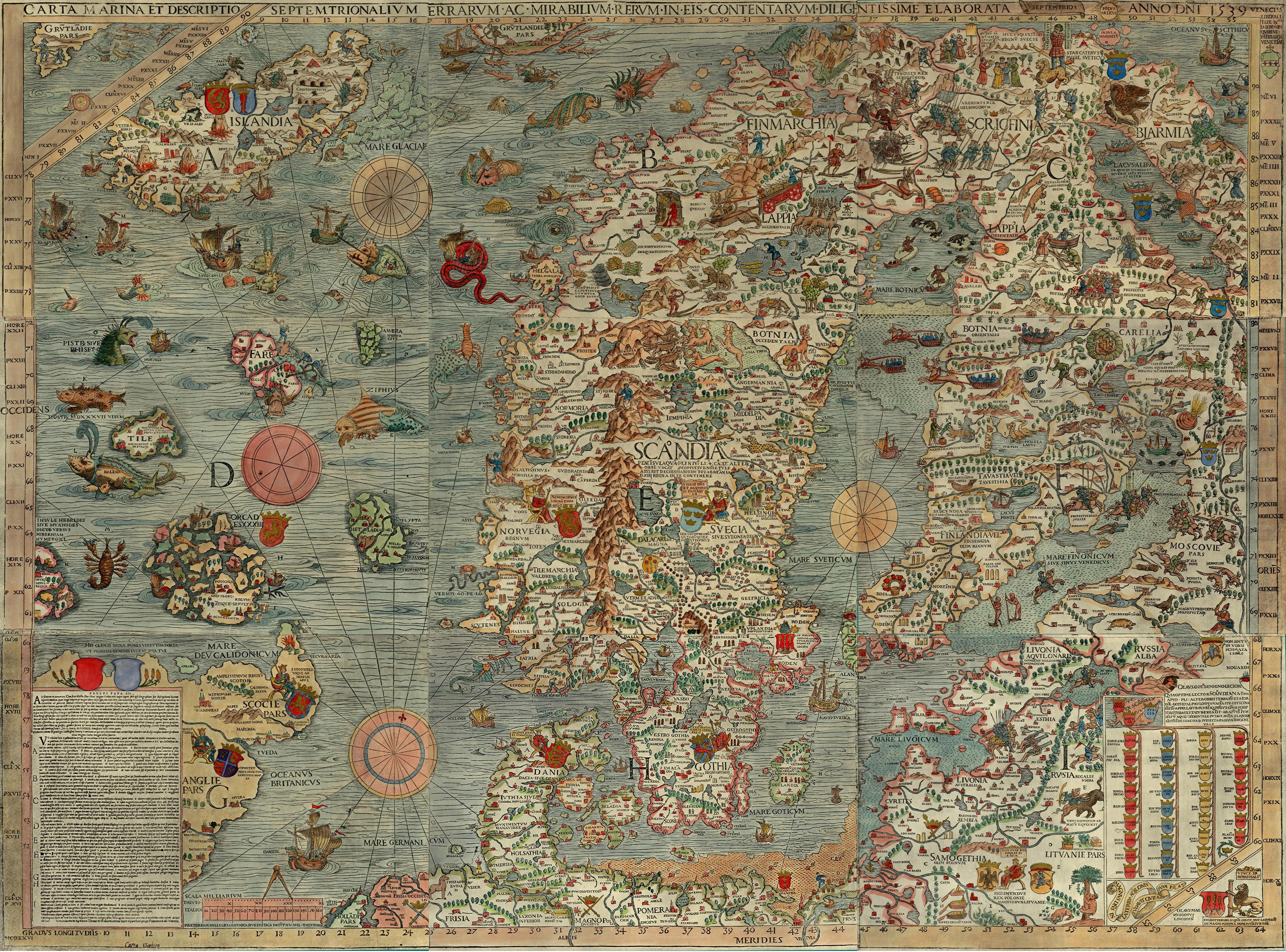
There is also an anachronism argument to be made, that accurate mapping and surveying techniques were not developed until the early modern period to assist the developing European states in clearly delineating their territory into legible administrative districts.  I think the realism concern is less important than the excuse to drop stylized, dubiously-accurate maps with crazy sea monsters on my players, with hopefully hilarious results.

On the flip side, running wilderness navigation is hard.  You do not have the structure of the dungeon, and your extensive experience in indoor spaces, to help you.  My earlier interest in mountain peaks and smoke visibility were part of an attempt to build usable language and conventions for wilderness exploration play (in the way that "You open the door, and see a 30x30 room with a door in the opposite wall, containing five gnolls" is clear and actionable. "You are in gently-rolling forested hills, on a narrow trail; from a treetop, you can see a mountain range to your west and multiple columns of smoke to the south.  The sun is low in the sky to the west, nearly touching the peaks" is a little less useful; it does not present an obvious menu, other than "make camp"), but I recognize now that without concealment, without prolonging wilderness travel and making it interactive, there can be no fun in exploration and such conventions and language are useless.

On further reflection, I guess what I'm really aiming to do is to turn the wilderness into the megamost dungeon.  The megadungeon structure is sort of dumb and deeply unrealistic, but it works.  A lot of the things that make good megadungeons work really well (multiple paths, varying danger levels, factions, restocking, path reuse, too-big-to-clear) actually make more sense or are simply unavoidable in the wilderness, but for the most part we've (well, I've at least) failed to put it all together properly.  I've failed to see the dungeon for the trees.

Wednesday, October 14, 2015

Domains at War: Another Test Battle, More Piledrivers!

We ran a test combat the other day of platoon-scale Domains at War Battles, with rough approximations of the PCs in my Midnight ACKS campaign leading a mixed force of elves, dwarves, and woodsmen against a column of orcs.  The PCs were handily victorious.

We did screw some stuff up, however!
  • No generals, just independent and interoperating commanders.  This is relevant, because generals apply half of their morale to the rolls of all units, and can force a morale check when killed.  Their leadership also limits the maximum number of divisions (independent commanders) available to each side. This mistake favored the orcs, who lost both of their commanders (which would've forced morale), and denied the PCs' units their general morale bonus.
    • James the Dwarf, having Morale +3 and Leadership 4, is probably the best choice for the PCs' general at this point.  I could see Skorn the Varangian being an excellent general in time, between her Charisma bonus, class features, and potential class proficiencies, but she is yet unlevelled. 
  • No lieutenants, but the PCs didn't really need them.  The orcs should maybe have had them at platoon scale.  Each platoon is roughly a warband of orcs (~35), which should have a subchieftain qualified to lead it.  This would've made the orcish command situation much less tenuous and enabled ready replacement of slain orcish commanders.
  • Applied commander morale bonus to all units in their division.  Again, this favored the orcs, who had more units per commander, whereas the PCs had three commanders and four units.
    • Although the only PC with a morale modifier was James; the Elder Bear inflicts a morale penalty on enemies but provides no bonus to his allies, and Scarth the wizard has excellent strategic ability / mass combat initiative but no bonus to morale (which made him a fine leader for the archers in the rear to disorder the enemy early in the turn).
  • When a commander is slain, his division's remaining units are not reassigned to other commanders until after the next morale phase.  We reassigned immediately.  Whoops.
  • We did not permit a fireball to be directed at an orc chieftain personally, even though he was within visibility range for a man-sized hero.  This one cuts both ways, of course.
  • The rules were unclear on whether or not retreating units can pass through threatened hexes; an orcish unit whose only path of retreat laid through one was ruled to be routed.  This, it turns out, is not correct.  So that one favored the PCs, and pretty handily, since that was a command unit.
  • Retreating, recoiling, and withdrawing units can be pursued, and irregular infantry like orcs must pursue.  This would've brought an orcish command squad back into melee with Scarth's longbowmen, and prevented him from firing on his next activation (granted, they're about as good in melee as at range, but that would've been a more concerning situation for the PCs).
  • Loose Foot cannot withdraw from units which have equal or greater marching speed, so actually the longbowmen couldn't've withdrawn from the orcs and should've taken the damage after all.
  • Initially we forgot that the longbowmen could withdraw, but we figured that one out and it was OK.
  • Our deployment was not doctrinaire, with the PCs coming at the orcish column from both sides and without a clear rearguard, vanguard, and main body.  On the other hand, it's platoon scale.  Meh.
  • Terrain was not handled rigorously.
We handled most of the 'core' combat mechanics of the game OK, though - movement was much more intuitive this time than last, hitting and damage are easy to start with, and shock and morale went way better than previously.  Last time we were running from a .doc draft of the Battles rules and it was cumbersome; this time I had the paper book in my hands, with bookmarks for the shock and morale modifier tables, and those went very quickly, which pleased me.  The heroes were all very effective in different ways; the Elder Bear shredded orcs with 4 attacks at 3+ while shape-strengthed, James' morale bonus kept the outnumbered dwarven infantry from breaking despite flanking attacks, and Scarth's fireballs did excellent damage on this scale, forcing shock rolls wherever they landed.  The fact that heroes engage heroes attached to their target unit instead of the unit itself did influence targeting decisions some (in that the Elder Bear really preferred to shred half a unit of orcs instead of trying to hit one chieftain once), but with generals working properly the incentive to kill enemy heroes should be stronger next time.

We also played an extra-large game of OGRE!  We had three players, so David and I each took a MkIII while Matt ran a double-strength defense.  It was a brutal game, with David stripped of all weapons but his AP guns and no movement about six hexes from the objective, while I lost all of my non-AP guns and was down to speed 1 at the end.  Matt almost stopped me one hex short of the objective, but the dice turned against him on the last turn of firing at my treads, and I succeeded in destroying the command post.  For our part, we destroyed most of his forces (of 24 armor units, he had 2 heavy tanks, a missile tank, and a howitzer out in the boonies remaining at end of game), but it was the closest game we've had yet.

Saturday, October 10, 2015

Quality Links

I've been pretty busy between crunch at work and prep for my Midnight ACKS game, but there have been a number of really good posts that came up on my radar this week.

First off, Koewn's analysis of ACKS' stealth mechanics is fantastic.  I was considering (am still considering, actually) an ACKS assassin that trades plate for something else, and this has reasonably convinced me that they don't need Naturally Stealthy (-1 to enemy surprise rolls) to be effective at sneaking at low levels.  Honestly, reading his analysis, I'm pretty convinced that ACKS' stealth system is fine and we've just been Doing It Wrong; I actually kind of like that a 1st level thief is ~18% more likely to surprise a target than a common man.  As Koewn points out, this is about on par with the incremental improvement in combat ability that fighters get, with a 1st-level fighter being better but not massively better than a common man. The question remains, though: what to give assassins?  I'm thinking Poison Use (some combination of bonus to saves against poison, bonus to proficiency throws to produce poisons, no chance to poison self when using poison), but I haven't set on anything yet.

Second, Trilemma has a pair of solid posts on knowlege and preparation and DM-player bandwidth.  The first is a good statement of the general philosophy behind his prior (excellent) posts on useful dungeon description and monstrous effects on terrain, as well as explaining the importance of intel in old-school gaming, the prevalence of monsters with crazy immunities, and (indirectly) why vancian casting was awesome.  In a way, it explains a lot of the mechanical oddities of the Old School that fell by the wayside as cultural, playstyle elements of the Old School (which made those mechanical elements sensible) faded due to dilution, and in identifying those cultural elements provides a path forwards/backwards, depending on how you look at it.

Trilemma's second post, on bandwidth, is particularly relevant to me at the moment, as I am engaged in world creation and trying to get data to my players.  It's also somewhat interesting because "the bandwidth problem" was something parts of my group have been talking about for years, but never thought to write down.  I have the good fortune of having a player this campaign who really likes lore (at one point he explicitly asked me for more lore, and I was taken aback; not a problem I've ever had before!), but my approach is still mostly a combination of a (written lore), c (no lore), and d (players propose reasonable lore).  Some but not many things are fixed (written lore), many things that aren't relevant to the game just don't exist (no lore), and if my players propose something that makes sense, it's on me to either find a good a reason it isn't true, or to adopt it.  I imagine this is probably true of most campaigns, that they follow hybrid approaches.  Still, interesting stuff to think about.

Finally, today from the Hill Cantons, two solid posts on building and running dynamic sandboxes [1, 2]!  Since I'm running a dynamic sandbox at the moment, these are extraordinarily relevant to my interests.  The first article discusses having a campaign news cycle and dynamic encounter tables, while the second focuses on his Chaos Index world engine and campaign-scale event charts.  The campaign news cycle is probably not reasonable for a setting like Midnight, where news is sparse and literacy is sparser, but dynamic encounter tables are something I've been playing with lately.  ckutalik proposes a "New Development" slot on one's random encounter tables, where something related to a world event or past PC actions shows up when rolled.  I've been thinking about having an encounter queue instead - when the PCs take an action which generates Consequences, those consequences go in a queue.  When you roll "queued encounter" on the table, you pick something sensible from the first couple of things in the queue and that's what they find.  This means that consequences can linger in the queue for quite a while, but will probably find the PCs eventually.  I've also considered having multiple queues on a per-area basis; failing to assassinate the duke might queue a squad of royal guards in his domains, and bounty hunters in each of several nearby domains.  Things like that.

From the second post, I could see setting up a Shadow Index, where certain actions increase the grip of the Shadow on the world and that alters things cosmologically (again, ideally I think I'd want per-area or -domain indices, so that some places can be deeply shrouded while others are 'points of light').  I've been running some loosely-defined world engines for various plots that are afoot; when the players decide to engage the ghouls hunting the farmers of Ostergot, the mushroommen of the Monastery Caverns grow and multiply, and when they fight the mushroommen, the ghouls spread.  Event charts are something I should consider; my plan currently is to use politics as the primary event-driving factor for the campaign, but the occasional natural disaster or similar would not be amiss.  My thought is to set up a network of high-power NPCs who have various relations with each other, and in any given unit of time some may undertake actions (declaration of war, assassination, charm / domination, slander, ...) against others, the consequences  of which trickle down to the PCs.  Event tables would be a simpler way to handle this, though, with "assassination attempt on X by Y", "raiding of X's domains by Y", and "warfare of X against Y" as table items with fillable variables as sensible.  Maybe I'll do that instead.

Anyway, good posts, well worth reading.

Wednesday, June 18, 2014

Reflections on Playing via Internet

This post brought to you by Microsoft!  Disimproving skype since 2011 (seriously, new version for linux dropped yesterday, and they removed support for ALSA.  WTF, guys.  It's the first release in over a year, and it's still 32-bit only.  Since I use Alsa, I guess I had better find another voice/video-over-internet solution...).

Which, of course, will only make already-lacklustre gaming-over-IP experiences less good.  So far, I think an accurate summary of our existing problems follows:
  • Voice-channel multiplexing failure.  We don't have transcontinental latency low enough for video to work, and as a result, we have a very hard time telling when someone is done speaking.  This results in substantial dead time on the wire after anyone says anything, as everyone else waits to see if they have anything else to say.  The opposite problem, of interruption / simultaneous starts, is also prevalent, which causes further backoff delays.
    • Potential solution: push-to-talk-like voice chat, with some manner of quiet indicator (either visual or a beep or background noise that cuts out) that someone is in or has exited talk mode.
  • Too many players.  Since we're on the internet already, let's invite everyone from everywhere, and their family and significant others!  I don't think this is necessarily a problem on the campaign-scale, depending on structure, but six-player sessions with already bad communications latency are just rough.  Consensus is basically impossible to establish, nevermind in a timely fashion.
    • Solution: picarqesue-style games, with small (<=4) player groups pulled from a potentially much larger pool of irregularly available players.  This has its own advancement and group cohesion problems, but that's true of any game in this style.
  • Distraction.  "Hold on guys, my pizza just got here," or worse yet, "brb I need to go cook for 20 minutes."  In a face-to-face game, there's one period of food-distraction for everyone, during which misc discussion occurs.  Here there're a bunch of them, unsynchronized, and they do not help the Too Many Players or Multiplexing problems.
  • Lack of out-of-game planning and discussion.  In college, the gamer crew was also a social circle which met and discussed outside of the game itself.  This is much less true post-diaspora, and also with isolated subgraphs like family members of one player.  Great games, I think, are driven by the external discussion, speculation, and musing surrounding them.  Ultimately, this may be a symptom of loss of cohesion as a social circle rather than anything gaming-specific.
    • Unfortunately, I don't think there's really a single digital center-of-interaction which is in regular use by all of the group, which is a major contributing factor.  I know Alex, my father, and I aren't really facebook users, for example, which is probably the closest thing.  While everyone is on obsidian portal, it's hindered by the forum structure (I like old-style forums, but I get the feeling others do not), crappy UI, and infrequency of checking.  It would probably be straightforward to get an IRC channel somewhere, which would also enable logging in a way that voice comms do not...
  • As mentioned in a previous post, scheduling has been fun, and unreliable attendance and tardiness are high.  This problem is only likely to get worse as sleep cycles diverge further; if I'm getting up at 0600 EST (if sun is up, cat is up.  If cat is up, I'm going to be awake whether I like it or not) and Drew is getting up at 1100 PST, opportunities for 4-6 hours of overlapping free time are going to be hard to come by.
  • DM burnout.  That's my excuse, at least, and my understanding from discussions with Alex drew a somewhat similar impression (setting burnout for him).  It's just been so long since I actually ran a decent game that it's rather discouraging.  Maybe you West Coasties and Yinzers have more fun things to do out there, but if one of y'all would be willing to assume the mantle, I for one would not be ungrateful.

Tuesday, November 19, 2013

ACKS: Critical Error. Also Thieves

So I got to thinking about Weapon Focus in ACKS last night, and how we perceived it as terrible.  I started doing some math, and semi-interesting results came out. 

The ACKSPC says that +1 to damage is worth about a proficiency, but Weapon Focus seems to generate much less than +1 damage per hit.  However, it turns out this is dependent on what you need to roll to hit - if you have a d6 weapon, Weapon Focus gives you >+1 damage per hit on average as long as you need an 18+ to hit.  d8 -> 17+ and d10 -> 16+.  These are, of course, the sort of to-hit numbers that PCs do their best to avoid having.  And yet, sometimes they occur...  and it's in just those sort of nasty situations that you want to put your target down as fast as possible, and extra damage is most helpful.

Thinking further on this, I begin to believe that our prior piledriver with respect to damage multipliers in ACKS is not as innocent as it initially appears.  We have been handling it as "if you have an x2 multiplier, you roll 2dn and take the total."  This generates a binomial distribution of results, with a 2 and a 12 each occurring one in 36 times, and a 7 occurring one in six times.  Basic probability stuff.  The rules as written instead say that we should be handling it as "1dn * 2".  This generates a uniform distribution, where a 2 and a 12 each occur with probability 1 in 6.

We, being human gamers, are risk averse and dislike the increased probability of rolling a 2 more than we like the increased probability of rolling a 12.  We like that when we get a multiplier, the odds of it being exactly double the average damage for one of our hits is high.  And yet...

I believe there are compelling reasons for using a uniform distribution instead of a multinomial one.  Foremost, it makes thieves and assassins a lot scarier to targets above their weight class!  In the most extreme case, you're a 13th level assassin doing a backstab polearm-charge with Weapon Focus and a natural 20 (we could stack Vorpal on there too, but that's silly - they don't make vorpal polearms!).  You're looking at an x7 multiplier on a d10.  In the multinomial case, the distribution of results is very strongly clustered around the mean of 38.5 (plus 5 damage bonus and some magic), with a standard deviation of 7.6.  Most of the time you'll do about 50 points of damage; as a result, you carry a reasonable threat of instant death to 11th-level or lower fighters.  Against an average 14th level fighter with 63 HP, your chance of an instant kill is a more-or-less negligible 0.5 percent or so, even in such a multiplier-stacked situation.  By comparison, on 1d10*7+5, your chance of an instant kill against such a 14th-level fighter is 20%.  Much scarier for that fighter.

Consider instead a 7th level assassin with x3 backstab, +3 damage bonus, and a d8 weapon in two hands.  Consider also a 10HD adult dragon with 45 HP.  With 1d8*3+3, you have a 1 in 4 chance of taking more than half of its HP in a single hit and forcing a morale roll in the opening round.  On 3d8+3, you will tend very strongly towards 16.5... which is not bad, but probably not decisive, and your odds of forcing a morale roll with 23 damage are but 6.8%.

Backstab is not supposed to be a nice reliable source of bonus damage dice in the style of 3.x sneak attack.  Backstab is supposed to be unreliable spike damage, built for hitting a high-power hard target and either generating a decisive advantage in the surprise round, or leading to an "oooh crap, that didn't work, time to start running" situation, in true thief or assassin style.

It is just in those 16+-to-hit situations against dragons and higher-level NPCs that the backstab and other damage multiplication mechanics give a chance of victory for a lucky underdog.  If you are their equal or better, and can likely win by simple application of fighters, why chance stealth and skullduggery, or leave things up to luck?  One should not.  No, these mechanics, and the classes which use them, are for those black hours when the enemy is stronger than you, the odds are already long, and you need every chance you can get.  If you fail your Move Silent roll, the morlocks will eat you...  but if you don't give it a shot, they'll eat you just as surely.  If you fail your Open Locks roll, you will starve to death in this cell, but to not attempt it has the same consequences.  If you roll a 1 on your backstab damage, the witches of the Bleak Academy will crush your puny domains beneath their beastman hordes...  but if you don't go for the backstab on the suicidal assassination mission deep behind enemy lines, there is no way you and yours will triumph.  And if lady luck smiles upon you enough times in a row, you may yet live to see another sunrise when all before seemed lost.  Thief skills are saving throws for the possible avoidance of otherwise certain doom.  Desperate times beget desperate men, and we shall call them thieves.

Saturday, November 9, 2013

ACKS Post-Mortem III: That We Might Improve

Matt mentioned "the problem areas we had before" in a chat with me, and I wasn't sure which ones specifically he was talking about.  In turn, and in preparation for Scales, it might be worth enumerating and analyzing alllll the things.  No names will be named, except where things were my fault (spoiler: it's all my fault on some level).

And if there's something I missed, players of last campaign, feel free to chime in.  But here are the things that I perceive made you unhappy.
  • Level inequality.  We had folks bringing 3rd-level characters into a game with 7th-level characters.  In principle, this should work because of exponential XP progression; lower level characters should catch up with higher levels ones within the time it takes the higher-level ones to gain a whole level, assuming equal XP shares for everyone.  In practice, this assumption was disrupted by lack of treasure and separate domains, and became a perpetual source of discontent.
    • Solutions: bring new players in with more XP, or allow existing players to burn reserve XP they probably won't need to boost starting player XP, or allow expenditures from the party treasury to generate reserve XP for a new player which is immediately spent.
  • Lack of treasure.  We were focused on clearing hexes, rather than exploring, finding the high-value lairs, and stealing the fat loots.  Caused by lack of understanding of how to play the mid-level game (and my consequent mishandling of treasure maps) and exacerbated by early domains.
    • Solutions: give many treasure maps, provide clear encouragement to players in the mid-levels to focus on stealing treasure from dragons rather than fighting giant catfish.  
  • Early domains.  We had a 5th-level character basically running a town at one point because they had demolished the existing power structure but none of the other players wanted a domain.  This was the beginning of separate domains, below.  Early domains also led to hex-clearing efforts by weak characters, who ran into a lot of trouble with things that a domain-level character would have dealt with easily.  
    • Solutions: Avoid early domains to force PCs to either trade or raid to reach domain levels, at which time they will have the requisite personal power to clear hexes with relative ease, avoiding boredom and frustration.  Threaten low-level PC rulers with 9th-level bandit leaders and other would-be usurpers on a regular basis.  Strong centralized rulers also good for keeping upstart PCs in their places until strong enough to challenge directly.
  • Separate domains.  Not directly causal of negative symptoms, but a contributing factor (and more of a contributing factor than early domains, I would argue).  Led to loss of cohesion, below.
    • Solutions: make the wilderness threatening enough to domains that PCs must unite or lose their holdings in the early domain levels.  Just like all other levels, really.  I was getting there with the Witches of Bleak, but took too long / damage already done.  Provide for division of domain income among the entire party, reducing incentives to personal domains at early levels (particularly to smooth differences in income between thieves' guilds and fighter domains; develop a cooperative domain ecology).  Standard of living costs may also be intended to restrict available individual cash to the point where unification is the only way to finance a new domain.
  • Loss of cohesion.  The lack of treasure forced people to pursue domain activities in order to gain XP and level.  Because we had separate domains, this led to conflict of interest, 'exploitation' of lower-level players to do dirty / bloody / boring / non-profitable hex-clearing work they weren't really equipped for, and subsequent disenfranchisement.  Seeds of conflict of interest were also present due to conflicting visions / reasons for playing, but probably resolvable if not aggravated by economics.  Multithreading to handle six unrelated schemes at once and stock many hexes contributed to DM overload, quality of game deteriorated, game over man.
    • Solutions:  Avoid separate domains, attempt to maintain common set of party goals.  Communicate!  Less good solutions (patches) include DM intervention in player planning and socialization ("You really ought to hold out for more money to go after those ankhegs..."), and unifying existential threats.
So.  How to avoid these this time?  Fixing lack of treasure and avoiding early domains are clear goals of the operative structure of this game.  Level inequality is a very real possibility with infrequent players, but if most expeditions are acquiring significant treasures, they should end up perpetually one level behind or so rather than four.  This is a mainly numerical problem, hence amenable to any number of mechanical / numerical solutions.  I'm most concerned about loss of cohesion with a playerbase this large; with this many people it would be very easy to let folks run hither and yon for a hundred reasons.  I suspect the best means of maintaining cohesion is player awareness that it is at risk; please communicate your goals with other players and be willing to help others toward their goals with the expectation that they will later help you towards yours (and then hold them to it, rather than clearing hexes for them indefinitely!).