I was revisiting Hill Cantons' AD&D and Apocalypse index and noticed a page I hadn't read before, comparing population density between Greyhawk and the Wilderlands of High Fantasy. One of the links in the post, to supplementary material for the Wilderlands published in Pegasus Magazine (which I hadn't heard of), seemed dead. So I went poking around on archive.org and am happy to report that mentioned pdfs are still available here. I skimmed them as I was pulling them down, but haven't read them in detail yet. Most of them seem to be site-based adventures around 40 pages in length. Some include pre-generated characters. Several cover islands. Some of the stats (particularly in the later entries) look to be for a percentile system rather than for D&D.

Showing posts with label Wilderlands. Show all posts
Showing posts with label Wilderlands. Show all posts
Sunday, August 1, 2021
From the Archive: Adventures from Pegasus Magazine

Saturday, January 21, 2017
Microsandboxing
Someone asked a question about sandboxing on /r/rpg recently, and now I have the wilderness on the brain again. I have some complaints about existing mapping doctrine. In the standard ACKS doctrine, civilization is basically required to be mapped (for the domain game if nothing else), which is an awful lot of work for very little payoff because you're not adventuring there. Really all you need is populations/market classes and travel times between points of interest in civilization, because the travel itself is minimally dangerous; random encounters are likely to be civilized folks, and there are roads and signs and farmers that you can ask for directions. There aren't really any strategic choices to be made in civilized travel that benefit from the degree of detail that hexes bring. Consequently, hexmapping civilization is a tremendous waste of time for the mid-levels, and frankly you could run a reasonable (simplified, population- rather than land-focused) domain game without it too.
In the West Marches approach, by contrast, civilization is left unmapped (which is great), but there is an onus to have functionally-infinite wilderness. This likewise is neither efficient nor realistic. It isn't efficient because anything that you build that the players never reach in the course of a campaign is probably wasted (sure, you can reuse it later maybe, but how many of us actually do that consistently?). It also isn't realistic because civilization expands to fill the area that can support it. The wilderness may be big, but there's always some civilization on the other side if you're willing to travel far enough (or lower your standards for civilization a little).
Ultimately I think the "non-state spaces" notion present in James C. Scott's writing (Seeing Like a State, The Art of Not Being Governed) presents a promising opportunity. Non-state space enclaves within a state are (relatively) tiny, self-contained wilderness sandboxes that are easily reached from civilization. I've talked about Mount Rainier before, and it's a good example - one could easily take a couple of hundred square miles around a large mountain, map it in detail, fill it with hill tribes and yetis and a dragon or two, and have a small, self-contained sandbox. There's civilization on both sides of the Cascade Range (well, if you count Eastern Washington... I kid), but there's still wilderness in the mountains. In the historical D&D context, Dearthwood from the City-State of the Invincible Overlord springs to mind. It's a forest practically up against the City-State's gates, and it's full of orcs. This is a classic non-state space, and would make a perfect tiny wilderness sandbox conveniently close to a large market. That was probably the whole point of Dearthwood, from the very beginning (with the trolls of the Mermist Marshes, a little further away, comprising a higher-level microsandbox). The Isle of Dread is another good example; it's big enough to play for a couple of sessions, like a good-sized dungeon, but it's bounded and therefore manageable.
Obviously the non-state enclave isn't the only type of wilderness. Borderlands between civilized areas can be bigger, and then there are places like the Russian steppe and the American Old West that are just huge. But these are unmanageably big, both to DMs who would use them and to players who would traverse them. If I have learned two things from running the Megadungeon Full of Rats, it is that tightly theming can stimulate DM creativity but bore players, and that tightly-scoping is really important. My initial intent with the Dungeon Dimensions was not a full-page dungeon of rats; it was many small dungeons, each tightly-themed and linked. In retrospect, that might have gone better, but I got carried away with the first level. I think loosely-themed, tightly-scoped, small-scale wildernesses offer a lot of opportunity in this regard. Having two or three such microsandboxes available offers choices and ability to alleviate boredom with a particular theme by handwaved safe travel through civilization.
So what are some decent ideas for wilderness microsandboxes? Big enough to take some time to explore, small enough to be manageable to DM and to be easily reached from civilization, and evocative?
Of course, there is the distinct possibility that this is what the actual practice of sandbox wilderness play has been all along, everyone knows it but doesn't talk about it much (because talking about the West Marches is much sexier), and I'm a little slow on the uptake where grand ambitions and practical limits are concerned. Much as I learned in a recent Autarch thread on having players draw their own maps (or not, as it turns out...). In which case, this is a perfectly useful post for the "OSR Lessons Learned" file [1][2][3]. In the same way that the typical, practical OSR dungeon is not Dwimmermount or Stonehell, the typical, practical OSR wilderness is not the Wilderlands of High Fantasy.
In the West Marches approach, by contrast, civilization is left unmapped (which is great), but there is an onus to have functionally-infinite wilderness. This likewise is neither efficient nor realistic. It isn't efficient because anything that you build that the players never reach in the course of a campaign is probably wasted (sure, you can reuse it later maybe, but how many of us actually do that consistently?). It also isn't realistic because civilization expands to fill the area that can support it. The wilderness may be big, but there's always some civilization on the other side if you're willing to travel far enough (or lower your standards for civilization a little).
Ultimately I think the "non-state spaces" notion present in James C. Scott's writing (Seeing Like a State, The Art of Not Being Governed) presents a promising opportunity. Non-state space enclaves within a state are (relatively) tiny, self-contained wilderness sandboxes that are easily reached from civilization. I've talked about Mount Rainier before, and it's a good example - one could easily take a couple of hundred square miles around a large mountain, map it in detail, fill it with hill tribes and yetis and a dragon or two, and have a small, self-contained sandbox. There's civilization on both sides of the Cascade Range (well, if you count Eastern Washington... I kid), but there's still wilderness in the mountains. In the historical D&D context, Dearthwood from the City-State of the Invincible Overlord springs to mind. It's a forest practically up against the City-State's gates, and it's full of orcs. This is a classic non-state space, and would make a perfect tiny wilderness sandbox conveniently close to a large market. That was probably the whole point of Dearthwood, from the very beginning (with the trolls of the Mermist Marshes, a little further away, comprising a higher-level microsandbox). The Isle of Dread is another good example; it's big enough to play for a couple of sessions, like a good-sized dungeon, but it's bounded and therefore manageable.
Obviously the non-state enclave isn't the only type of wilderness. Borderlands between civilized areas can be bigger, and then there are places like the Russian steppe and the American Old West that are just huge. But these are unmanageably big, both to DMs who would use them and to players who would traverse them. If I have learned two things from running the Megadungeon Full of Rats, it is that tightly theming can stimulate DM creativity but bore players, and that tightly-scoping is really important. My initial intent with the Dungeon Dimensions was not a full-page dungeon of rats; it was many small dungeons, each tightly-themed and linked. In retrospect, that might have gone better, but I got carried away with the first level. I think loosely-themed, tightly-scoped, small-scale wildernesses offer a lot of opportunity in this regard. Having two or three such microsandboxes available offers choices and ability to alleviate boredom with a particular theme by handwaved safe travel through civilization.
So what are some decent ideas for wilderness microsandboxes? Big enough to take some time to explore, small enough to be manageable to DM and to be easily reached from civilization, and evocative?
- The Lonely Mountain
- Mirkwood
- Swamp of the frogmen
- Tropical island chain with walled port-city and cannibal natives in the uplands
- Wasteland
- Result of magical experimentation, Chernobyl-style
- Result of necromancer / ghoul infestation
- Fungal forest, as in the Grim Fist
Of course, there is the distinct possibility that this is what the actual practice of sandbox wilderness play has been all along, everyone knows it but doesn't talk about it much (because talking about the West Marches is much sexier), and I'm a little slow on the uptake where grand ambitions and practical limits are concerned. Much as I learned in a recent Autarch thread on having players draw their own maps (or not, as it turns out...). In which case, this is a perfectly useful post for the "OSR Lessons Learned" file [1][2][3]. In the same way that the typical, practical OSR dungeon is not Dwimmermount or Stonehell, the typical, practical OSR wilderness is not the Wilderlands of High Fantasy.
Friday, September 16, 2016
Seeing Like a State (Scooped!)
So I've been reading Seeing Like a State on and off for... dear god, four months now. There are some very interesting ideas here, particularly relevant to ACKS. As is my practice, I tend to wait to write a D&D-focused review of nonfiction books until I've finished them, but Noisms has scooped me! To be fair, I discovered Seeing Like a State because he had a post that mentioned another book by the same author (The Art of Not Being Governed; none of my local libraries carry it, unsurprisingly), so I can't be too mad.
He did grab one of the best quotes, though (reposted for discussion):
Noisms then uses this to extrapolate a wilderness as dungeon model (of which I am a known fan), with height up from the river valleys corresponding roughly to increasing dungeon level, and with PCs as agents of the river-valley states who go into the wilderness to extract tribute.
I think this model does a particularly good job of making sense of the Wilderlands of High Fantasy. Something that always bothered me about the Wilderlands was Dearthwood. By itself, a forest full of orcs is unremarkable. But when it's within spitting distance of a powerful city-state, it becomes somewhat more straining of disbelief. If you interpret the City-State as a river-valley and estuary power, though, the elevated forests full of non-cooperative, semi-nomadic humanoids fit nicely into the "non-state space" mold proposed by Leach. In the absence of precise cartographic surveying or friendly local guides who know the terrain, the forces of the City-State are largely unable to bring the orcs to battle in the forest itself. A similar dynamic applies to the Troll Fens, another piece of uncivilized land right on the City-State's doorstep (I recall Seeing Like a State mentioning the Marsh Arabs as occupants of a similar non-state space).
Moving to the "PCs as agents of the state in the wilderness" point, a model I've kicked around over the years for this is tax-farming. Throughout history, states have found it annoying to collect taxes and tribute from uncooperative people. Some historical polities (I recall reading of the Mongols doing this) hired independent contractors (private individuals) to go collect tribute in distant provinces and bring it back. This is a wonderful way to play low-domain / high-wilderness levels. You bid against other tax-farmers ("I will collect 20000 gp for the crown this year from the province of Baluchistan!" "Pfah, pathetic! If appointed tax agent to Baluchistan, I would collect 25000 gp for the crown this year!"), take your private army to Baluchistan, and then shake down the locals for everything you can get. Cue feuds with local bandits and tribesmen, previous tax farmers who set themselves up as warlords Heart of Darkness-style, wilderness monsters, peasant rebellions... After a year of this, you bring the crown's share of the tribute (the amount you bid) back, and keep whatever's left as your rightful payment. And if you didn't make your tribute goal... well, maybe don't come home. This also works very well with the City-State, which is nominally a powerful state with many tributaries. In practice though these tributaries are distant, the infrastructure and bureaucracy is insufficient for easy and safe extraction and transport of goods, and waging a military campaign to go take tribute by force is expensive, risky, and messy. Much better to let private adventurers assume the risks and reap some of the profits. It also, like the dungeon, has a nice boundedness property - you're only allowed to collect taxes in the province of Baluchistan, and if you go raid across the border into Afghanistan (to make your quota, say), the tax official for Afghanistan's going to be right pissed if he hears of it. Also, as in the dungeon, the players are very much outsiders, with poor maps and noncooperative locals.
Another passage from Seeing Like a State suggests a related approach:
Anyway, there's a lot of good stuff in Seeing Like a State (I'm particularly interested in his concept of legibility, the limits of a sovereign's ability to measure and understand the people and places that he rules) as it applies to ACKS, and I'm excited to see other parts of the OSR picking up "wilderness as dungeon" as an operative metaphor.
He did grab one of the best quotes, though (reposted for discussion):
[Edmund Leach] suggested that we look at the precolonial Burmese state not as a physically contiguous territory, as we would in the contest of modern states, but as a complex patchwork that followed an entirely different logic. We should picture the kingdom, he insisted, in terms of horizontal slices through the topography. Following this logic, Burma was, in practice, a collection of all the sedentary, wet-rice producers settled in valleys within the ambit of the court center. These would be...the state spaces. The next horizontal stratum of the landscape from, say, five hundred feet to fifteen hundred feet would, given its different ecology, contain inhabitants who practice shifting cultivation, were more widely scattered and were therefore less promising subjects of appropriation. They were not an integral part of the kingdom, although they might regularly send tribute to the central court. Still higher elevations would constitute yet other ecological, political and cultural zones. What Leach proposed, in effect, is that we consider all relatively dense, wet-rice settlements within range of the capital as "the kingdom" and the rest, even if relatively close to the capital, as "nonstate spaces".
The role of statecraft in this context becomes that of maximising the productive, settled population in such state spaces while at the same time drawing tribute from, or at least neutralizing, the nonstate spaces. These stateless zones have always played a potentially subversive role, both symbolically and practically. From the vantage point of the court, such spaces and their inhabitants were the exemplars of rudeness, disorder and barbarity against which the civility, order and sophistication of the centre could be gauged. Such spaces, it goes without saying, have served as refuges for fleeing peasants, rebels, bandits, and the pretenders who have often threatened kingdoms.
Noisms then uses this to extrapolate a wilderness as dungeon model (of which I am a known fan), with height up from the river valleys corresponding roughly to increasing dungeon level, and with PCs as agents of the river-valley states who go into the wilderness to extract tribute.
I think this model does a particularly good job of making sense of the Wilderlands of High Fantasy. Something that always bothered me about the Wilderlands was Dearthwood. By itself, a forest full of orcs is unremarkable. But when it's within spitting distance of a powerful city-state, it becomes somewhat more straining of disbelief. If you interpret the City-State as a river-valley and estuary power, though, the elevated forests full of non-cooperative, semi-nomadic humanoids fit nicely into the "non-state space" mold proposed by Leach. In the absence of precise cartographic surveying or friendly local guides who know the terrain, the forces of the City-State are largely unable to bring the orcs to battle in the forest itself. A similar dynamic applies to the Troll Fens, another piece of uncivilized land right on the City-State's doorstep (I recall Seeing Like a State mentioning the Marsh Arabs as occupants of a similar non-state space).
Moving to the "PCs as agents of the state in the wilderness" point, a model I've kicked around over the years for this is tax-farming. Throughout history, states have found it annoying to collect taxes and tribute from uncooperative people. Some historical polities (I recall reading of the Mongols doing this) hired independent contractors (private individuals) to go collect tribute in distant provinces and bring it back. This is a wonderful way to play low-domain / high-wilderness levels. You bid against other tax-farmers ("I will collect 20000 gp for the crown this year from the province of Baluchistan!" "Pfah, pathetic! If appointed tax agent to Baluchistan, I would collect 25000 gp for the crown this year!"), take your private army to Baluchistan, and then shake down the locals for everything you can get. Cue feuds with local bandits and tribesmen, previous tax farmers who set themselves up as warlords Heart of Darkness-style, wilderness monsters, peasant rebellions... After a year of this, you bring the crown's share of the tribute (the amount you bid) back, and keep whatever's left as your rightful payment. And if you didn't make your tribute goal... well, maybe don't come home. This also works very well with the City-State, which is nominally a powerful state with many tributaries. In practice though these tributaries are distant, the infrastructure and bureaucracy is insufficient for easy and safe extraction and transport of goods, and waging a military campaign to go take tribute by force is expensive, risky, and messy. Much better to let private adventurers assume the risks and reap some of the profits. It also, like the dungeon, has a nice boundedness property - you're only allowed to collect taxes in the province of Baluchistan, and if you go raid across the border into Afghanistan (to make your quota, say), the tax official for Afghanistan's going to be right pissed if he hears of it. Also, as in the dungeon, the players are very much outsiders, with poor maps and noncooperative locals.
Another passage from Seeing Like a State suggests a related approach:
The demography of precolonial Southeast Asia was such that control of land per se, unless it was a strategically vital estuary, strait, or pass, was seldom decisive in state building. Control of the population — roughly five persons per square kilometer in 1700 — mattered far more. The key to successful statecraft was typically the ability to attract and hold a substantial, productive population within a reasonable radius of the court. Given the relative sparseness of the population and the ease of physical flight, the control of arable land was pointless unless there was a population to work it. The precolonial kingdom thus trod a narrow path between a level of taxes and corvee exactions that would sustain a monarch’s ambitions and a level that would precipitate wholesale flight. Precolonial wars were more often about rounding up captives and settling them near the central court than asserting a territorial claim. A growing, productive population settled in the ambit of a monarch’s capital was a more reliable indicator of a kingdom ’s power than its physical extent.This reminds me somewhat of this post, where PCs build domains out of whatever sort of creatures they can find and coerce in the wilderness. Taking peasant, serf, and slave as a muddied equivalence class, it would not be difficult to conceive of PCs as "labor collection agents" for a state, going into the wilderness to acquire peasants (some of whom might be green and have tusks) and bringing them back by force to settle near the capital, where they can be monitored and taxed (help help I'm being repressed!). Whether any given set of players would veto such a campaign on moral grounds is another question.
The precolonial state was thus vitally interested in the sedentarization of its population — in the creation of permanent, fixed settlements. The greater the concentration of people, providing that they produced an economic surplus, the greater the ease of appropriating grain, labor, and military service.
Anyway, there's a lot of good stuff in Seeing Like a State (I'm particularly interested in his concept of legibility, the limits of a sovereign's ability to measure and understand the people and places that he rules) as it applies to ACKS, and I'm excited to see other parts of the OSR picking up "wilderness as dungeon" as an operative metaphor.
Sunday, June 5, 2016
Never Show Them the Map
I was thinking about why wilderness play is sort of boring, and one of the conclusions I have reached is that showing your players your ground-truth hexmap of unexplored wilderness areas is an incredibly bad idea. I'm not talking about the secret DM layer where you keep your monster lairs - I'm talking about just terrain. Maybe everyone else already knows this, but I'm going to talk about it anyway.
One of the exciting things about dungeoneering is opening a door into the unknown. The potential for death and treasure is clear, and maybe there will be some curious or exploitable feature. Maybe on the other side is a portal to hell, a shaft descending in darkness to the 6th level of the dungeon, or the hall of the mountain king. The gradual construction of a player map, which can be exploited to circumvent lairs and reach desired destinations with minimal risk, is a satisfying activity. In OSR systems where there is not much system-mastery to be had, world-mastery can fill the same role, rewarding players for their attention to detail and their skill. Additionally, when players keep their own map, they necessarily end up a little uncertain about it, and this adds to tension.
Given that this works well in the dungeon, why don't we do it in the wilderness? Notably, a number of very successful wilderness adventures and settings actually have given players a blank map and said "have fun filling this in". The original Wilderlands of High Fantasy did this way back in the 80s. The player map was a central feature of the widely-imitated Western Marches campaign, and Pathfinder's popular Kingmaker adventure path did the same. In these cases, the hexcrawl is actually a crawl, with decisions along the way forced by lack of information. By contrast, in my attempts at wilderness campaigning with a high-detail ground-truth hexmap, typically the party looks at the map, calculates an optimal route, deals with any random encounters along the way, and arrives at their destination. Rations are laid in with perfect accuracy, so logistics are almost never an issue; hunting and foraging never occur, and resting only results from forced march. The travel becomes interactive, nonlinear, only when the party fails a navigation roll (an exceedingly unlikely occurrence when you have two characters with Navigation, although re-reading the rules it looks like multiple characters with Navigation don't stack, but Navigation and Explorer do stack so it works out about the same), and the satisfaction of exploration, the joy of discovery, never occurs.
Alexis very accurately expresses this major source of discontent with my last campaign in his book:
On the flip side, running wilderness navigation is hard. You do not have the structure of the dungeon, and your extensive experience in indoor spaces, to help you. My earlier interest in mountain peaks and smoke visibility were part of an attempt to build usable language and conventions for wilderness exploration play (in the way that "You open the door, and see a 30x30 room with a door in the opposite wall, containing five gnolls" is clear and actionable. "You are in gently-rolling forested hills, on a narrow trail; from a treetop, you can see a mountain range to your west and multiple columns of smoke to the south. The sun is low in the sky to the west, nearly touching the peaks" is a little less useful; it does not present an obvious menu, other than "make camp"), but I recognize now that without concealment, without prolonging wilderness travel and making it interactive, there can be no fun in exploration and such conventions and language are useless.
On further reflection, I guess what I'm really aiming to do is to turn the wilderness into the megamost dungeon. The megadungeon structure is sort of dumb and deeply unrealistic, but it works. A lot of the things that make good megadungeons work really well (multiple paths, varying danger levels, factions, restocking, path reuse, too-big-to-clear) actually make more sense or are simply unavoidable in the wilderness, but for the most part we've (well, I've at least) failed to put it all together properly. I've failed to see the dungeon for the trees.
One of the exciting things about dungeoneering is opening a door into the unknown. The potential for death and treasure is clear, and maybe there will be some curious or exploitable feature. Maybe on the other side is a portal to hell, a shaft descending in darkness to the 6th level of the dungeon, or the hall of the mountain king. The gradual construction of a player map, which can be exploited to circumvent lairs and reach desired destinations with minimal risk, is a satisfying activity. In OSR systems where there is not much system-mastery to be had, world-mastery can fill the same role, rewarding players for their attention to detail and their skill. Additionally, when players keep their own map, they necessarily end up a little uncertain about it, and this adds to tension.
Given that this works well in the dungeon, why don't we do it in the wilderness? Notably, a number of very successful wilderness adventures and settings actually have given players a blank map and said "have fun filling this in". The original Wilderlands of High Fantasy did this way back in the 80s. The player map was a central feature of the widely-imitated Western Marches campaign, and Pathfinder's popular Kingmaker adventure path did the same. In these cases, the hexcrawl is actually a crawl, with decisions along the way forced by lack of information. By contrast, in my attempts at wilderness campaigning with a high-detail ground-truth hexmap, typically the party looks at the map, calculates an optimal route, deals with any random encounters along the way, and arrives at their destination. Rations are laid in with perfect accuracy, so logistics are almost never an issue; hunting and foraging never occur, and resting only results from forced march. The travel becomes interactive, nonlinear, only when the party fails a navigation roll (an exceedingly unlikely occurrence when you have two characters with Navigation, although re-reading the rules it looks like multiple characters with Navigation don't stack, but Navigation and Explorer do stack so it works out about the same), and the satisfaction of exploration, the joy of discovery, never occurs.
Alexis very accurately expresses this major source of discontent with my last campaign in his book:
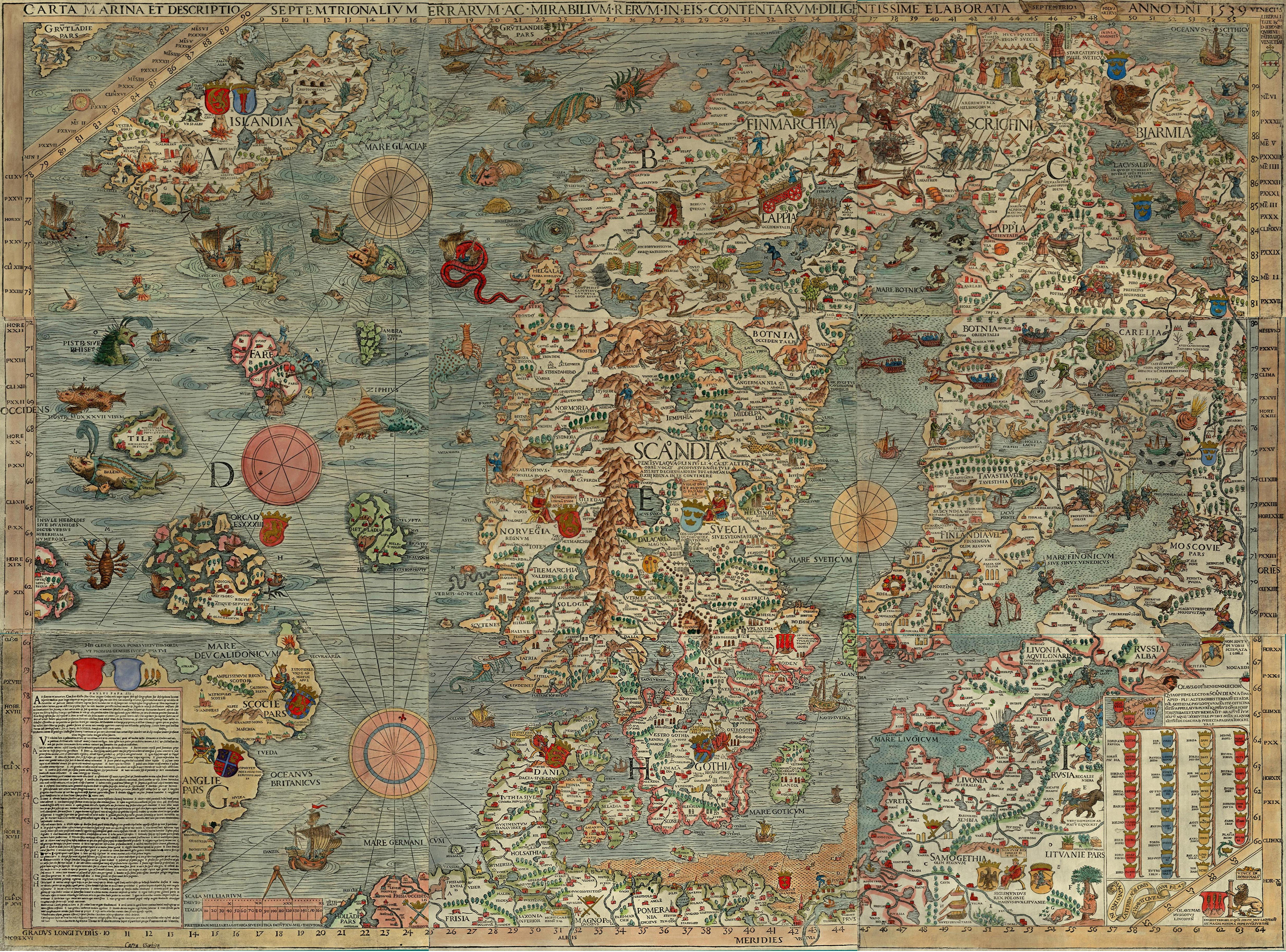
A mistake I made many times as a young DM was in recognizing, unfortunately, a common pattern. If I made the party aware of a place that contained something valuable, they would, most times, unquestioningly march out and get it. My campaigns rushed from target to target, and as I assigned each target, the next sessions would become lamentably predictable. I began to feel trapped in my own campaigns. After a time this became quite dull... Parties are more interested in and involved with targets they cannot see... If the party is told where to go, they will go there. But if the party is told only that the destination is 'nearby', they will go everywhere.There is also an anachronism argument to be made, that accurate mapping and surveying techniques were not developed until the early modern period to assist the developing European states in clearly delineating their territory into legible administrative districts. I think the realism concern is less important than the excuse to drop stylized, dubiously-accurate maps with crazy sea monsters on my players, with hopefully hilarious results.
On the flip side, running wilderness navigation is hard. You do not have the structure of the dungeon, and your extensive experience in indoor spaces, to help you. My earlier interest in mountain peaks and smoke visibility were part of an attempt to build usable language and conventions for wilderness exploration play (in the way that "You open the door, and see a 30x30 room with a door in the opposite wall, containing five gnolls" is clear and actionable. "You are in gently-rolling forested hills, on a narrow trail; from a treetop, you can see a mountain range to your west and multiple columns of smoke to the south. The sun is low in the sky to the west, nearly touching the peaks" is a little less useful; it does not present an obvious menu, other than "make camp"), but I recognize now that without concealment, without prolonging wilderness travel and making it interactive, there can be no fun in exploration and such conventions and language are useless.
On further reflection, I guess what I'm really aiming to do is to turn the wilderness into the megamost dungeon. The megadungeon structure is sort of dumb and deeply unrealistic, but it works. A lot of the things that make good megadungeons work really well (multiple paths, varying danger levels, factions, restocking, path reuse, too-big-to-clear) actually make more sense or are simply unavoidable in the wilderness, but for the most part we've (well, I've at least) failed to put it all together properly. I've failed to see the dungeon for the trees.
Thursday, August 28, 2014
Mythic Wilderlands
I'm a bit excited about ckutalik's Slumbering Ursine Dunes. I've been reading Chris' Hill Cantons material for some time, and he's had a number of very inspiring; his news posts are always entertaining, I've linked his pointcrawling posts before, and I discovered world-engines through him (one of the things which I believe would make living worlds more viable to run). But most recently he's put 'mythic wilderness' on my brain.
I think mythic wilderness is probably a very useful concept for a number of reasons. First, the required degree of simulation fidelity is reduced for the judge (moi), because Out There is fuzzier than In Here, by the nature of Out There. It has rules, but they're not quite the same rules as the woods out back in real life. This works for my playerbase, too - we're not Boy Scouts, survivalists, and ecologists. We're computer programmers, and we know about as much about real wilderness as your average ecologist knows about perl (if that), except maybe for our one guy who does orienteering. We are, however, substantially more familiar with European mythology, so that's might provide a common set of expectations around the table.
Finally, the mythic wilderness offers me a nice chance to move away from 'black chaos' to 'green chaos.' One of my players once told me "Every game you run is actually Warhammer. Traveller, ACKS, 3.5, whatever - you can run Warhammer in any system." And it's fairly true; I've been stuck in a thematic rut. It's all about the ineffable demon gods and their cultists, piles of skulls, devouring horrors from beyond space and time, good guys who are bad, and bad guys who are worse.
So perhaps it is time for a change, from "man against the darker parts of his own nature" to "man against nature", as a theme.
But while the Ursine Dunes are tempting, they're also some months out, probably. As a result, I am considering rolling my own. I think the Wilderlands of High Fantasy would suit - there's a lot of the titular Wilderlands near the City-State which, for all its storied grandeur, stands as one of a handful of bastions of civilization in the region. To the south lies jungled Altanis, and to the west the Tharbrian steppe. Plenty of space for the fey to cavort and the wolf-men to howl.
I think mythic wilderness is probably a very useful concept for a number of reasons. First, the required degree of simulation fidelity is reduced for the judge (moi), because Out There is fuzzier than In Here, by the nature of Out There. It has rules, but they're not quite the same rules as the woods out back in real life. This works for my playerbase, too - we're not Boy Scouts, survivalists, and ecologists. We're computer programmers, and we know about as much about real wilderness as your average ecologist knows about perl (if that), except maybe for our one guy who does orienteering. We are, however, substantially more familiar with European mythology, so that's might provide a common set of expectations around the table.
Finally, the mythic wilderness offers me a nice chance to move away from 'black chaos' to 'green chaos.' One of my players once told me "Every game you run is actually Warhammer. Traveller, ACKS, 3.5, whatever - you can run Warhammer in any system." And it's fairly true; I've been stuck in a thematic rut. It's all about the ineffable demon gods and their cultists, piles of skulls, devouring horrors from beyond space and time, good guys who are bad, and bad guys who are worse.
So perhaps it is time for a change, from "man against the darker parts of his own nature" to "man against nature", as a theme.
But while the Ursine Dunes are tempting, they're also some months out, probably. As a result, I am considering rolling my own. I think the Wilderlands of High Fantasy would suit - there's a lot of the titular Wilderlands near the City-State which, for all its storied grandeur, stands as one of a handful of bastions of civilization in the region. To the south lies jungled Altanis, and to the west the Tharbrian steppe. Plenty of space for the fey to cavort and the wolf-men to howl.
Sunday, October 6, 2013
RennFest, Colonial Battlefleet, and Setting Work
Just what it says on the tin:
Had a good time at the Maryland Renaissance Fair(e) this weekend. Rediscovered mead; much like honeyed whiskey, but with strong overtones of water. The jousting at German renn faires was better, but this one had elephants and pythons and a cursing well which I am stealing for my upcoming campaign, so hey.
Also picked up a copy of Colonial Battlefleet from the wargame vault today. Interesting system. Their initiative mechanic and the roles mechanism are both interesting changes from Starmada, and the fact that they provide a Big List of Weapons should prevent some of the guncheese we had in Starmada: Admiralty. I don't like how they laid out said table (by weapon tonnage, rather than alphabetically by weapon name or weapon 'family'), but that is at least a useful ordering during ship contruction. Their shields are also very different from S:AE shields (would be interested in seeing some non-forward-focused shields, but I'm happy enough as-is without the extra complexity). I like the way they handled tech levels, mostly, except for Laser Weaponry, which I think they screwed up with regards to Screen role availability. One thing that does torque me off a little is some of the really implausible faux science used to justify mechanics that are in place for game balance reasons - things like "When you teleport something, all inorganic chemical reactions in it cease. As a result, you can only teleport marines, not bombs." That grinds my gears a bit; you could've just said "You can't teleport bombs because the yield isn't sufficient for a man-sized bomb to damage a starship" (since scale is intentionally vague), or built a bomb-teleporter weapon, or left the players to not think of it like we didn't in six months of Starmada games with teleporter-marines, but no. Instead you had to make something ridiculous up and call attention to it, which might produce a counter like "OK, that's cool, we're the Tyranids and we're going to build living bomb-marines with organic detonators. Wheee-BOOM." That said, upon running a test game against myself with some converted Homeworld ships, it was quick, bloody, reasonable simple, and overall satisfactory. So if any of the old Starmada Crew is reading this, I'm down for some games over internet (it's hex-based, so should work fine with VTTs). Fair warning, though - I have been growing out my beard since the weather cooled off... (for those unfamiliar, we observed that gamers with beards were significantly more likely to win at Starmada than were clean-shaven gamers. The prevailing hypothesis is that this was due to the increase in planning efficiency acquired by stroking one's beard)
Oh yeah. The editing is not fantastic, and some areas are lacking examples, but the intent of the rules is generally clear, so it's just sort of annoying rather than obstructionary.
Finally, ACKS setting. Contemplated Wilderlands of High Fantasy, Northern Reaches (Western Marches into mythic Scandinavia), and Midnight in the Late 3rd Age. Am currently settled on "The Scaled Continent". The pitch:
In elder days, the children of squamous gods ruled the world, and man, elf, and dwarf suffered beneath their forked and envenomed lash. But now their empire has fallen to ruin under rebellion and internal strife, and the men of Aura seek the reclaim the treasures that were once stolen from them and taken across the Sea of Tears, to line the jungled halls of the serpent-kings. From the Isle of Voltager, their settlers and adventurers struggle against the environment, the natives, and sometimes each other for the riches of... the Scaled Continent.
Thematic elements:
Had a good time at the Maryland Renaissance Fair(e) this weekend. Rediscovered mead; much like honeyed whiskey, but with strong overtones of water. The jousting at German renn faires was better, but this one had elephants and pythons and a cursing well which I am stealing for my upcoming campaign, so hey.

Also picked up a copy of Colonial Battlefleet from the wargame vault today. Interesting system. Their initiative mechanic and the roles mechanism are both interesting changes from Starmada, and the fact that they provide a Big List of Weapons should prevent some of the guncheese we had in Starmada: Admiralty. I don't like how they laid out said table (by weapon tonnage, rather than alphabetically by weapon name or weapon 'family'), but that is at least a useful ordering during ship contruction. Their shields are also very different from S:AE shields (would be interested in seeing some non-forward-focused shields, but I'm happy enough as-is without the extra complexity). I like the way they handled tech levels, mostly, except for Laser Weaponry, which I think they screwed up with regards to Screen role availability. One thing that does torque me off a little is some of the really implausible faux science used to justify mechanics that are in place for game balance reasons - things like "When you teleport something, all inorganic chemical reactions in it cease. As a result, you can only teleport marines, not bombs." That grinds my gears a bit; you could've just said "You can't teleport bombs because the yield isn't sufficient for a man-sized bomb to damage a starship" (since scale is intentionally vague), or built a bomb-teleporter weapon, or left the players to not think of it like we didn't in six months of Starmada games with teleporter-marines, but no. Instead you had to make something ridiculous up and call attention to it, which might produce a counter like "OK, that's cool, we're the Tyranids and we're going to build living bomb-marines with organic detonators. Wheee-BOOM." That said, upon running a test game against myself with some converted Homeworld ships, it was quick, bloody, reasonable simple, and overall satisfactory. So if any of the old Starmada Crew is reading this, I'm down for some games over internet (it's hex-based, so should work fine with VTTs). Fair warning, though - I have been growing out my beard since the weather cooled off... (for those unfamiliar, we observed that gamers with beards were significantly more likely to win at Starmada than were clean-shaven gamers. The prevailing hypothesis is that this was due to the increase in planning efficiency acquired by stroking one's beard)
Oh yeah. The editing is not fantastic, and some areas are lacking examples, but the intent of the rules is generally clear, so it's just sort of annoying rather than obstructionary.
Finally, ACKS setting. Contemplated Wilderlands of High Fantasy, Northern Reaches (Western Marches into mythic Scandinavia), and Midnight in the Late 3rd Age. Am currently settled on "The Scaled Continent". The pitch:
In elder days, the children of squamous gods ruled the world, and man, elf, and dwarf suffered beneath their forked and envenomed lash. But now their empire has fallen to ruin under rebellion and internal strife, and the men of Aura seek the reclaim the treasures that were once stolen from them and taken across the Sea of Tears, to line the jungled halls of the serpent-kings. From the Isle of Voltager, their settlers and adventurers struggle against the environment, the natives, and sometimes each other for the riches of... the Scaled Continent.
Thematic elements:
- Settings:
- heavily-trapped temples to bloodthirsty gods
- overgrown and ruined cities of the Old Masters
- human frontier settlements (incl. abandoned and overtaken)
- the Serpent's Tongue (major river)
- sailing ships anchored off the coast
- volcanoes
- Opposition:
- Lizardmen, frogmen, toadmen, turtlemen, crocodilemen, &c
- With accompanying witch-doctors and guardbeasts
- Prehistoric and/or gigantic beasts
- yes dinosaurs
- also giant cockroaches
- and dire armadillos carrying dire leprosy
- Monsters from South American and/or African myth and ecology
- (some research required, void where inaccurate)
- Dragons
- Pirates
- Dragon-pirates
- not, however, from Ninja Island
- Screaming river-eels
- Wereleopards (forvalaka)
- Anything with scales that didn't fall into the above categories
- Ambulatory plant life
- Dysentery and worse jungle diseases
- Monsoon season
- Resources:
- Local guides
- Mules
- Dugout canoes
- Treasure maps of dubious veracity
- Steel and alcohol (as trade goods with the natives)
- Gullible henchmen (but when aren't those a resource?)
- Treasure:
- Golden idols
- Crystal skulls
- Rubies the size of a man's fist
- Holy grails?
- Spellbooks containing forgotten and forbidden spells of the reptile mages, written on halfling-skin vellum (demium?)
- Exotic spices and hardwoods
- Rescued slaves
- Cities of gold
- Fountains of youth
- Possible untimely death
- Modules:
- Caverns of Thracia
- DCC#16: Curse of the Emerald Cobra
- A source of fond memories from my youth
- Isle of Dread
- Temple of the Frog (inasmuch as it is a ruined temple "in the city of the enemy")
- Thematic fiction:
- "Lost World" stories
- Heart of Darkness
- Pulp portrayals of the tropics (eg, King Kong)

Monday, April 8, 2013
Games I Want to Run After Graduation
This post differs from previous "Games I Want to Run" posts, in that instead of contemplating what system to use, I can happily say that ACKS will likely be the weapon of choice for considerable future gaming. Instead, setting is the primary question.
So I think there are three main settings which have my attention currently, and which seem to have a tendency to recur in my thought even over the course of years. Those settings are Midnight, the Western Marches, and the Wilderlands. There are some interesting commonalities here. All three settings are pretty wilderness-focused; in Midnight, the wilderness is where you are safest from Izrador's law, while in the Wilderlands and the Marches, it's where the adventures are and an obstacle to be traveled through. All three are also fairly unforgiving; there are Dangerous Things in the world, and they want to eat you. In both of these regards, all three are well-suited to ACKS. Midnight might get a bit funny with the economics, but the others would work quite well.
As for the particular instantiations of the three, I'm thinking a Wilderlands campaign that starts with the sprawling dungeons beneath the City-State (inspired by Hill Cantons and kjd-imc) at low levels and gradually extends outwards into the wilderness towards classic Wilderlands locations like the Caverns of Thracia, Modron, and so forth, naturally all interpreted with a fair degree of creative license. For example, the word Modron, for me, is reminiscent of these guys, so I get mechanical vibes. In my Wilderlands, Modron is a mostly-human city which became a haven for heretical dwarven machinists cast out of Thunderhold. They turned it into the Clockwork City, complete with Rhodes-style defensive clockwork colossus watching the mouth of the Roglaroon, but tensions between Modron and Thunderhold remain high. Haghill sounds to me like it's ruled by a lawful (evil) hag countess who has sworn fealty to the (likewise evil-side of lawful) Overlord. And so forth.
For the Western Marches, I've been working on a Vikingy sandbox in the same model on-and-off in a number of systems over the last couple years. It would be interesting to run, but I feel like I missed my chance, and now it would likely be held up against Skyrim due to similar themes. So I might hold off on that one for a while longer...
And finally Midnight. Always tricky, Midnight. But Alexander Macriss made an interesting note during this interview, that ACKS' default setting is very much a 'crumbling empire in decline' sort of place, which reminded me of an idea I had for Midnight some time ago - run it at the end of the Third Age, with events in the campaign leading up to the Last Battle and the (probable? certain? prophesied?) defeat of the armies of men, elves, and dwarves before the Night Kings and their orc hordes. Start with hunting spies and cultists in the cities and their dungeon lairs, then move out into the wilderness in pursuit of orcish warbands and marauders. Finally, come domain-time, move into the political realm, try to maintain cohesion among the allies while ousting plots among the nobility and preparing for all-out war. Or fall to darkness and perhaps become a Night King yourself... Come the Last Battle, many PCs would probably die fighting, but ACKS' hench focus would leave a goodly cast of mid-level heroes to flee into the woods to fight in the Fourth Age, in a world that the players once shaped. Retaking parts of the Fortress Wall or fighting in the ruins of Nalford is more meaningful when these were places you once ruled. Player investment in the world across the gap of catastrophe. And of course, there's always the possibility that they might win... but victory is temporary, for how can you kill a god?
Also convenient about Third Age Midnight (Dusk?) is that events are in motion which are not immediately threatening to the PCs, whereas in the Fourth Age, it can be hard to generate sensible events without necessarily crushing the PCs beneath a pile of orcs. There is the problem of foreknowledge, though - if you tell your players "We're playing Midnight in the Third Age, leading up to the fall of the world to darkness as the ending of a chapter of the game", they're going to act very differently from "Sure there are rumors of the Dark God stirring in the North, but nobody takes that seriously. Every other time he's invaded, we've pushed him back; we'll do it again if we have to. In completely unrelated news, the Prince has disappeared recently." Also challenging to mix the sort of inherent plottiness of "Izrador is coming" into a sandbox game; could prep it as a timeline, or use some sort of world engine to track the progress of his agents and react to PC actions (philosophical question - if you build a world engine with a finite-time convergence property, is it railroading?).
Of course, the syncretic approach is also an option. An icebox where the PCs may accidentally awaken the Shadow in the North gives a sort of poetic justice to it, since it puts partial responsibility on them, or a game set in part of the Fortress Wall focusing on wilderness expeditions into Izrador's lands leading up to the war would work well too. Viridistani invasion could serve much the same function in a Wilderlands game, as a catastrophic event which shatters much of the social order and redraws borders. I guess that's something to consider, too - even if the PCs in a Dusk game do manage a feat like killing the Night Kings at the Last Battle, there are orcs enough for everyone, and there will be cleanup operations and reconquests for years to come. Combining all three would be even better, but would probably require some custom setting work (and it's hard to justify a megacity + underdungeons right on the northern frontier).
Anyway, fun stuff to think about.
So I think there are three main settings which have my attention currently, and which seem to have a tendency to recur in my thought even over the course of years. Those settings are Midnight, the Western Marches, and the Wilderlands. There are some interesting commonalities here. All three settings are pretty wilderness-focused; in Midnight, the wilderness is where you are safest from Izrador's law, while in the Wilderlands and the Marches, it's where the adventures are and an obstacle to be traveled through. All three are also fairly unforgiving; there are Dangerous Things in the world, and they want to eat you. In both of these regards, all three are well-suited to ACKS. Midnight might get a bit funny with the economics, but the others would work quite well.
As for the particular instantiations of the three, I'm thinking a Wilderlands campaign that starts with the sprawling dungeons beneath the City-State (inspired by Hill Cantons and kjd-imc) at low levels and gradually extends outwards into the wilderness towards classic Wilderlands locations like the Caverns of Thracia, Modron, and so forth, naturally all interpreted with a fair degree of creative license. For example, the word Modron, for me, is reminiscent of these guys, so I get mechanical vibes. In my Wilderlands, Modron is a mostly-human city which became a haven for heretical dwarven machinists cast out of Thunderhold. They turned it into the Clockwork City, complete with Rhodes-style defensive clockwork colossus watching the mouth of the Roglaroon, but tensions between Modron and Thunderhold remain high. Haghill sounds to me like it's ruled by a lawful (evil) hag countess who has sworn fealty to the (likewise evil-side of lawful) Overlord. And so forth.

For the Western Marches, I've been working on a Vikingy sandbox in the same model on-and-off in a number of systems over the last couple years. It would be interesting to run, but I feel like I missed my chance, and now it would likely be held up against Skyrim due to similar themes. So I might hold off on that one for a while longer...
And finally Midnight. Always tricky, Midnight. But Alexander Macriss made an interesting note during this interview, that ACKS' default setting is very much a 'crumbling empire in decline' sort of place, which reminded me of an idea I had for Midnight some time ago - run it at the end of the Third Age, with events in the campaign leading up to the Last Battle and the (probable? certain? prophesied?) defeat of the armies of men, elves, and dwarves before the Night Kings and their orc hordes. Start with hunting spies and cultists in the cities and their dungeon lairs, then move out into the wilderness in pursuit of orcish warbands and marauders. Finally, come domain-time, move into the political realm, try to maintain cohesion among the allies while ousting plots among the nobility and preparing for all-out war. Or fall to darkness and perhaps become a Night King yourself... Come the Last Battle, many PCs would probably die fighting, but ACKS' hench focus would leave a goodly cast of mid-level heroes to flee into the woods to fight in the Fourth Age, in a world that the players once shaped. Retaking parts of the Fortress Wall or fighting in the ruins of Nalford is more meaningful when these were places you once ruled. Player investment in the world across the gap of catastrophe. And of course, there's always the possibility that they might win... but victory is temporary, for how can you kill a god?
Also convenient about Third Age Midnight (Dusk?) is that events are in motion which are not immediately threatening to the PCs, whereas in the Fourth Age, it can be hard to generate sensible events without necessarily crushing the PCs beneath a pile of orcs. There is the problem of foreknowledge, though - if you tell your players "We're playing Midnight in the Third Age, leading up to the fall of the world to darkness as the ending of a chapter of the game", they're going to act very differently from "Sure there are rumors of the Dark God stirring in the North, but nobody takes that seriously. Every other time he's invaded, we've pushed him back; we'll do it again if we have to. In completely unrelated news, the Prince has disappeared recently." Also challenging to mix the sort of inherent plottiness of "Izrador is coming" into a sandbox game; could prep it as a timeline, or use some sort of world engine to track the progress of his agents and react to PC actions (philosophical question - if you build a world engine with a finite-time convergence property, is it railroading?).
Of course, the syncretic approach is also an option. An icebox where the PCs may accidentally awaken the Shadow in the North gives a sort of poetic justice to it, since it puts partial responsibility on them, or a game set in part of the Fortress Wall focusing on wilderness expeditions into Izrador's lands leading up to the war would work well too. Viridistani invasion could serve much the same function in a Wilderlands game, as a catastrophic event which shatters much of the social order and redraws borders. I guess that's something to consider, too - even if the PCs in a Dusk game do manage a feat like killing the Night Kings at the Last Battle, there are orcs enough for everyone, and there will be cleanup operations and reconquests for years to come. Combining all three would be even better, but would probably require some custom setting work (and it's hard to justify a megacity + underdungeons right on the northern frontier).
Anyway, fun stuff to think about.
Monday, March 11, 2013
No News is... No News
Well, midterms happened, and now it's spring break. No gaming for the last two weeks due to illness on various peoples' parts, and nobody's here this week, so not looking good for the immediate future either. Lack of posting has been due to lack of energy, not lack of ideas. Things kind of on the docket for when I get around to them:
- Dwarven Muleskinner class for ACKS - explorer meets venturer by way of Dwarf Fortress
- ACKS scripts - I wrote python scripts for automating annoying parts of ACKS (like settlement demand modifier generation) last month. I should clean them up and put them in a repo somewhere for public consumption.
- Traveller ships - the Traveller game that has been on sickleave recently has humans at TL10, which is insufficient for Jump 2. I've taken it upon myself to build a Jump 1 ship or two beyond Yachts and Fat Traders. Unfortunately, I'm bad at deckplans.
- ACKS Wilderlands - putting domains on the map and nobles in the domains
- Midnight - I was re-reading parts of Midnight the other day and realized that while it would be really cool to run with ACKS, it would also be very difficult, because a whole bunch of assumptions about economics are invalid in Midnight (and magic is kind of different too). Particularly troubling is providing PCs with a market and
replacementshenchmen, and the complete unavailability of high-power divine magic (ie, RL&L) looks liable to spike mortality. Sooo... I dunno. On the other hand, once Domains at War is out, ACKS would be really sweet for running a guerrilla campaign against the Shadow on the borders of the elven territories; Fantasy F*ckin' Vietnam meets Empire Strikes Back, Lord of the Rings, and Indiana Jones (when the PCs go hunting for power nexuses). - Custom treasure tables
- Stargrunt / Dirtside / Full Thrust - not really a creative project, but I want to play more GZG stuff. I guess I could build Vassal plugins... ?
Friday, March 1, 2013
Wilderlands of High Fantasy Review-ish Thing
As I've mentioned before, I've had a slight fascination with the Wilderlands of High Fantasy ever since reading some of Al's posts about it. I found a bargain copy of the Necromancer version, and skimmed it, but overall found it too long and unwieldy and detailed to really make any use of. But I stumbled across this Grognardia post in praise of the original Wilderlands, and the comments were rather inspiring and mentioned particularly that the original Wilderlands encouraged (nay, required) rolling a lot of your own material. So I picked up pdfs of of the first Wilderlands book and accompanying five mapsheets from rpgnow as a late birthday present to self. It's... interesting.
I like how it goes straight from table of contents to random ruins and relics tables. I think they're pretty much the same as the ones in the 3.x version, but "Anti-grav air vehicle" jumped out at me this time. The old sci-fi / fantasy mix is very present here, and I think I can get on board with it. The following rules for various types of caves are awesomely old-school; they break caves down into multiple categories geologically, and provide varying tables for entrance types and cave structure based on these geologically classifications. Highlights include a chance of collapsing abandoned mineshafts using fireball and chance of dying of hypothermia if you fall into running water in an ice cave. The lair types and random dungeon generation both look pretty usable, too; no 45-degree angles here (60-degree angles instead, because I guess they were expecting dungeons to be mapped on a hex-grid like everything else). The searching rules I could take or leave; they'd require some adaptation in any case.
After the initial rules, we get into lists of towns and ruins. These vary pretty significantly in quality; everything from "Partially sunken, worm-eaten spent sewage - 1 wight" to "Deep underground in a large cavern lies the fabled dwarven city of Krazandol. It was once the capitol of a northern kingdom of dwarves that stretched for many miles. Krazandol's craftsmen were famed all over the world for their works in iron, silver, gold, and mithril... But its riches were to be its downfall, because it became so well-known that the Dragons of Banzot heard about it, and in a three-day battle drove the dwarves out. The Great Wyrms and all of the riches are still in the dwarven city of one Great Keep and 317 houses." The citadels, towns, and lairs mostly leave me unenthused; I could probably steal names, ruler names, and resources from the towns, but that's about it. The isle descriptions seem good as a rule, though.
There are some more interesting rules buried further in (the organization of this book is... basically nonexistent. Editing is pretty bad too, and no OCR, but it was like $3 and from the '70s). Hydrographic terrain and prospecting both excite me, though I'm a bit skeptical about mapping down to the 1056-foot hex level. Having hirelings accidentally anger other NPCs is good fun. Domain rules are present, but I think I prefer ACKS'. The population density numbers are not bad, though, and the variant morale table offers finer granularity.
So, from the book itself, I'll probably steal a few things, but am unlikely to get all that much use. The maps, though... mmmm maps. I've already started looking at them and going "hmmm, the City-State would need n 24-mile hexes to support it... and I think they would make sense here, here, there, here..." So, promising. Might have to use this as my next ACKS setting, running just on the maps and some of the tables from the book rather than the settlement descriptions...
I like how it goes straight from table of contents to random ruins and relics tables. I think they're pretty much the same as the ones in the 3.x version, but "Anti-grav air vehicle" jumped out at me this time. The old sci-fi / fantasy mix is very present here, and I think I can get on board with it. The following rules for various types of caves are awesomely old-school; they break caves down into multiple categories geologically, and provide varying tables for entrance types and cave structure based on these geologically classifications. Highlights include a chance of collapsing abandoned mineshafts using fireball and chance of dying of hypothermia if you fall into running water in an ice cave. The lair types and random dungeon generation both look pretty usable, too; no 45-degree angles here (60-degree angles instead, because I guess they were expecting dungeons to be mapped on a hex-grid like everything else). The searching rules I could take or leave; they'd require some adaptation in any case.
After the initial rules, we get into lists of towns and ruins. These vary pretty significantly in quality; everything from "Partially sunken, worm-eaten spent sewage - 1 wight" to "Deep underground in a large cavern lies the fabled dwarven city of Krazandol. It was once the capitol of a northern kingdom of dwarves that stretched for many miles. Krazandol's craftsmen were famed all over the world for their works in iron, silver, gold, and mithril... But its riches were to be its downfall, because it became so well-known that the Dragons of Banzot heard about it, and in a three-day battle drove the dwarves out. The Great Wyrms and all of the riches are still in the dwarven city of one Great Keep and 317 houses." The citadels, towns, and lairs mostly leave me unenthused; I could probably steal names, ruler names, and resources from the towns, but that's about it. The isle descriptions seem good as a rule, though.
There are some more interesting rules buried further in (the organization of this book is... basically nonexistent. Editing is pretty bad too, and no OCR, but it was like $3 and from the '70s). Hydrographic terrain and prospecting both excite me, though I'm a bit skeptical about mapping down to the 1056-foot hex level. Having hirelings accidentally anger other NPCs is good fun. Domain rules are present, but I think I prefer ACKS'. The population density numbers are not bad, though, and the variant morale table offers finer granularity.
So, from the book itself, I'll probably steal a few things, but am unlikely to get all that much use. The maps, though... mmmm maps. I've already started looking at them and going "hmmm, the City-State would need n 24-mile hexes to support it... and I think they would make sense here, here, there, here..." So, promising. Might have to use this as my next ACKS setting, running just on the maps and some of the tables from the book rather than the settlement descriptions...
Friday, April 20, 2012
Still Alive...
... but not much to say. Most of the stuff I was working on seems dusty or non-useful. I have started brewing a setting for ACKS in preparation for the summer game, though. At this point I'm just kind of sketching on the macro level. It would be a viable strategy to just pick a small region, detail it, and drop the characters into it... but I kinda feel like the Big Picture is an important part of sandboxing. Even having some rough data down gives me material to use; where are these merchants from? Well, where does it make sense for them to be from? And so forth. I think I'm going to wait on player input before I choose a region to start drilling down to deeper detail for.
At this point I think my primary sources of inspiration are history, the Wilderlands, and Leiber's Fafhrd and the Grey Mouser stories (of which I must admit I have not read as much as I would have liked). History is handy mostly on a flavor level; yes, part of me does want to run wintery Medieval Northern European fantasy, but Skyrim kinda beat me to the punch, and there are a lot of underutilized sources from the classical world. So far I've tapped the Phoenicians, Egyptians, Hellenic Greeks, Babylonians, and Byzantines, and I'm also considering the Hittites. More of a "civilization is yet young and not really all that civilized" flavor that I really liked in Iron Heroes.
Wilderlands and Leiber both seem to agree on a couple points that I'd like to steal. From Wilderlands, the primary political unit is the city-state and the territories which pay it tribute, and these city-states exist in a tense pseudo-peace most of the time. War is a possibility, but open war at least is not continuous. Related in Leiber's work is the existence of The City, Lankhmar (or, in Wilderlands, the City State of the Invincible Overlord). Effectively, a Rome-grade city which is rife with corruption. These are great places to pick up hooks, buy and sell crazy things, become embroiled in intrigue, and (as an endgame goal) conquer and rule yourself. Also notable in both of these settings is the wide variety of climates; I'd like it to be possible to climb White Fang Mountain one session and explore a ruined desert city the next (just as was done in Swords Against Wizardry) at sufficiently high levels for travel to be relatively easy. So that's something I'm consciously keeping in mind as I map. A world of diverse climates is likely to have a higher number of distinct cultures, too; pulling from Guns, Germs, and Steel, cultural diffusion is strongly influenced by crop spread. Since crops grow best in similar climates, many climates means many less-advanced cultures without that much interaction, which is perfect for the feel I'm going for.
At this point I think my primary sources of inspiration are history, the Wilderlands, and Leiber's Fafhrd and the Grey Mouser stories (of which I must admit I have not read as much as I would have liked). History is handy mostly on a flavor level; yes, part of me does want to run wintery Medieval Northern European fantasy, but Skyrim kinda beat me to the punch, and there are a lot of underutilized sources from the classical world. So far I've tapped the Phoenicians, Egyptians, Hellenic Greeks, Babylonians, and Byzantines, and I'm also considering the Hittites. More of a "civilization is yet young and not really all that civilized" flavor that I really liked in Iron Heroes.
Wilderlands and Leiber both seem to agree on a couple points that I'd like to steal. From Wilderlands, the primary political unit is the city-state and the territories which pay it tribute, and these city-states exist in a tense pseudo-peace most of the time. War is a possibility, but open war at least is not continuous. Related in Leiber's work is the existence of The City, Lankhmar (or, in Wilderlands, the City State of the Invincible Overlord). Effectively, a Rome-grade city which is rife with corruption. These are great places to pick up hooks, buy and sell crazy things, become embroiled in intrigue, and (as an endgame goal) conquer and rule yourself. Also notable in both of these settings is the wide variety of climates; I'd like it to be possible to climb White Fang Mountain one session and explore a ruined desert city the next (just as was done in Swords Against Wizardry) at sufficiently high levels for travel to be relatively easy. So that's something I'm consciously keeping in mind as I map. A world of diverse climates is likely to have a higher number of distinct cultures, too; pulling from Guns, Germs, and Steel, cultural diffusion is strongly influenced by crop spread. Since crops grow best in similar climates, many climates means many less-advanced cultures without that much interaction, which is perfect for the feel I'm going for.
Monday, April 9, 2012
On Expeditionary Play

A vital part of retaining command of any expedition is having the fanciest hat.
A sense of direction helps, too.
During the Hollowtown session of Tim's campaign, we ran into an odd situation. We had decided to head for Helheim Green, and were in the process of negotiating for passage aboard a ship, and for the hiring of a crew. Being the party treasurer and a covetous old dwarf (gold may not be terribly useful for my quest... but it sure is pretty), I was concerned that we actually might not have enough cash to make good on Matt's wager and to provide per-casualty hazard pay to all of our surviving crew. Matt interjected, though, with "Once we get the green dragon's hoard, the expedition should be in the black, though," and then something clicked.
In particular, it seemed to echo something I had read in the rpgist's ACKS playlogs:
"A few days later we're back in Mitylene. The [stone] head they had recovered fetched a decent price, but with two healing potions used the expedition was in the red."And I went "Oooh... so this is that old-school resource management thing I keep hearing about!" (I'm actually kind of joking; Trailblazer is really fairly weak on resource management, what with the short rests and similar. Really the primary resource we're having ground down is action points. But gold is certainly one of some concern these days, too).
More seriously, I think the usage of the term 'expedition' over 'adventure' is likely worthwhile. An expedition clearly entails going somewhere, likely exotic. It conjures images of dense jungles, crocodile-filled rivers, scorching deserts, mule trains, sailing ships, and volcano-temples full of bloodthirsty natives. It has an almost pulpy feel to it. The term adventure is positively bland by comparison, evoking a slight sense of risk, but nothing on the order of an expedition. Crossing the street can be an adventure, but I would be hard-pressed to find streets where crossing entails an expedition. Further, an expedition ends, by definition, when you return home. You may decide to mount a follow-up, but it's a separate expedition. Likewise, you may build a camp at your destination as a base for forays into the surrounding area, but this is not home or civilization, where there are shopkeepers, taverns, and the rule of law. This clear start and end provides a nice kind of bookending, and is very suggestive of episodic play. Adventure, on the other hand, has been confused in this sense; where does an adventure begin or end? When the dungeon is cleared? There is no clear answer, and the issue has only been further obscured by hundreds of published modules.
Finally, to return to the beginning, an expedition suggests logistics, and it is fairly natural for english speakers to say that an expedition is in the red or black. If you say that an adventure is in the black, the natural response is to ask if you're playing Traveller and speaking in the Firefly style. Thinking in terms of expeditions seems likely to encourage players toward resource management, because it brings to mind such people as Lewis, Clark, and Shackleton, who made a habit of bringing quite a lot of supplies and henchmen with them. The term "adventurer", on the other hand, has been torn from its roots among the gentlemen-adventurers of previous centuries and, in an RPG context, means "drifters capable of destroying towns", or, colloquially, "murder-hobos." Also conveniently, one who undertakes expeditions is not an expeditionist, expeditioneer, or other noun; it is to the players to choose titles for themselves, rather than "adventurer."
So: come summer, when I too run ACKS, there will not be adventures. There will be expeditions. And I quite look forward to using the Wilderlands of High Fantasy Ruins and Relics table to generate targets for them (even if I am unlikely to run a game in the Wilderlands, it's a good table).
Thursday, August 11, 2011
On Hiatus...
No tabletops last weekend, between Tim being sick, Ythir's campaign ending, people being out of town, and moving. Not looking like a whole lot this weekend either... so it's back to videogames, theorycraft, and planning for me. Decent progress on all fronts, though.
My graphics card is doing poorly, so no TF2 for me. This is saddening, because I was getting to be pretty decent at it, but also good, because the pyro dreams were getting old. No Tribes or UT either, which is unfortunate... so I'm back to Kingdom of Loathing. Running my 8th hardcore ascension as an Accordion Thief to complete the Nemesis Quest ring for the trophy. I kind of hate Accordion Thief as a class; buffs are a pain to manage and expensive to boot. So far it's going well, though; I've just been playing like a Disco Bandit. There have been a ton of changes since I left in February; the Knob Goblin quest, the Liver of Steel quest (fewer hellions :( ), the Crypt, moon signs, no stat days during ronin / HC... most important to me, though, was the Valhalla update. It's letting me perm skills significantly more quickly and with much greater flexibility, so that's cool. Likewise, the replacements for lead-in gear and consumables are awesome. Compared to previous runs, I'm currently at the end of Day 2 where I was at the end of Day 5 on my previous fastest hardcore run. It's just nuts. My goal for this run was initially 10 days, but since my previous best was 10 days and I'm currently doing much better than that, I think I'm revising it down to 7 (which would also beat my previous best softcore run... I've picked up a bunch of skills, knowledge, and familiars since then, though. I think it's doable). After this run, I'm looking at picking up some +non-combat skills; that seems to be what's holding me back in a bunch of places. I also want to bank some karma in Moxie runs and then do a Turtle Tamer run to pick up Tao of the Terrapin, Hero on the Half Shell, and Shieldbutt to make further muscle runs more bearable. Then maybe a Seal Clubber run as to go basementing for a telescope...
But enough of that gibberish. I've also resumed work on the Starcraft -> Stargrunt conversion. Zerg morale seems to be the really hard part. I'm kind of considering stealing Warbard's rules for Kra'Vak morale; they would very much deliver a "Your zerglings have slipped the Overmind's leash and gone berserk" kind of effect. On the other hand, since the zerg seem likely to have the close-combat advantage (both in numbers and in terms of close-combat weapons per squad)... so giving them the ability to charge the enemy rather than retreating when normal men would fall back kind of plays into their hands. I guess playtests are the only way to determine what really works. I'm also lacking a good model for stimpacks or adrenal zerglings presently. Finally, squad composition in Starcraft is totally backwards compared to the expectations of Stargrunt; 12 marines with no support weapons, and a separate squad of 12 firebats? What is this madness!? So that's an issue to be overcome as well...
I've also been planning Wilderlands. I've found a Dungeon Crawl Classics module that fits well into the Wilderlands, and I think I'm going to run it. It's one I've played through before, so I have an idea of how it actually goes (though hopefully the party won't be so horribly overpowered this time... oh, True Sorcery Dabbler-stacking, you so broken...). It also ties in nicely with another module I want to steal inspiration from... and so a campaign is born. I think I'm moving away from the episodic and open-table focus and more towards the style of the Traveller game I ran last semester, where a fairly-fixed party of PCs travels and gets into trouble wherever they happen to end up. The issue, then, is long dungeoncrawls... I might cut out extraneous encounters to keep things moving. I guess I'm looking for a better balance between dungeon and wilderness than we had in Traveller; Traveller focused really heavily on the travel, and while dungeoncrawls did happen (er, "Ruin and/or derelict ship crawls"), they were played very loosely, had only 3ish fights in a dungeon tops, and did not dominate gameplay as dungeons do in D&D. So I guess I'm looking for a middle ground between the super-abstract dungeon and the super-detailed dungeon.
My graphics card is doing poorly, so no TF2 for me. This is saddening, because I was getting to be pretty decent at it, but also good, because the pyro dreams were getting old. No Tribes or UT either, which is unfortunate... so I'm back to Kingdom of Loathing. Running my 8th hardcore ascension as an Accordion Thief to complete the Nemesis Quest ring for the trophy. I kind of hate Accordion Thief as a class; buffs are a pain to manage and expensive to boot. So far it's going well, though; I've just been playing like a Disco Bandit. There have been a ton of changes since I left in February; the Knob Goblin quest, the Liver of Steel quest (fewer hellions :( ), the Crypt, moon signs, no stat days during ronin / HC... most important to me, though, was the Valhalla update. It's letting me perm skills significantly more quickly and with much greater flexibility, so that's cool. Likewise, the replacements for lead-in gear and consumables are awesome. Compared to previous runs, I'm currently at the end of Day 2 where I was at the end of Day 5 on my previous fastest hardcore run. It's just nuts. My goal for this run was initially 10 days, but since my previous best was 10 days and I'm currently doing much better than that, I think I'm revising it down to 7 (which would also beat my previous best softcore run... I've picked up a bunch of skills, knowledge, and familiars since then, though. I think it's doable). After this run, I'm looking at picking up some +non-combat skills; that seems to be what's holding me back in a bunch of places. I also want to bank some karma in Moxie runs and then do a Turtle Tamer run to pick up Tao of the Terrapin, Hero on the Half Shell, and Shieldbutt to make further muscle runs more bearable. Then maybe a Seal Clubber run as to go basementing for a telescope...
But enough of that gibberish. I've also resumed work on the Starcraft -> Stargrunt conversion. Zerg morale seems to be the really hard part. I'm kind of considering stealing Warbard's rules for Kra'Vak morale; they would very much deliver a "Your zerglings have slipped the Overmind's leash and gone berserk" kind of effect. On the other hand, since the zerg seem likely to have the close-combat advantage (both in numbers and in terms of close-combat weapons per squad)... so giving them the ability to charge the enemy rather than retreating when normal men would fall back kind of plays into their hands. I guess playtests are the only way to determine what really works. I'm also lacking a good model for stimpacks or adrenal zerglings presently. Finally, squad composition in Starcraft is totally backwards compared to the expectations of Stargrunt; 12 marines with no support weapons, and a separate squad of 12 firebats? What is this madness!? So that's an issue to be overcome as well...
I've also been planning Wilderlands. I've found a Dungeon Crawl Classics module that fits well into the Wilderlands, and I think I'm going to run it. It's one I've played through before, so I have an idea of how it actually goes (though hopefully the party won't be so horribly overpowered this time... oh, True Sorcery Dabbler-stacking, you so broken...). It also ties in nicely with another module I want to steal inspiration from... and so a campaign is born. I think I'm moving away from the episodic and open-table focus and more towards the style of the Traveller game I ran last semester, where a fairly-fixed party of PCs travels and gets into trouble wherever they happen to end up. The issue, then, is long dungeoncrawls... I might cut out extraneous encounters to keep things moving. I guess I'm looking for a better balance between dungeon and wilderness than we had in Traveller; Traveller focused really heavily on the travel, and while dungeoncrawls did happen (er, "Ruin and/or derelict ship crawls"), they were played very loosely, had only 3ish fights in a dungeon tops, and did not dominate gameplay as dungeons do in D&D. So I guess I'm looking for a middle ground between the super-abstract dungeon and the super-detailed dungeon.
Thursday, August 4, 2011
Interesting Magic Items
"It is not the sword, but the hand that wields it."
A significant portion of Trailblazer's analysis of 'the spine' is motivated by the desire to prove that "The Big Six" items are not necessary for game balance. For those unfamiliar, the Big Six are magic weapons, magic armor and shields, rings of protection, cloaks of resistance, amulets of natural armor, and ability score boosters like the belt of giant strength and the headband of intellect. These items are all distinguished by 1) requiring no actions to activate and 2) applying bonuses to the core combat stats of a character (mental ability score boosters are an odd case, in that they increase the save DCs for spellcasters, but are significantly less useful for noncasters). As TB's analysis shows, these items contribute significantly to a character's power, especially in regards to defense; of the big six, three exist for the sole purpose of boosting AC, while only one exists solely for boosting attack and damage. Further, the cloak of resistance is critical in boosting poor saves to a reasonable rate of success, especially as character level increases. Poor saves grow at 1/3 of character level, while monster special ability save DCs grow at 1/2 of monster hit dice. As monsters of CR n often have greater than n hit dice, and sometimes as many as 2n hit dice or more, player character poor saves are rapidly outstripped without some kind of extra bonus (namely the cloak).
Trailblazer uses its analysis to suggest that there may be alternatives to using the Big Six, namely Combat Reactions, Action Points, and similar. Though I don't remember seeing an explicit motivation for this move, I have inferred several. First, getting rid of the Big Six combats the "Christmas Tree Effect", namely that player characters are so decked out in shiny magical items that they look like Christmas trees done up in tinsel and glowing ornaments. This is a problem both because it generates downright silly character portraits (see some of the art from the Epic Level Handbook, for example), and the concentration of wealth involved stresses the economics of the campaign world. Removing the Big Six also eliminates magic item turnover. We've all seen it; you find a +3 sword and all of a sudden your +2 sword, companion for many long adventures, a named and storied weapon, falls by the wayside. The final complaint that I see about the Big Six is that they're boring. They're uninteresting and don't feel magical.
So I thought to myself, "Hey, let's follow Trailblazer's lead, get rid of the Big Six, and make some magic items that are interesting." I've got a couple ideas along these lines. TB suggests items with spells per day; I'd actually done this before reading Trailblazer's suggestions in this regard, by giving a party a Cloak of the Cat, which allowed the wearer to use of Cat's Grace and Catfall each once per day. That was kind of interesting, though to be fair it was a bit underpowered at the level I gave it out. I'd probably make some such 'buff items' usable as swift actions, so that as with the Big Six, they don't have a huge impact on the action economy of a combat. I also considered various conditional save boosters, like an amulet that grants a bonus to saves against poison, or a bonus to will saves, or a bonus to just your poor saving throw(s). Again, less bland than normal, and not complex enough to bog down play. Magic weapons with spells per day that gain charges under certain conditions, like a bloodthirsty weapon that gains a charge when you slay a living foe with it, or one that gains a charge on a critical threat, might also work. A little more complex, but they're primarily a tool for melee classes, whose gameplay and choice sets tend to be simpler than those of casters. If we can trust a caster with a pile of wands, each of which has charges, it seems reasonable to trust the fighters similarly.
But this post isn't really about those interesting magic items.
Because I realized, as I went to write that post, that nearly every fantasy RPG blogger and their brother has a post like that, either lamenting the lack of interesting magic items, suggesting how to make magic items more interesting, or giving a few examples of their own. Likewise, all those interesting things slow down play, confuse new players (or if they're situational bonuses, like a bonus against poison, they're forgotten and wasted), and increase book-keeping. Plus, it's possible those guys playing fighters wanted to avoid the kind of resource management that casters have to do, and really don't want to deal with spells per day or charged swords. It's all fine and good for the DM to be handing out interesting items, but it's the players who have to deal with actually using them.
Which brings us to the crux of things - D&D is a game that we play for fun. "Are the Big Six items fun?" is, in a sense, a more important question than whether they're interesting or boring or balanced or anything else. Likewise, are 'interesting' magic items fun? Sure, it's nice to have an oddball magic item now and then, as Tim's use of the Stone of Alarm, Horn of the Tritons, and Forn of Hog showed in the sequel campaign. But I get the feeling that if every damn magic item operated like those, it would get kinda overwhelming... unless you had fewer magic items.
Which led me to the conclusion that the best way to handle the Big Six is to make them inherent / innate bonuses. I'm considering two schemes, but they both work very similarly. In the first, when you level, you get a budget of astral gold pieces that you can 'spend' on inherent bonuses. In the second, you spend literal gold pieces while carousing, and this boosts your inherent capabilities. If you're boosting your Constitution, it might be that you literally drank thousands and thousands of gold pieces worth of ale, and your liver has turned to steel, rendering you more resistant to attacks. Natural armor bonus from expensive ritual scarifications, Intelligence bonus from concocting expensive elixirs which boost your brainpower, Wisdom bonus from sacrificing gold to your deity in exchange for guidance, attack and damage bonus from getting into many many barfights and paying for damages, and so forth. Gold gets spent, you get permanent enhancement bonuses to things at the same rates it would have cost you normally. Pros and cons of these inherent bonuses:
A significant portion of Trailblazer's analysis of 'the spine' is motivated by the desire to prove that "The Big Six" items are not necessary for game balance. For those unfamiliar, the Big Six are magic weapons, magic armor and shields, rings of protection, cloaks of resistance, amulets of natural armor, and ability score boosters like the belt of giant strength and the headband of intellect. These items are all distinguished by 1) requiring no actions to activate and 2) applying bonuses to the core combat stats of a character (mental ability score boosters are an odd case, in that they increase the save DCs for spellcasters, but are significantly less useful for noncasters). As TB's analysis shows, these items contribute significantly to a character's power, especially in regards to defense; of the big six, three exist for the sole purpose of boosting AC, while only one exists solely for boosting attack and damage. Further, the cloak of resistance is critical in boosting poor saves to a reasonable rate of success, especially as character level increases. Poor saves grow at 1/3 of character level, while monster special ability save DCs grow at 1/2 of monster hit dice. As monsters of CR n often have greater than n hit dice, and sometimes as many as 2n hit dice or more, player character poor saves are rapidly outstripped without some kind of extra bonus (namely the cloak).
Trailblazer uses its analysis to suggest that there may be alternatives to using the Big Six, namely Combat Reactions, Action Points, and similar. Though I don't remember seeing an explicit motivation for this move, I have inferred several. First, getting rid of the Big Six combats the "Christmas Tree Effect", namely that player characters are so decked out in shiny magical items that they look like Christmas trees done up in tinsel and glowing ornaments. This is a problem both because it generates downright silly character portraits (see some of the art from the Epic Level Handbook, for example), and the concentration of wealth involved stresses the economics of the campaign world. Removing the Big Six also eliminates magic item turnover. We've all seen it; you find a +3 sword and all of a sudden your +2 sword, companion for many long adventures, a named and storied weapon, falls by the wayside. The final complaint that I see about the Big Six is that they're boring. They're uninteresting and don't feel magical.
So I thought to myself, "Hey, let's follow Trailblazer's lead, get rid of the Big Six, and make some magic items that are interesting." I've got a couple ideas along these lines. TB suggests items with spells per day; I'd actually done this before reading Trailblazer's suggestions in this regard, by giving a party a Cloak of the Cat, which allowed the wearer to use of Cat's Grace and Catfall each once per day. That was kind of interesting, though to be fair it was a bit underpowered at the level I gave it out. I'd probably make some such 'buff items' usable as swift actions, so that as with the Big Six, they don't have a huge impact on the action economy of a combat. I also considered various conditional save boosters, like an amulet that grants a bonus to saves against poison, or a bonus to will saves, or a bonus to just your poor saving throw(s). Again, less bland than normal, and not complex enough to bog down play. Magic weapons with spells per day that gain charges under certain conditions, like a bloodthirsty weapon that gains a charge when you slay a living foe with it, or one that gains a charge on a critical threat, might also work. A little more complex, but they're primarily a tool for melee classes, whose gameplay and choice sets tend to be simpler than those of casters. If we can trust a caster with a pile of wands, each of which has charges, it seems reasonable to trust the fighters similarly.
But this post isn't really about those interesting magic items.
Because I realized, as I went to write that post, that nearly every fantasy RPG blogger and their brother has a post like that, either lamenting the lack of interesting magic items, suggesting how to make magic items more interesting, or giving a few examples of their own. Likewise, all those interesting things slow down play, confuse new players (or if they're situational bonuses, like a bonus against poison, they're forgotten and wasted), and increase book-keeping. Plus, it's possible those guys playing fighters wanted to avoid the kind of resource management that casters have to do, and really don't want to deal with spells per day or charged swords. It's all fine and good for the DM to be handing out interesting items, but it's the players who have to deal with actually using them.
Which brings us to the crux of things - D&D is a game that we play for fun. "Are the Big Six items fun?" is, in a sense, a more important question than whether they're interesting or boring or balanced or anything else. Likewise, are 'interesting' magic items fun? Sure, it's nice to have an oddball magic item now and then, as Tim's use of the Stone of Alarm, Horn of the Tritons, and Forn of Hog showed in the sequel campaign. But I get the feeling that if every damn magic item operated like those, it would get kinda overwhelming... unless you had fewer magic items.
Which led me to the conclusion that the best way to handle the Big Six is to make them inherent / innate bonuses. I'm considering two schemes, but they both work very similarly. In the first, when you level, you get a budget of astral gold pieces that you can 'spend' on inherent bonuses. In the second, you spend literal gold pieces while carousing, and this boosts your inherent capabilities. If you're boosting your Constitution, it might be that you literally drank thousands and thousands of gold pieces worth of ale, and your liver has turned to steel, rendering you more resistant to attacks. Natural armor bonus from expensive ritual scarifications, Intelligence bonus from concocting expensive elixirs which boost your brainpower, Wisdom bonus from sacrificing gold to your deity in exchange for guidance, attack and damage bonus from getting into many many barfights and paying for damages, and so forth. Gold gets spent, you get permanent enhancement bonuses to things at the same rates it would have cost you normally. Pros and cons of these inherent bonuses:
- On the plus side, they can't be stolen from you. On the minus side, when you die, the other PCs can't take them off your corpse (which, in turn, doesn't screw with party wealth when people die. So it's really a plus, from my perspective, but players might be less happy about it).
- On the plus side, they apply regardless of what weapon you're using or armor you're wearing, increasing your versatility in that regard. On the minus side, they can't be changed once chosen - if you invest umpty thousand gold pieces in boosting your strength, but realize later that you should've gone with dexterity, you can't just swap your gauntlets of ogre power with the rogue's gloves of dexterity.
- On the plus side, they can't be dispelled - they're part of you. On the minus side, they don't stack with buffs or any Big Six magic items you might find; if you have +4 to strength by this scheme, it's a +4 enhancement bonus, and Bull's Strength does you no good at all. Likewise, if you have a +2 weapon bonus, a +1 sword is no help (should you happen to find one, which is unlikely).
- On the plus side, you get to choose whatever you want, rather than finding a +1 ring of protection when everyone in the party has +2s, and you can choose to specialize in unusual ways. If you have a melee mage, you can get the +3 weapons without stepping on the fighter's toes. On the minus side, you only get these things between adventures; you no longer have the possibility of going "Ooh, I grabbed a random wang from the dragon's hoard, and it's +n! I stab the dragon with it!"
- On the minus side, you can't take these things off of dead NPCs. On the plus side, this gives me an excellent excuse to hand out tons and tons of gold pieces. When was the last time the dragon's hoard was actually enough gold for the dragon to sleep on? Those days are back, baby.
Sunday, July 31, 2011
Games I Want to Run, Part 2
So the votes are in among the options I posted here, from three players from last semester. One vote of "Fields of Blood would be cool if you can fix the caster issues, but Western Marches would also be badass", one vote of "Fields of Blood would be awesome if you added rules for fighters training units and such, but Wilderlands / episodic would be awesome too", and one that was primarily for Wilderlands. This input leaves my predicament ultimately unsolved... but that's OK, because the purpose of asking for feedback wasn't to resolve it, but to get some thoughts from third parties.
So... Fields of Blood got a good bit of support, but it was all predicated on shrinking the strategic advantage casters get as a result of FoB's increased scales. First, I'm not sure that's doable; non-casters have no equivalent to spells to be researched, nor an equivalent to items to be created, and they just can't do the strategic-level movement and reconnaissance that teleport and scrying permit. Craft Fortification, letting individuals boost unit training rates, Command as a class skill, and solo missions into enemy territory are all well and good, but I really don't think it's fixable.
There's also a kind of timing problem - I don't know how long Tim's current campaign is going to run into the semester. If it runs long, then FoB might end up starting up towards the end of the semester, and then I foresee it dying on Thanksgiving and Winterbreak. Since FoB would require a lot of work to prep, that would be kind of a shame and a waste. The episodic structure of Wilderlands would be more likely to survive this kind of thing - as long as I keep a one-adventure buffer prepped and ready to go, Wilderlands could almost be run on a spontaneous basis. Tim also mentioned today that alternating DMing / co-DMing would make everybody's life a lot easier; as it stands, we have more players than a single DM can run a game for. Having two DMs who kind of work in parallel, allowing players from the other game into their own game would allow each of them a little more slack. There is much potential here.
Finally, Western Marches. I had an epiphany last week, which was kind of disappointing to me... It was prompted by an observation Ben Robbins makes in the last post in his Western Marches series. To quote:
So, conclusions: Wilderlands it is for the parts of next semester when I'm not playing in Tim's game (I don't think I'll be able to commit to both running and playing regular games, and I really want to finish Fjolkir's grudge against the dragon). Now the task becomes tweaking Trailblazer for the episodic style of play, studying the setting, and coming up with good hooks and opposition.
So... Fields of Blood got a good bit of support, but it was all predicated on shrinking the strategic advantage casters get as a result of FoB's increased scales. First, I'm not sure that's doable; non-casters have no equivalent to spells to be researched, nor an equivalent to items to be created, and they just can't do the strategic-level movement and reconnaissance that teleport and scrying permit. Craft Fortification, letting individuals boost unit training rates, Command as a class skill, and solo missions into enemy territory are all well and good, but I really don't think it's fixable.
There's also a kind of timing problem - I don't know how long Tim's current campaign is going to run into the semester. If it runs long, then FoB might end up starting up towards the end of the semester, and then I foresee it dying on Thanksgiving and Winterbreak. Since FoB would require a lot of work to prep, that would be kind of a shame and a waste. The episodic structure of Wilderlands would be more likely to survive this kind of thing - as long as I keep a one-adventure buffer prepped and ready to go, Wilderlands could almost be run on a spontaneous basis. Tim also mentioned today that alternating DMing / co-DMing would make everybody's life a lot easier; as it stands, we have more players than a single DM can run a game for. Having two DMs who kind of work in parallel, allowing players from the other game into their own game would allow each of them a little more slack. There is much potential here.
Finally, Western Marches. I had an epiphany last week, which was kind of disappointing to me... It was prompted by an observation Ben Robbins makes in the last post in his Western Marches series. To quote:
You could have a “solo” West Marches game with just one group doing all the exploring, and it would probably be a fun and pleasant affair, but it’s nothing compared to the frenzy you’ll see when players know other players are out there finding secrets and taking treasure that they could be getting, if only they got their butts out of the tavern.So: to capture the awesome that was WM, I'd need to have a big playerpool with multiple groups. This means that I can't run WM during the summer; there just aren't enough people around. Likewise, to run it as well as possible, I'd also need to have multiple, competing groups meeting regularly at different times. This implies that I'd need to have a couple nights free a week to run games for different groups... and I don't see that happening during the semester. So there is basically no time when I can run it. After college, I imagine I may have trouble finding a playerpool of sufficient size... so I think that's a dream which may never come to fruition. Saddening, but I'm going to keep it in the back of my brain nonetheless in case an opportunity presents itself (say, spring of senior year maybe).
So, conclusions: Wilderlands it is for the parts of next semester when I'm not playing in Tim's game (I don't think I'll be able to commit to both running and playing regular games, and I really want to finish Fjolkir's grudge against the dragon). Now the task becomes tweaking Trailblazer for the episodic style of play, studying the setting, and coming up with good hooks and opposition.
Friday, July 15, 2011
Games I Want to Run
I have an awesome problem going into next semester: there are more games that I want to run than I could possibly actually run. So I'm going to toss them up here and see if I can get some feedback.
The first I've been considering is Fields of Blood. For those unfamiliar, FoB is a sourcebook devoted to letting players rule and run realms under D&D3.5. As far as setting goes, I'm considering a Norse / Germanic / Northern European land of Black Forests and grim peaks, where the cunning nibelungen dwarves of Niflheim can craft whatever you desire for a dread price, and the Fey Folk of the woods are dying out as the power of the realms of men waxes. To the north is the Grey Sea, and to the south lie the Howling Hills of the wulfen beastmen. The realms of men are fractious, tenuously united beneath a High King, but with each of the noble houses scheming for its own advantage. Notable source of inspiration of the Song of Ice and Fire, as a lowish-magic northern European highish-lethality setting. The PCs enter this milieu as landless humans, disinherited second or third sons of minor lords, minor knights, upjumped peasants, highwaymen on the run, that kind of person, probably around 8th level, and proceed to carve out lands and titles for themselves.
The advantage of the FoB approach is that it solidly grounds the PCs in the gameworld. Their actions have consequences, and there are incentives for involving themselves in local affairs. They take squires, lead crusades, hold castles, marry ladies fair or strapping young knights, and have children who grow to be the next generation of PCs. On the other side of the same coin, though, is the necessity of a well-detailed setting for the PCs to go conquer, as well as the addition of an extra 'realm layer' of mechanics for me to keep track of and prep. I also expect that balance issues may be magnified in FoB as compared to 3.5; a 9th-level wizard can decimate an army with fireballs and teleport out if things are going badly, while a 9th-level fighter simply can't, to say nothing of realm-level capabilities like scrying and other powerful divinations. Timescales are also a problem; time in FoB is measured mainly in weeks. Casters gain here, as well, from the increased availability of time for things like spell research and item crafting; fighty-types have no similar 'downtime'-burning mechanics. Finally, it isn't very flexible as far as player availability goes; if the General of the Armies can't make it to one session, you're kinda hosed.
The other approach I'm considering inverts these advantages and disadvantages. I found a used copy of the Necromancer Games version of the Wilderlands of High Fantasy Campaign Setting, and want to run an episodic game set there, played in the open-table style. Basically, play would be divided into short, one-session adventures, corresponding to a single episode of a TV show or a single short story in an anthology. I intend to draw on the Thieves' World anthologies and Fritz Lieber's Lankhmar anthologies for inspiration (though I should probably also read up on Conan as well). A typical session runs as follows: I prep a hook and a session's worth of opposition. Players show up, with veteran players assisting new players in rolling up characters at an established 'baseline' level (probably in the 4th to 6th range) while I do a little more prep. The Heroes assemble in a seedy tavern in the City State of the Invincible Overlord, get their hook, and go do their thing (along the lines of the Beyond the Black Gate post linked above with the word episodic). The session ends with them back where they started, but richer and more experienced. XP is awarded by the numbers, so players who show up more often tend to level faster. I'm considering using one of the old-school "Spending GP on ale and wenches gets you XP" rules so that leveling doesn't end up being terribly slow (13 encounters per level is a few too many for me...).
The open-table part comes in with the easy entrance and exit of PCs; if you have a new player (or if somebody dies), they get a new character. If somebody decides not to show up one day, no big deal; larger shares of loot for everyone else (if they survive). If somebody decides never to come back, it's bad, but the campaign goes on. This allows new players to 'dip their toes in', so to speak, without committing to spending n hours a week on the game. This style of play also saves me prep time; prep consists of rolling up a random objective, assembling some opposition from one or more monster manuals, and embellishing as I go. This style of play has another advantage, in that it parallelizes well; if I need a week's break and I know another decent DM (and I dare say that I do), I might be able to hand a week's session off without giving away any big secrets or burdening them with a huge amount of work. Heck, I could even alternate weeks of DMing (or, better yet, roll each week for who's DMing), and play in the campaign on my off-weeks. There are two obvious disadvantages here, though: the first is the inverse of FoB's boon, namely that the PCs are terribly disconnected from the world. They're itinerant sellswords doing dirty work for gold, not holding castles and leaving grand marks on the world. The second disadvantage is of down-time; with no standardized (and probably not even any specified) amount of time between episodes, item creation and spell research suddenly become hugely ambiguous. I'm considering turning item creation feats into 'per-episode' resources; for example, Brew Potion might, at the beginning of each episode that you show up for, let you roll up 2d4 random potions that you brewed since last episode. You get 'em at no cost, but they spoil at the end of the episode. Scrolls could work similarly, but wands would be much trickier; perhaps a variant of Crafting Points as a per-episode resource would work.
The third and final option that I've been tossing around for a year and a half now is to run a derivative of Ben Robbins' Western Marches campaign. This, however, would be a ton of work for me, and I like the Wilderlands as a setting well enough to run that instead. Then there's the other crazy option, which is to run Fields of Blood in the Wilderlands, but then I lose the flavor that I want in FoB and have to put up with the craziness of the Wilderlands.
The first I've been considering is Fields of Blood. For those unfamiliar, FoB is a sourcebook devoted to letting players rule and run realms under D&D3.5. As far as setting goes, I'm considering a Norse / Germanic / Northern European land of Black Forests and grim peaks, where the cunning nibelungen dwarves of Niflheim can craft whatever you desire for a dread price, and the Fey Folk of the woods are dying out as the power of the realms of men waxes. To the north is the Grey Sea, and to the south lie the Howling Hills of the wulfen beastmen. The realms of men are fractious, tenuously united beneath a High King, but with each of the noble houses scheming for its own advantage. Notable source of inspiration of the Song of Ice and Fire, as a lowish-magic northern European highish-lethality setting. The PCs enter this milieu as landless humans, disinherited second or third sons of minor lords, minor knights, upjumped peasants, highwaymen on the run, that kind of person, probably around 8th level, and proceed to carve out lands and titles for themselves.
The advantage of the FoB approach is that it solidly grounds the PCs in the gameworld. Their actions have consequences, and there are incentives for involving themselves in local affairs. They take squires, lead crusades, hold castles, marry ladies fair or strapping young knights, and have children who grow to be the next generation of PCs. On the other side of the same coin, though, is the necessity of a well-detailed setting for the PCs to go conquer, as well as the addition of an extra 'realm layer' of mechanics for me to keep track of and prep. I also expect that balance issues may be magnified in FoB as compared to 3.5; a 9th-level wizard can decimate an army with fireballs and teleport out if things are going badly, while a 9th-level fighter simply can't, to say nothing of realm-level capabilities like scrying and other powerful divinations. Timescales are also a problem; time in FoB is measured mainly in weeks. Casters gain here, as well, from the increased availability of time for things like spell research and item crafting; fighty-types have no similar 'downtime'-burning mechanics. Finally, it isn't very flexible as far as player availability goes; if the General of the Armies can't make it to one session, you're kinda hosed.
The other approach I'm considering inverts these advantages and disadvantages. I found a used copy of the Necromancer Games version of the Wilderlands of High Fantasy Campaign Setting, and want to run an episodic game set there, played in the open-table style. Basically, play would be divided into short, one-session adventures, corresponding to a single episode of a TV show or a single short story in an anthology. I intend to draw on the Thieves' World anthologies and Fritz Lieber's Lankhmar anthologies for inspiration (though I should probably also read up on Conan as well). A typical session runs as follows: I prep a hook and a session's worth of opposition. Players show up, with veteran players assisting new players in rolling up characters at an established 'baseline' level (probably in the 4th to 6th range) while I do a little more prep. The Heroes assemble in a seedy tavern in the City State of the Invincible Overlord, get their hook, and go do their thing (along the lines of the Beyond the Black Gate post linked above with the word episodic). The session ends with them back where they started, but richer and more experienced. XP is awarded by the numbers, so players who show up more often tend to level faster. I'm considering using one of the old-school "Spending GP on ale and wenches gets you XP" rules so that leveling doesn't end up being terribly slow (13 encounters per level is a few too many for me...).
The open-table part comes in with the easy entrance and exit of PCs; if you have a new player (or if somebody dies), they get a new character. If somebody decides not to show up one day, no big deal; larger shares of loot for everyone else (if they survive). If somebody decides never to come back, it's bad, but the campaign goes on. This allows new players to 'dip their toes in', so to speak, without committing to spending n hours a week on the game. This style of play also saves me prep time; prep consists of rolling up a random objective, assembling some opposition from one or more monster manuals, and embellishing as I go. This style of play has another advantage, in that it parallelizes well; if I need a week's break and I know another decent DM (and I dare say that I do), I might be able to hand a week's session off without giving away any big secrets or burdening them with a huge amount of work. Heck, I could even alternate weeks of DMing (or, better yet, roll each week for who's DMing), and play in the campaign on my off-weeks. There are two obvious disadvantages here, though: the first is the inverse of FoB's boon, namely that the PCs are terribly disconnected from the world. They're itinerant sellswords doing dirty work for gold, not holding castles and leaving grand marks on the world. The second disadvantage is of down-time; with no standardized (and probably not even any specified) amount of time between episodes, item creation and spell research suddenly become hugely ambiguous. I'm considering turning item creation feats into 'per-episode' resources; for example, Brew Potion might, at the beginning of each episode that you show up for, let you roll up 2d4 random potions that you brewed since last episode. You get 'em at no cost, but they spoil at the end of the episode. Scrolls could work similarly, but wands would be much trickier; perhaps a variant of Crafting Points as a per-episode resource would work.
The third and final option that I've been tossing around for a year and a half now is to run a derivative of Ben Robbins' Western Marches campaign. This, however, would be a ton of work for me, and I like the Wilderlands as a setting well enough to run that instead. Then there's the other crazy option, which is to run Fields of Blood in the Wilderlands, but then I lose the flavor that I want in FoB and have to put up with the craziness of the Wilderlands.
Subscribe to:
Posts (Atom)