Sunday, March 5, 2023

Oozes and Other Bunker-Buster Monsters

There was a discussion on the osr subreddit the other day about players resting in the dungeon, and it occurred to me that if you iron spike or bar a door shut so you can rest but roll an ooze on the wandering monster table while resting, it might just be able to get through under/around the door and disrupt your sleep.

Thinking about whether there were other types of monsters that could do something similar, incorporeal undead and swarms also spring to mind.  Maybe vampires if you let them go gaseous voluntarily.  Any of your burrowing enemies like ankhegs, grey worms, purple worms, thoqqas, and xorns, though those will mostly be loud and noticeable.

There's an interesting parallel with Deep Rock Galactic here, where they introduced several enemies (the bulk detonator and the oppressor) explicitly to counter the strategy of building bunkers.  These enemies can "force the door" by digging and are either difficult to damage from the front or explode massively.  It kinda makes me wonder whether some of these classic D&D monsters that might plausibly pass through doors were originally developed as counters for resting in dungeons.

I think this has interesting implications for how you build random encounter tables for dungeon levels.  If there's a "bunker buster" monster on your table, then the party is at risk of having their sleep disrupted if they barricade-and-rest on that level.  I went looking for AD&D 1e's tables but still haven't found them.  In OD&D Book 3, there's only the Ochre Jelly on the 3rd level table (though there sure are a lot of MUs who might be able to knock in a door).  Moldvay / OSE is much more interesting through this lens, with the following levels container the following potential bunker-buster monsters:

  1. Nothing really (green slime isn't motile so doesn't count)
  2. Grey Ooze.  Pixies hiding in the room you're bunkering in to prank you in your sleep would be pretty funny but I'm not sure it really counts.
  3. Ochre Jelly and Shadows (Gelatinous Cube too but it probably can't fit under doors?), Basic Adventurers potentially
  4. Grey Ooze, Ochre Jelly, and Wraiths.  Rust monsters too, depending on how exactly you do your spiking.  Expert Adventurers also possibly.
  5. Black Pudding, Ochre Jelly, Spectres, Expert Adventurers, possibly White Dragon
  6. Black Pudding, Purple Worm, Vampire, Expert Adventurers, possibly Red Dragon.

By the end there a solid quarter of possible wandering monsters are possible bunker-busters.  But holing up in the top levels of the dungeon is probably pretty safe!

If players quietly rest 8 hours in the dungeon, they'll get 3 wandering monster rolls per hour, or 24 total rolls.  Since the probability of a monster on each roll is 1 in 6, you expect four wandering monsters.  So if a quarter of your table for a given level is bunker-busters, then resting will usually fail.

ACKS has heuristics for building dungeon wandering monster tables, with one-third beastmen, one-third mindless/animals, and one-third "men and monsters".  It would be interesting to add a heuristic around bunker-busting enemies as well.  If you have one on a 1d12 table, then it won't come up in 70% of rests (assuming 4 wandering monsters are rolled; there's a long tail of bad luck in the wandering monster checks).  Two out of 12 means something gets through the door in 52% of rests.  At three out of 12, the door only holds in 32% of rests.  I think I kinda like 2 in 12 - you can do one ooze and one incorporeal undead, swarm, or burrower, so there's some variety, and rests are pretty close to a fair 50/50 shot.  Or if you count Rival Adventuring Party, then the interruption isn't necessarily unfriendly, but it might still be an interruption.

Saturday, February 18, 2023

Surviving Fifth Level: The Heist Hypothesis

In another instance of recording bright things people have said in the ACKS discord, Arbrethil had some thoughts in response to Surviving First Level: The Heist Hypothesis and since he still hasn't started a blog (hint hint), I guess I'll record it here.

My players often break your assumptions (hiring lots of henchmen) [ed:to be fair, this is Moldvay's position and I'm just trying to solve it], but I've also definitely seen heist type play happen.  And I think when it does, it's often in the wilderness, where treasure hauls are bigger and random encounters are checked less often.  Certainly the odds of winning a wilderness fight are worse, but evasion lets you get away most of the time if it's not a fight you want.  And if you can find a good lair - stupid ogres that you can distract and bamboozle, or a lone dragon that can't both pursue pesky adventurers and guard its lair - that can be enough to level the thief on its own.  The other piece of the puzzle that stands out to me is the utility of a massed spear charge. Even if only three of your five characters can make a spear charge, if you win initiative you've got solid odds of cleaving through a dungeon-sized band of beastmen.  Once you can hire a few additional characters, a high AC PC-led dungeon phalanx trumps most any random-encounter sized band of beastmen on dungeon levels 1-2 even without magic support.
So I think your analysis of them going down to 2nd level pretty much checks out, and wilderness heists are like that but in every way moreso.
Emphasis mine.  I think the points about spear charges and high-AC phalanxes are good ones in ACKS specifically, though spear-charges can also work against the players if they encounter organized and appropriately-armed opponents.  The really interesting point (and one which cuts across both ACKS and OSE/B/X) is that that low-wilderness-level play is often very heist-like.  My Bjornaborg game was very treasure-map-centric once it got into the wilderness levels; get to the treasure, kill whatever's guarding it (if anything), and get back to town with it, avoiding encounters whenever possible.  And intuitively, it seems like there should be some parallels between low-dungeoneering-level and low-wilderness-level play, in that you don't have all the tools for either yet, under a theory of spell/class design where new abilities tend to be appropriate for the phase of the game where they become available.  To gather intel, you don't have Invisibility at 1st, and you don't have Wizard Eye at 5th.  To slow pursuit, you don't have Web at 1st, and you don't have Wall of Fire at 5th.  So it sort of makes sense that a style of play appropriate to the early-dungeon phase might re-appear in the early-wilderness phase, because you're in a similar lacking-tools situation.

This might also have something to do with my players' frustration with low-wilderness play.  I have never run 1st level before.  They've never played 1st-level OSR games before.  So we've never had to "solve" 1st level.  Hence, having to learn 1st level's lessons at 5th level instead.  But by 5th, you're more invested and the stakes are much higher; if you're learning heist play at 1st and you mess up, oh well, new characters are easy.

I wonder if this is the whole root of the problems I've been having with running wilderness game for literally a decade at this point.  It would be pretty funny if for all my theorizing about wilderness as dungeons and hiding maps and resource models and microsandboxes, the real answer was "make sure your players have had to survive 1st level."  A simple, practical, culture-of-play thing with unexpected consequences being the answer would be so perfectly on-brand for the OSR that I wouldn't even be mad.

But since, we're here and theorizing - there are some important differences in the resource model between 1st in the dungeon and 5th in the wilderness.  Fireball is pretty analogous to sleep - except that often in the wilderness you can regain fireball most days.  So that's a tremendous difference in your ability to deal with repeated encounters in a single expedition.  On the other hand, there's still some similarity in tackling lairs; one fireball isn't going to win a wilderness humanoid lair fight any more than a single sleep is going to win a dungeon lair fight.  And this is what drives the back to the heist dynamic - it's really about inability to take lairs head-on, since that's where the treasure (hence XP) is.  On the other hand, the ability to replenish fireballs daily opens up Fabian options for gradual lair reduction during a single expedition not available in the dungeon at 1st level.

The mercenaries-and-hirelings situation also bears examination through this lens.  Mercenary troops in the low wilderness levels probably serve about the same function are hirelings at 1st level; you're not going to be able to acquire and finance enough of them of high quality to rely on them alone to take out humanoid lairs, but they can even your odds against humanoid encounters, and at least help hold the line, pin the humanoids, and help prevent you from being overrun.  I'm really curious whether Moldvay would push against the use of mercenaries in the low wilderness levels in the same way he pushes against hirelings right out of the gate, so that players learn to do without them rather than using them as a crutch.  It seems worth considering to me; we certainly had fights in low-wilderness that my players "cheesed" with massed troops and then I got butthurt and wrote a long post about it.  I guess maybe I should go read Expert and see if Moldvay expresses an opinion on this.

In any case - thanks again Arb for pointing this parallel out!

Saturday, February 11, 2023

Snakebites and Magic Rocks

Or, I spent 15 hours reading wikipedia pages on venomous snakes so I guess I may as well make a post out of it.

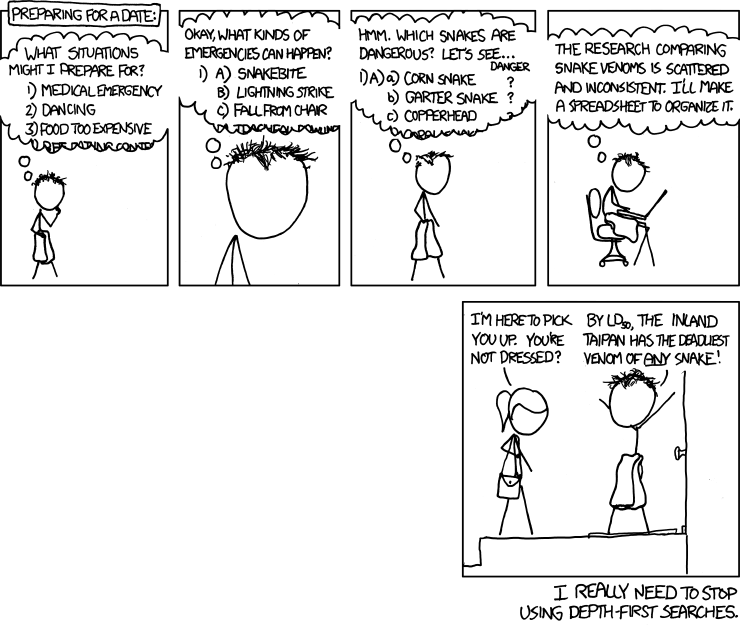
https://xkcd.com/761/

I am not a herpetologist.  I am not your herpetologist.  Nothing in this post should be construed to be medical advice, nor expected to be perfectly accurate.  Everything here is gross generalizations for the purposes of gaming.

The two big families of venomous snakes dangerous to man are the elapids and the vipers (there are some dangerous ones in other families like the colubrid boomslang though)

  • Elapids
    • Include cobras, taipans, sea snakes, coral snakes, kraits, mambas, pretty much all of the various intensely venomous Australian snakes with unassuming names like the Western Brown Snake...
    • Often relatively long and thin body form 
    • Mostly have round pupils
    • Mostly lay eggs
    • Have relatively short, non-folding fangs at the front of the mouth
    • Venom is often primarily neurotoxic and kills by stopping respiration
    • In some cases, venom is almost entirely neurotoxic in action and causes no pain or swelling at the bite site, making it hard or impossible to tell if a bite was "dry" until onset of symptoms
    • The combination of short fangs and quick-acting venoms often lead to an attack pattern against their primary prey of wrapping around and biting multiple times to guarantee some good deep killing envenomations
    • Hunting pattern is often active - seeking out prey, going into burrows
    • In humans, time to kill from a wet bite is often 30 minutes to six hours
  • Vipers
    • Include rattlesnakes, copperheads, cottonmouths, adders, pit vipers, bushmasters, fer-de-lance, ...
      • Pit vipers are called this because they have a pit on each side of their head between the eye and the nostril which can sense infrared, not because they live in pits.  It's actually a pretty big category and includes most (all?) New World vipers
    • Often relatively stocky/girthy/thicc body form 
    • Many have slit-pupils like cats
    • Mostly give birth to live young
    • Have long, thin fangs that fold up against the roof of the mouth when not in use, and lower jaws that hinge out past 150 degrees to let them strike with the long fangs
    • Venom is often primarily toxic to blood and muscle tissue, causing clotting, hemorrhage, blistering, necrosis, kidney failure from rhabdomyolysis.  May require amputation of the bitten limb even if it doesn't kill you.
      • I have now seen some pictures of necrotized viper bites that I cannot unsee
    • Wet bites are typically very painful and swell up
    • Between the fragile but long-reach and deep-injecting fangs and the slow venoms, attack pattern against primary prey is often a single lunging bite and then backing off and waiting for the prey to die.
      • Some can track bitten prey by the smell of some components of the venom acting on the prey's blood
      • Often a passive hunting style, waiting in ambush for passing prey to tag
    • In humans, time to kill from a wet bite is often 10+ hours (overnight or the next day) unless the bite was onto a vein  

On reflection, it seems like regular-sized mundane venomous snakes are really more like traps than they are combat encounters.  You didn't poke the pile of leaves with a 10' pole before you stepped in it, save vs poison, and unless you roll a 1 you still have at least half an hour to get a Delay Poison or Neutralize Poison in before you keel over.  The necrosis angle on viper bites could be somewhat interesting, might play out a bit like ACKS' Dismember spell on a failed save.  2HD for a 5' pit viper that probably weighs 5 pounds seems really high.

Where you'd expect to see save-or-die poison with a pretty quick time to kill would be in snakes for whom humans are a common prey species.  I recall reading somewhere that most predators hunt prey that is something like a 10th of their own mass to minimize the risk of being injured by the prey.  I don't know how true this is but it sort of passes the smell-check; a mouse is much smaller than a cat, a mosquito is much smaller than a bat or sparrow, a seal is much smaller than a great white shark.  I would expect pack hunting, ambush, and venom to all shift those closer to 1:1, since these strategies reduce the risk of injury to the predator.

The Eastern Diamondback Rattlesnake is typically about 6 feet long and weighs about 5 pounds.  It commonly preys on cottontail and marsh rabbits, which weigh about 2-3 pounds.  Scaling up mass with the cube of any single dimension, we'd expect a 12 foot rattlesnake built to the Eastern Diamondback's proportions to weight about 40lbs, and a 24-foot rattlesnake to weigh about 320.  That seems a size at which hunting adult humans as a primary prey sounds plausible.  Incidentally, this is also about the size of a large reticulated python, which have been known from time to time to prey on humans, including adult male humans.  I think this length and mass would be a better match for the 4HD giant rattler stats than the 10' in its description.

Anyway, a few other fun snake "facts":

  • King cobras have a really low-pitched growly hiss apparently
  • The yellow-bellied sea snake can get about 33% of its oxygen needs by absorbing oxygen from the water through its skin
  • We're pretty sure sea snakes don't drink seawater, but nobody is really sure where they get fresh/brackish water.  It's theorized that they might drink the layer of brackish water at the top of the water column during heavy rains
  • The small-scaled burrowing asp can rotate its fangs sideways out of its mouth and uses this in confined spaces where it doesn't have room to bite.  It has also been observed to sting each rodent in a burrow containing multiple before stopping to eat any of them.  Next time your players meet a snake and complain that trying to bite each PC in turn was too smart, show them this.
  • Some venomous snakes which hunt by ambush use "caudal lures", where the tip of their tail look like a tasty worm or grub.  A dungeon-snake whose tail looks like some sort of unattended treasure would be pretty funny.

I also wandered into some articles on treating snakebite.  Antivenin is made by injecting large mammals like horses with small doses of venom and then harvesting their antibodies.  Antivenom can have some pretty significant side effects, called "serum sickness", from reactions to horse proteins.  These can take up to two weeks to appear and in rare cases can kill you.  In folk medicine, there's a whole genre of magic healing stones, some of which nominally work on snakebites (bezoar stones from inside of toads and snake-stones or black-stones often made from burnt animal bones) and some of which might be made by snakes (adder stones).  There were also madstones, which might not have been stones at all but body parts of albino deer used to try to treat rabies?  In conclusion I feel OK about having some non-magical treatments for snakebite that give you a second save but also entail bed rest afterwards.

Thursday, February 2, 2023

1e's Time in the Dungeon

The introduction to the AD&D 1e DMG mentioned that it's reasonable to omit random encounter wandering monster rolls if you understand the purpose of random encounters and it doesn't apply.  It doesn't tell you what that function is, though.  So I went looking for it and sadly didn't find it.

Instead, I found the table of how long various actions in dungeon exploration take.  It's split across a page boundary (pages 96 and 97) so I have reproduced it in text here rather than as a screenshot:

  • DOOR - search for traps: 1 round
  • DOOR - listening for noise: 1 round
  • ROOM - mapping, and casually examining a 20'x20' area: 1 turn
  • ROOM - thoroughly searching after initial examination: 1 turn
  • SECRET DOOR - checking for by simple tapping of floor or wall, by 10'x10' area: 1 round
  • SECRET DOOR - thorough examination for means to open, by 10'x10' area: 1 turn

I was very surprised to see the time-costs of some of these actions listed in rounds (which in 1e are minutes, 10 per turn, not 6-10 seconds) rather than turns.  I went back and checked and B/X (well, OSE) simply doesn't have times listed for any of the interactions with doors, and doesn't distinguish between types of searching - it just says that searching a 10'x10' area takes a turn.  I think I had been running listening at doors, searching them for traps, and searching for secret doors as taking a turn each.  I'm not sure how I feel about breaking the atomicity of the exploration turn and allowing it to be subdivided further into rounds.  I also find it very amusing that on page 97 shortly after this table of suggested times to perform these actions, Gygax complains about players who search everything and listen at every door.

Assume that your players are continually wasting time (thus making the so-called adventure drag out into a boring session of dice rolling and delay) if they are checking endlessly for traps and listening at every door. If this persists despite the obvious displeasure you express, the requirement that helmets be doffed and mail coifs removed to listen at a door, and then be carefully replaced, the warnings about ear seekers, and frequent checking for wandering monsters (q.v.), then you will have to take more direct part in things. Mocking their over-cautious behavior as near cowardice, rolling huge handfuls of dice and then telling them the results are negative, and statements to the effect that: “You detect nothing, and nothing has detected YOU so far —“, might suffice. If the problem should continue, then rooms full with silent monsters will turn the tide, but that is the stuff of later adventures.

But...  my brother in dice, you set the time cost to perform these actions so low that players would be stupid not to search for traps and listen at every door.

Maybe it's stupid to require a turn to listen at a door - but it works well and it's an actual choice!  And if it takes a turn to listen at a door, search it for traps, or try to pick a lock, then maybe you really don't need the no-retry clauses.

This does force me to consider that maybe I should give the party "free" attempts at finding secret doors in passing, assuming that they're tapping as they go because it's quick, and then make a successful turn-length search primarily for finding the mechanism of action / trigger.

There is also an interesting bit in here:

A gnome, for instance, must remain relatively quiet and concentrate for a turn to detect facts about an underground setting. Likewise, a dwarf must work at it. An elf doesn’t detect secret doors 162/3% of the time by merely passing them unless he or she is actually concentrating on the act. A character with a sword must have it out and be thinking about its power in order for the weapon to communicate anything to him or her. To sum it all up, DON’T GIVE PLAYERS A FREE LUNCH! Tell them what they “see”, allow them to draw their own conclusions and initiate whatever activity they desire.

Emphasis mine.  I think grouping in the use of magic sword detection abilities with these inherent racial abilities is telling about the expected frequency and ease-of-use of sentient swords.  There are no swords with detection abilities on table III.G. Swords on page 124 - swords with detection abilities only arise from the Sword Primary Abilities table for "unusual" (sentient) swords on page 167.  In conclusion, further evidence that the sentient sword rules are significant and have a purpose.

Saturday, January 28, 2023

Getting a Sense for 24-Mile Hexes

I'm considering doing some mapping on 24-mile hex scales, and wanted to get a sense of just how big that was.  Previously I had imposed a ~24-mile hex grid over parts of France, but that doesn't really tell me much.  But the same technique was easy to apply to more familiar country:


One could reach most of these same conclusions from just looking at numbers - distances between cities, areas of states.  But it's still interesting.

Pennsylvania is something like 85 or 90 24-mile hexes - enough area to be a Kingdom by ACKS' standards.

Massachusetts is maybe 16 hexes, somewhere in the large duchy to small principality range.  The projection might be messing with this a bit, I think taking MA's land area and dividing it by the area of a 24-mile hex I get closer to 20 hexes.

Lake Erie is something like 16 24-mile hexes - enough area to be a merfolk duchy.

Even Rhode Island is good hex or two (or three by the numbers).

It's only about four hexes from DC to Richmond - about a week encumbered on foot at 60' speed or with a cart with plenty of draft animals.

Megacity Ruin Hexes

New York City proper basically occupies a whole 24-mile hex; it's 32 miles from Yonkers to the southwestern tip of Staten Island, 25 miles from that tip of Staten Island to JFK airport, and 18 miles from JFK to Yonkers.  And that's ignoring Newark and most of Long Island.  Washington DC proper is 70 square miles (about two full 6-mile hexes) and is maybe a 6th of the DC metro area.  The DC beltway and the ring-road around Boston both have radii of about 10 miles, and there's plenty of 'burbs outside those rings.  In a post-apocalyptic setting, one could readily fill an entire 24-mile hex with terrain type "ruined city" and it wouldn't be crazy.

Culture Distances

New York City is 13 hexes by land to Richmond or 14 by sea to Norfolk, and 14 hexes by sea or 8 by land to Boston - and those were distances great enough for significantly different cultures, accents, and modes of life to emerge and persist for a long time, even starting from a shared language.  This checks out if you look at France too - Paris to the middle of Brittany (which was unified with the French crown in 1532 but where only half of the population spoke French in 1900) is about 10 hexes, and Paris to Zurich is about 12 hexes.  From the southwestern tip of Flanders to the northeastern end of the Netherlands, the whole region where Dutch is the primary language, is only about 240 miles - 10 hexes.

Philadelphia to Pittsburgh is 11 hexes across a mountain range, well up into that "cultural divergence" distance.  Hence the Westsylvania movement.  Pittsburgh to Chicago is another 19 hexes - enough distance for at least one complete divergent regional culture (and likely a dialect if not a whole new language) in between them.

This 10-hex cultural divergence distance is also interesting from the perspective of kings of people, not of places - if every 10 hexes or so of forest and hills you have a culture shift, then the natural size for a kingdom of a people, of a culture, is about 10 hexes by 10 hexes of such terrain.  Which is on the low side for a kingdom in ACKS, but it's in the right range.  It's possible I've accidentally picked odd boundary situations (though I'm not aware of a big natural barrier between Brittany and Paris...).  At this size, you can march your army from one side of the kingdom to the other and back in about two months.  "Two weeks from the center to the border" might be a reasonable heuristic.  Beyond that you start getting into empire - you can conquer them and extract tribute, but they'll retain their own culture for a long time (longer than the campaign will run, in any case).

These numbers are also kind of in the right ballpark for a couple of other thing sin ACKS.  A kingdom in ACKS tends to have a single Class II market city, which has a trade range by road of 144 miles (6 24-mile hexes), which is a little short but means that the whole trade range (by road) is probably within the kingdom if the city is centrally located.  These sort of 10-hex distances are also towards the outer limit for supplying your army from a centrally-located capital city in Domains at War: Campaigns without having forward supply bases, too - the base range is 96 miles (4 24-mile hexes), but this is multiplied by 4 on roads or by 3 through "settled" territory.  Assuming a ring of settlement around the central market and then diminishing population density and road construction at the frontiers, we might reasonably expect to get x3 supply chain length for a good portion of the way but then logistics break down at the edge and we end up a little short of x3 overall.  So it's the area you can definitely project power into with no prep.

...  it's about 290 miles from London to Dublin as the crow flies and that's sure a culture-border that has persisted over centuries.  London to the south edge of Scotland is about 275 miles by land, 11 hexes.  London to the edge of Cornwall is only about 7 hexes and the Cornovii have mostly lost their own language (though it took a thousand years from when the Saxons arrived) and have a dialect of English, while London to the edge of Wales is a mere 6 hexes - but there's some rough country in Wales, and the English language didn't start making inroads into Wales until the Industrial Revolution, which is well after the period we're interested in modeling cultural dynamics for.

(I eagerly await corrections from my readers in the UK)

I don't really have a good theory of these sort of culture-distances along nautical routes yet.

Nautical Matters

At 72 miles per day (three hexes), it would be four days by sail from NYC to either Norfolk or Boston with favorable winds.  Those numbers don't seem totally crazy - the Everglades Challenge is a motorless small craft race from Tampa to Key Largo, which is 275 or 300 miles (11-12 hexes) or so, and the winning time in 2013 (which mostly had a favorable wind out of the north) was around two days of near-constant sail with very little sleep.

The continental shelf is also interesting, 2-4 hexes of shallow ocean off of the coast before the bottom drops off and it gets deeeep.  It might be merciful to have separate encounter tables for littoral vs pelagic ocean with different weights for dragon turtles.

Thursday, January 26, 2023

AD&D 1e's Time Sinks

I've been working my way through the 1e DMG and translating/summarizing the DMing advice out of Gygaxian into plain english for my own use.  I'm not that far through it yet but one thing that is constantly sticking out at me is that there are many time sinks.  For example:

  • Every time you go digging through a pile of rotting crap or spend time holed up in unsanitary conditions you might catch a disease, which may cost you 2-4 weeks of downtime (and possibly ability score damage, death, blindness...).  You can also catch parasites from drinking bad water, with similar effects.
    • As an aside, the paladin's disease immunity sounds amazing if the disease rules are played straight
    • I'm probably going to end up writing another post about this at some point.  I think there's a good disease system waiting to be derived from this system - one not as crushingly awful as LotFP's corruptions and not as "all-or-nothing" as B/X's save-or-die diseases.
  • When a paladin hits 4th level, he gets a vision of a horse.  Not a horse, just a vision.  And then he gets to go on a ~2 week quest to get his special mount.
  • Thieves and assassins can go spying and infiltrate organizations.  Simple missions take up to a week, complex missions take multiple weeks.
  • High-level assassins can study poisons, which takes many many weeks (and costs lots and lots of gold).  Once they've done their course they can create pretty arbitrary poisons, which takes a week or two.
  • If you miss your initial window for Cure Disease after contracting lycanthropy, one of your options to remove it is to spend a month or so in an abbey drinking holy water infused with wolfsbane out of a silver chalice (for a considerable donation to the monks hosting you, of course).

That's all in the first 23 pages.  It's not like there's a big list of "campaign activities that take time", it's all mixed in with everything else, and if I didn't have time on my mind I probably wouldn't see it.  But it's there.  Lots of ways for time to get spent.

Maybe it would be fun to compile that list of all the ways to spend downtime (or to have downtime inflicted on you) in 1e.

Sunday, January 22, 2023

Surviving First Level: The Heist Hypothesis

I'm still trying to figure out what a reliable or intended strategy for surviving 1st level is supposed to look like.  In part so that I can design a dungeon that supports it, or at worst not design a dungeon that accidentally hard-counters it.

Assume for the sake of argument a Big Four party of fighter, MU, cleric, thief.  Total XP required to get them all to 2nd is 7200.  Assuming stats roughly typical for 3d6, with +5% prime reqs all around and not much else, bringing us down to about 6850 XP.  Assume also that we're following Moldvay's advice to not let new players lean on hirelings as they learn the game.

A single dungeon encounter of 2d4 (average 5) goblins is a pretty fair match outside of the party's one sleep per day.  3d4 (average 7.5) skeletons are liable to get messy if the cleric fails the turning roll.  And those are both bite-sized random encounters with pocket change at best for treasure.  Lairs are much bigger, and dividing and conquering them requires shared languages, decent luck with reaction rolls, and ideally multiple humanoid lairs to pit against each other - but we can't count on getting that from the stocking tables.

Fighting monsters for their treasure seems like a pretty bad idea at 1st level.  You don't have any healing resources and your one sleep might be best used to survive a fight that you didn't want to be in, rather than offensively to win a fight that probably won't have treasure.  Oil and war-dogs are great and all, but...  is that really the intended solution?

Is it possible that you're meant to spend first level skulking about, looking for trapped or unguarded treasure and avoiding almost all encounters?

Well...  I'm not sure the math works out.  In ACKS, the expected value of an unguarded treasure on the first level of a dungeon is 870 GP, so you'd need about 8 unguarded treasures to get everyone to 2nd, for that cure light and extra sleep per day (the thief, incidentally, will level after only about four such treasures).  Buuut between trap rooms and empty rooms, about 9% of rooms (1 in 11) have treasure but no monsters.  So on average you'd need to explore 88 rooms on the first level of the dungeon to level by unguarded+trapped treasure, and that's assuming no casualties to traps, random encounters, stumbling into lairs, etc (granted, also assuming no monster XP - but if you're avoiding lairs and start heading for the exit when you've burnt your one sleep on a random encounter, you're talking maybe 25-50 monster XP per expedition). 88 rooms is huge for the first level of a dungeon - when I'm building standalone non-mega dungeons, I often have about that many rooms across three levels.  But it's sort of plausible that one could build a ruin that large, all of dungeon level 1.  88 rooms is also going to take quite a lot of play time to get through - my players in Rat-hell were exploring maybe 10 rooms per session, so we're looking at 9 sessions without any resets from casualties.  That seems like a long time to spend at 1st level.

The situation is much worse in OSE.  It's still 9% of rooms with treasure but no monsters, but the expected value of that treasure on the first level of the dungeon is a paltry 160gp - about a fifth of what it is in ACKS.  So you'd need to explore over 400 first-level dungeon rooms to level everyone off of unguarded treasure in OSE.

Is the answer to go deeper?  If you're already adopting a Robinsonian posture towards monsters, and the unguarded loot is better at lower levels, maybe this isn't crazy.  And traps don't necessarily scale up when you go down; ACKS' list of traps is the same for 1st-3rd dungeon levels, and OSE doesn't specify.  2nd level unguarded treasure in OSE has an expected value of 492 gp (about triple), while in ACKS it's 1491 gp (almost double).  And many of the random encounters on the 2nd level dungeon table are still susceptible to sleep - 5 2HD lizardmen vs 9 HD affected on average by sleep, for example.  So a 2nd level random encounter isn't necessarily any more of a game-ender than a 1st-level one is...

With ACKS' treasure numbers, I could see a dungeon with 30 rooms in the first level and 30 rooms in the second level yielding enough unguarded/trapped treasure to get a party to 2nd.  'course, in those 60 rooms you've got about 20 monster rooms, of which probably 2 are lairs...

There is also the question of surviving the traps.  In 60 rooms, we're talking about 20 traps (of which 6-7 have treasure).  Most of the "treasure traps" are threats only to whoever interacts with the treasure, but some of the "room traps" are threats to the whole party at once.  In 20 trapped rooms, we'll probably pull the "room fills with poison gas" one at least once, and it could easily happen twice.  Saves at 1st are pretty bad (we should expect ~1.5 survivors based on saves).  Finding and Removing Traps at 1st is also pretty terrible.  The Trapfinding proficiency in ACKS is actually a huge boost at this point in the game, almost doubling the thief's chances of successfully finding or removing a trap (granted, it's 15% chance of success to 25%, which is still not great).  ACKS also removes the poison gas room trap, though the falling bricks from the ceiling for 2d6 is arguably worse at this point since Petrification and Paralysis saves are slightly worse than Poison and Death, and its average damage is still going to be enough for the vast majority of 1st-level characters.

On the other hand, when you frame Finding Traps as "15% chance to detect non-monster TPKs before they fire", thieves start to sound pretty good.  It's not a high chance, but it's better than nothing.