Showing posts with label Morrowind. Show all posts

Sunday, September 20, 2020

ACKS Morrowind: Guar

Rollie the guar and his elf


Guar
% in lair: None
Dungeon encounter: None
Wilderness encounter: Herd (2d6)
Alignment: Neutral
Movement: 120' (40')
Armor class: Desc 7, Asc 13, ACKS 3, as Ring Mail
Hit dice: 3
Attacks: 1 (bite)
Damage: 1d8
Save: F1
Morale: 0
Treasure: None
XP: 50

These bipedal lizards measure 10 to 12' from nose to tail and weigh around 650 lbs.  They are omnivorous, eating roots, fungus, rats, and scrib with equal relish.  Wild guar have been known to attack and eat humanoids during particularly lean years.  Their ungainly heads contain fat and water reserves like the hump of a camel, over a thick skull containing a brain the size of a man's fist.  During competition for mates, guar headbutt each other; these impacts resemble the initial collision in a sumo match.  The guar's tail serves as an essential counterbalance to its front-heavy mass distribution; hence the Ashlander expression, "to be the tail of the guar", meaning to do a task which is important but unpleasant, unglamorous, or smelly.  Domesticated guar express their affection by licking.

A herd of wild guar is often led by an huge old guar (or "old chonker") of 4HD and AC4 weighing 1100 lbs, whose bite deals 2d6 damage.

Both the Ashlanders and civilized dunmer raise guar for meat and as pack animals.  As pack animals, a typical guar can carry 12 stone at 120' speed or up to 25 stone at 60' speed.  Racing on guar-back is a popular sport among Ashlander children.  Very large guar can carry 22 stone at 120' speed or 44 stone at 60' speed, but they are rarely used as battle mounts because they aren't very smart and tend to like to stop and eat things on the battlefield.  Rumor has it that the Redorans are working on selectively breeding guar for carrying capacity and trainability as cavalry.  When butchered for meat, a guar yields 25 stone, and a very large guar yields 44 stone.

The hide of a guar is a common ingredient in alchemical recipes, and the hides of very large guars are worth 100XP towards magical research dealing with Fellowship, Sanctuary, Vigor, Charm Animal, Summon Animal, and Predict Weather effects.

Sunday, November 17, 2019

ACKS Morrowind: Silt Striders

Why walk when you can ride?

Silt striders are the first means of fast travel most Morrowind players encounter, and also the one that is the most iconic.  They're giant bugs whose shells are partly hollowed out, their nerves poked to make them move on command, and used as buses.


Elf on the dock for scale

Silt striders pose a couple of interesting questions.  What do their young look like?  Do they lay eggs?  How big an egg?  Where do they fit ecologically?  What do they eat?  Some folks advance theories that they're primarily aquatic, but since there are silt striders in Ald'ruhn and Maar Gan, both unreachable by water, and plenty of silt strider husks in the Ashlands, I don't like this theory.  One proposal is that they're like salmon, with adults migrating in from the sea to lay eggs in the Ashlands, where they then die.  Their mouths are so high that they probably need to bring food up, but their pointy front legs aren't clawed.  Maybe they're filter feeders who sift the dust?  But the head and mouth don't look built for that.  Likewise, any herbivorous explanation doesn't make sense with the height; there aren't any trees that tall in the Ashlands, or even in most of the West Gash.  Maybe they eat that persistent pest, the cliff racer.  Maybe when Saint Jiub hunted the cliff racer to extinction, he also doomed the silt striders to extinction.  If they eat cliff racers in the wild, what do they eat in captivity?  How much meat does a house-sized carnivorous insect need per day?

The common cliff racer.  Somewhat larger than man-sized.  Note the keeled breastbone and lack of feet.
Cliff racers are sort of like wyverns, but smaller, faster, without the venom, and much more numerous.

This seems like a fine time to break out the Lairs and Encounters rules for building monsters.

Silt striders are fantastic vermin, saving as a fighter of HD/2 and with probably 0 special abilities.  Their body form is...  maybe Beetle is the closest?  With a body mass exponent of 1.63 and a carrying capacity factor of 0.43.  Silt striders are...  big.  Even excluding the height from the spindly legs, the main body is about 10 feet tall and as broad.  Measuring some pixels on screenshots, I think they're around 25-30 feet long, or towards the upper end of ACKS' Gigantic size category.  Call it 26,000 pounds (about two elephants by mass).  Some math gives us...  53 HD.  That's a lot.  Two elephants is only 18 HD.  Leeet's go with 36 HD.

As for carrying capacity, doing some jiggery-pokery with the cube-square law, I get around 2750 stone.  I think, if I'm reading this right.  2750 pounds seems too low (since a man-sized Giant Tiger Beetle can carry almost that much), but 2750 stone is more than the silt strider itself weighs.  That is more than the cargo capacity of a 60' longship.  An elephant can carry 180 stone.  So it weighs twice as much as an elephant, and can carry almost 15 times as much.

Beetles, man.

I think we're going to need broader, flatter feet to distribute all that load and not sink into the ground, especially in silt.  Also howdah-like cargo platforms, because they've only got a horizontal profile of about 250 square feet.

I guess ridiculous carrying capacity is a really good reason to bother "domesticating" these huge dangerous bugs and using them to transport cargo though.

Speaking of dangerous:

% in lair: 40%
Dungeon enc: N/A
Wilderness enc: Solitary (1) / Solitary (1)
Alignment: Neutral
Movement: 150' (50')
Armor class: 6
Hit dice: 36 (THAC0 -4+)
Attacks: 3 (claw, claw, bite) or 1 (trample at +4)
Damage: 4d10/4d10/8d6 or 16d8
Save: F18
ML: 0
Treasure: P+M
XP: 6750

Trainable at a -2 modifier with a training period of 5 months.  Natural lifespan of 55 years, reach adulthood at 5 and a half.  The value of a "trained" silt strider is around 224,000 GP by the formula in Lairs and Encounters.  Which, I suppose, does explain why there are only 9 of them on the whole island.  This same formula also puts a medium horse at almost 600gp, where a medium warhorse is less than half of that, and a medium riding horse is only 40gp.  So I imagine it might be appropriate to apply a substantial discount for "this is the beast of burden of our people".

Taking that price at face value though, an untrained silt strider is worth 2/3 (~150kgp), a young one 50% (112kgp), and a baby or egg 25% (~56kgp).  So that would be a pretty funny mid-level ashlands adventure, to secure a 5' diameter silt strider egg and roll it back to civilization.

For Domains at War, five silt striders make up a company-scale unit.  With their ridiculous carrying capacity, it makes a lot of sense to put artillery on top of them.  Lamellar barding (3600gp, +4 AC, 48st), gigantic war howdah (240gp, 18st), 6 dudes in lamellar with bows and short swords (96st, AC5), a light catapult (100gp, 120st), and 20 rounds (6st) uses like...  15% of the carrying capacity.  Sadly there are no numbers for the weight of siege towers.

Siege Striders
MV 2/5/8 FM?.  Tall spindly legs allow them to walk over obstacles 10' tall or less.
AC 9
HD 40+2
UHP 14
Attacks:
Melee: Only the striders can attack, the riders are too high up.  10 melee at -4+.  On charge, 10 trample at -8+.  As gigantic creatures, their melee attacks deal 50 SHP to wood and 5 SHP to stone structures.
Ranged: 2 shortbow 13+.
Siege: 1 light catapult 13+, range 5-10, reload 5.  Deals 50 SHP to wood and 5 SHP to stone structures.
ML: +1

I dunno.  Maybe this is too big and too expensive.  Maybe I should work up reasonable beasts of burden for a horseless continent.  Horse-sized beetles pulling wagons, pack guars, riding wasps, etc.

Rollie the Pack-Guar and his elf

Thursday, November 14, 2019

ACKS Morrowind: Market Classes, Trade Routes

Working out populations and market classes for all the towns of note:

Ald Velothi: One smith, no inns, ~1.5k population, Large Village, class V.  Age 1000-2000 years (it is Old Velothi after all), sea coast, scrub, hills.
Ald'ruhn: Previous post, population 4500, Small City, class IV.  Age 100-1000 years, desert, hills.
Balmora: Previous post, population 8000, Small City, class IV.  Age 1000-2000 years canonically but I dunno if that actually makes sense, riverbank, scrub, hills.
Caldera: One smith, one inn, ~2k population, Large Village, class V.  Age <20 years, scrub, hills.
Dagon Fel: No smiths, one inn, ~2k population, Large Village, class V.  Age <20 years, sea coast, scrub, hills?
Ebonheart: One very good smith but he's part of the garrison rather than serving civilian markets, one inn, big fortress, long-range boat service...  population 2k, Large Village, class V.  It's a military and administrative center, with supporting civilian population, but not much beyond that.  Would probably also have been the sensible place to put the Census and Excise office, and to have the prison ship arrive at.  Age <20 years (Armistice era), sea coast, grasslands, plains.
Ghostgate: inn and smith, but...  it's really just a fortress-monastery.  Class VI market at the fortress.  Age 100-1000 years (Tribunal era), desert, mountains.
Gnaar Mok: no inns, smiths, or taverns, population <400 (call it 350), Small Village, class VI.  Age 100-1000 years, sea coast, rainforest?, plains.
Gnisis: two non-garrison smiths, no inns, 3k population, Small Town, class V.  Age 100-1000 years, sea coast and river, scrub, hills.
Hla Oad: one smith but not open to the public, no inn but yes really lousy tavern, 400 population, Small Village, class VI.  Age 100-1000 years, sea coast, rainforest, plains.
Khuul: no smiths, no inn, one really lousy tavern, 400 population, Small Village, class VI.  Age 21-100 years, sea coast, scrub, hills.
Maar Gan: one smith, one inn, 2k population, Large Village, class V.  Age 100-1000 years, desert, mountains.
Molag Mar: two smiths, no inns, 3k population, Large Village, class V.  Age 100-1000 years, sea coast, desert, hills.
Pelagiad: one non-garrison smith, one inn, 2k population, Large Village, class V.  Age <20 years, Lake, Grasslands, Hills.
Sadrith Mora: Three smiths, two inns, population 4500, Small City, class IV.  Age 100-1000 years, sea coast, scrub, hills.
Seyda Neen: No smiths, one pretty decent tavern, population 500, Village, class VI.  Age <20 years years, sea coast, rainforest, plains.
Suran: One smith, no inns (but two "taverns"), 1500 population, Large Village, class V.  Age 1000-2000 years (canonically built concurrently with Balmora), river, lake, grasslands, hills.
Tel Aruhn: One smith, no inns, 1500 population, Large Village, class V.  Age 100-1000 years, sea coast, scrub, plains.
Tel Branora: One smith, one inn, 2000 population, Large Village, class V.  Age 100-1000 years, sea coast, scrub, plains.
Tel Mora: One smith, one inn, 2000 population, Large Village, class V.  Age 100-1000 years, sea coast, scrub, hills.
Vivec: Previous post, population 13000, City, class III.  Age 100-1000 years (right around 1000 in the mid-3rd Era), sea coast, lake, grasslands, plains.
Vos: No smiths, one inn, 2000 population, Large Village, class V.  Age 1000-2000 years (Velothi era), sea coast, savanna, plains.

One interesting thing that picking out ages highlights is that there were a number of cities built canonically in the Velothi / pre-Tribunal era.  It would make sense to have some ruined cities from that era too, probably around the propylon fortresses, since those are from that era too.  Gnisis is particularly intriguing in this light; it's right on a river mouth (a sensible place for an initial settlement), there's a propylon fortress right across the river, and Arvs-Drelen is a Velothi-era dome.

Adding trade routes (blue for water, brown for road) with ranges based on these market classes, here's what we get:


So we have one big component with Vivec, Balmora, Ald'ruhn, and the villages on the south and southwestern coasts, another component with most of the Telvanni towns on the northeast plus Dagon Fel, a small Redoran component in the northeast, and then a few isolated villages (Maar Gan and Gnaar Mok). 

My scale concerns strike again, but this time in the other direction - some of the settlements which have fast travel services (boats and silt striders) that you can hire to take you to other settlements in Morrowind are now out of each others' trade ranges.  I think the biggest offenders here are Tel Branora to Sadrith Mora, and the Gnisis component.  Not sure what, if anything, to do about this.  Probably just let players charter ships and silt striders anyway; I don't think the ACKS rules for chartering a vessel require it to be along a trade route.

I think this view frames the locations the Houses were trying to take in an interesting way.  Redoran's capital is cut off from his villages by distance, and probably relies on importing food from Hlaalu.  Taking Bal Isra would help link up Maar Gan, and then Shishi north of that pushes towards the sea to link up to Khuul.  For my money I'd've settled on the other side of the mountains though, building a chain of villages up the West Gash from Ald'ruhn to Khuul, plus taking the old fortresses of Andasreth and Berandas.  Maybe the northern approach through Bal Isra and Shishi was hatched after their failure to take Andasreth.

Hlaalu's stronghold of Odai Plateau solidifies his control of the river.  Telvanni's attempt to take Odirniran is the beginnings of a bridge between Tel Branora and the rest of his settlements; Uvirith's Grave is just one of six or so places Telvanni has taken in Molag Amur and the Ashlands (but this is the first mushroom tower there, rather than taking a Velothi dome).

I feel that Hlaalu's position is strong, with a big swath of productive, contiguous territory interrupted only by their Imperial allies, but there's not much more that they can take uncontested; Redoran's already mad about Caldera, and will probably block further expansion up the West Gash if they can.  The right play for Hlaalu might be to clear out Ald Sotha properly and expand their plantations into that part of the Ascadian Isles.  Redoran's position is a little precarious; they're committed into the Ashlands in support of the Temple.  Telvanni is expanding like crazy into the Grazelands, Sheogorad, Ashlands, and Molag Amur, but these expansions are mostly just some mid-level wizard taking a tower with his 3-5 henchmen, and they don't coordinate well, plus the land is pretty marginal.  Telvanni probably benefits from buying time for their wizards to level and their many tiny bases to mature in secret; buying this time probably looks a lot like playing Temple+Redoran against Imperial+Hlaalu and avoiding picking direct fights with either.  Or it would, if Telvanni were coordinated instead of infighting.

Monday, November 11, 2019

ACKS Morrowind: Maps

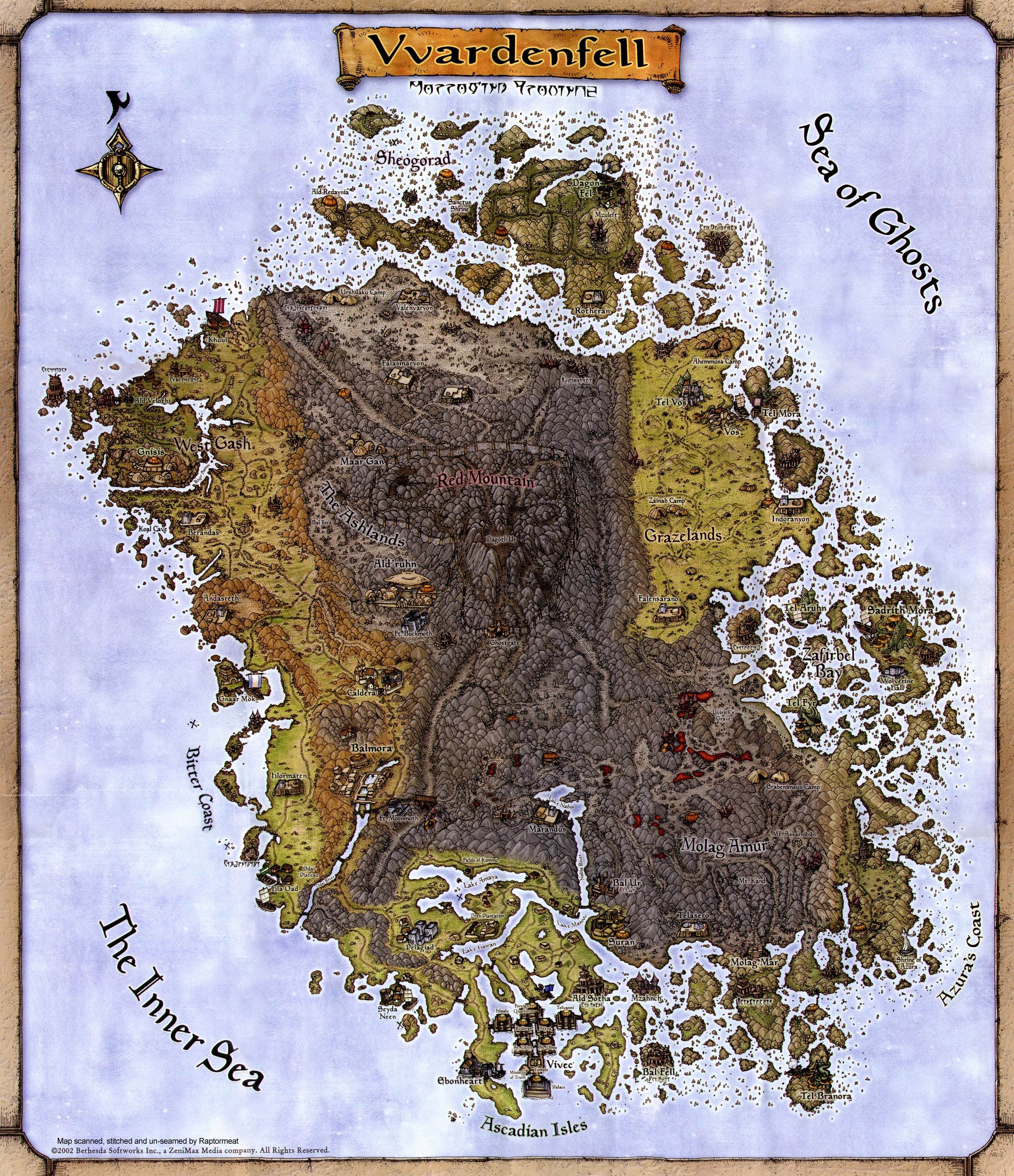
Been working on mapping.  Here's the poster map with a 24-mile grid over it.

I'm not in love with this particular gridding; a number of towns are very un-centered in their hexes (particularly annoying for Ghostgate), and Vos and Tel Mora are in the same hex.  But I'm not sure a regular grid that centers every town on the right scale is doable.

I also worry that this scale is somewhat too small.  It's only one or two 24-mile hexes from Ghostgate to Dagoth Ur.  From one end of the map to another, Vivec to Dagon Fel by boat, it's only five or six days under sail in a swift ship (not allowing sailing at night, as the coast is rocky and treacherous).  Under two weeks to circumnavigate the whole island, even in a slower sailing vessel and without sailing at night.

Here's another with overlays for population density.  Yellow hex overlay indicates taxable borderlands (~100 families per 6-mile hex; excludes the untaxed and illegible Ashlanders), green overlay indicates civilized population density (~250 families per 6-mile hex), and blue overlay indicates double-civilized population density (~500 families per 6-mile hex).


I think the total population comes up a few thousand families short of what I intended as of the first post; I think I could probably fit them into the blue hexes by raising population density there a little further.

Monday, November 4, 2019

Taking the ACKS to Morrowind: Intro, Population, and Area

I have a deep, and perhaps silly, nostalgia for Morrowind.  It was the second cRPG I played.  The first was Neverwinter Nights, and the difference was profound.  Morrowind was beautiful and first-person, even if I only got a few frames per second and maybe it's not so beautiful anymore.  It was also mysterious.  I knew third edition D&D, and so I knew Neverwinter Nights; even if I hadn't, it came with a thick spiral-bound manual that talked about all the classes and feats available in the game, if I recall correctly.  Morrowind came with a thin manual and a big poster map covered in towns, camps, ruins labeled in a foreign script, and black Xs marking who-knows-what.  It was an incomplete map, once which whets the appetite rather than satiating it.  I think it was the first sandbox I ever saw.

There were a lot of things about the setting that would make it very well-suited to domain play.  At the time of the game, the big volcanic island (Vvardenfell) on which it takes place is largely unsettled; for a long time it was sacred ground, then a wave of colonization occurred after the Armistice, and then a quarantine was put in place to prevent the spread of the Blight off of the island.  So you've got three great houses with relatively new settlements but plenty of grudges, the old temple administration with two military orders and a waning god-king, and occupying imperial garrisons as a condition of the armistice, all mostly cut off from the mainland by policy.  Plus the unfriendly ashlander natives, blight zombies, and an angry volcano god who speaks in dreams.

The player arrives into this mess on a prison ship, and the quarantine sets the limits of the sandbox.  It's a clever setup.

So I sort of wonder if there's room for a Vvardenfell-alike, in the way that the Wilderlands of High Fantasy have spawned a number of derivatives.  Obviously one can't just take the setting wholesale, because the wiki exists and would provide all the answers, and also because it would be unpublishable for money due to Zenimax's license.  But the Elder Scrolls has a tradition of fan content, and I imagine one could give it away for free.

Outside of those difficulties, there are definitely enough verisimilitude problems to make straight-porting to ACKS tricky.  Mostly the issue I think is that things were omitted and scaled down; cities have only the handful of interesting people as NPCs and few of the peasants, a smattering of farms stand in for a developed agricultural breadbasket region, and it's unclear if the distance you can travel in an in-game day is really reasonable.

So the first question for such a port would be "just how big is this sandbox anyway"?  Without trusting spatial metrics, the best way to get something reasonable might be to take the vendors available in cities and use that to determine their populations, and then work from there to areas of land required to support those populations.  Balmora, for example, has four smiths, four inns, and one bookseller, which would be consistent with a population in the 6500-8000 range, which in ACKS would be a large town or a small city, class IV market.  This seems roughly consistent with the feeling of the place, though it's billed as the seat of a great house.  Vivec has six smiths, which would put it around 9000 people, but two booksellers, suggesting a population of closer to 13000, just sneaking into City status with a class III market.  If I count alchemists and enchanters as "magic shops", then I get much bigger numbers; Vivec has 8 alchemists and four enchanters, suggesting a population north of 33000 and Large City / class II market status, while Balmora has 2 enchanters and 3 alchemists, for 14000 and City / class III market.  Not counting apothecaries (which I assume are mostly healers rather than selling ingredients to wizards), Sadrith Mora (another house seat) has 4 alchemists and 2 enchanters, for 16800 population and class III.  Ald'ruhn, the final house seat, has three enchanters, three alchemists, three smiths, and one inn, so population ranges from 4500 to 16800, against class III or IV.

Taking either of these configurations, class II Vivec and class III house seats or class III Vivec and class IV house seats, we end up on one of two rows of the Urban Population table, where Vvardenfell has somewhere between 625,000 and 2.5 million inhabitants.  This is incongruous with the fact that Duke Dren is only a duke, as those are prince-to-king numbers.  Taking this map, which has Vvardenfell looking like about a third of the area of the province of Morrowind, and knowing that the province of Morrowind as a whole is a kingdom, principality-tier population seems reasonable.  So let's go with the lower, principality end of those population figures.  The duke is sort of a puppet anyway.  This also means we're basically writing off the extraordinarily high wizard-merchants-per-capita and going with the population numbers from smiths, inns, and booksellers.  Maybe we can bring the wizards back when we get to per-class demographics; certainly Telvanni settlements seem to have more wizards than clerics or thieves.

Getting back to distance, we need to first traverse population density.  Large parts of the island are wilderness or borderlands.  Given that the island is newly settled, and that they were defeated in war by a Rome-analog power, something in the lower end of the population density range is probably reasonable as an average.  There are dense agrarian regions with large enslaved lizardman and catman populations, but then there are also low-density pastoral regions.  Taking a population of 625,000 (or 125,000 families) and 250 families per settled hex on average, we get 500 settled 6-mile hexes, or 31 settled 24-mile hexes.  Taking the unsettled interior as about one and a half times as large as the settled coasts, we need another 45 24-mile hexes in there, for a total of around 80 24-mile hexes, or about 9x9 grid (call it 11x11 with some water).  As a nice bonus, this is right around the recommended size for a detailed region in ACKS, and it should give me enough six-mile hexes of wilderness to actually make rooms out of.

"Beyond the Ghostfence, there are no safe places, no allies. Stockpile resources. Plan for retreat and replenishment."

Sunday, October 21, 2018

Figuring out Morrowind

When I was a kid playing Morrowind, I thought its leveling system was horribly slow and convoluted.  So I downloaded mods that changed how it worked and it was fine.

Returning to Morrowind via OpenMW as an adult, I re-downloaded and re-created a couple of simple mods that I had used, and played through the game.  When I finished, I was way overpowered and had a tremendous amount of cash.

I went and did other things for a month and came back to it.  I started a new game and one of the first things the first questgiver in the game does is give you some cash and tell you to get some training or gear.  I stopped and thought about that for a moment, and everything kind of clicked.

Training was the missing mechanic.

When I was a kid, coming from a 3rd Edition D&D background, Morrowind's economy made no sense.  There's hardly anything worth buying in terms of equipment - there are a few vendors in out-of-the-way places that carry high-quality items (the glass armor guy, the grandmaster alchemist), but all the good weapons can only be found by adventuring.  Spending money on leveling was immersion-breaking, incompatible with my 3E-flavored understanding of fantasy worlds.  So I just accumulated money and ground out levels.

Having seen the OSR, this "money for XP" thing now makes total sense.  Morrowind's development began in the mid-90s, and its descent from AD&D is apparent in its training mechanics and the relationship between wilderness and city.  Go to wilderness, get money and magic items, return to city, spend money on training.

And the heavy use of training changes the way the whole rest of the game works.  It tames the worst parts of Morrowind's leveling system, where you can raise ability scores based on what skills you raised during the level.  If you're not using training, you really have to grind skill uses to get good ability score boosts, and you're likely to incidentally raise some skills and waste some multipliers.  But if most of your skill points are coming from training rather than skill use, you eliminate the grind, and reduce the window for uncontrolled skill increases to mess up your ability score increase plan.  If a couple of skills rise while you're out on an adventure, you have to take them into account when you're spending your money on post-adventure training, but it's pretty manageable.

Heavy use of training also changes the utility of guilds.  Guild rank increases how much guild members like you, and if they're trainers that means they charge you less.  Getting about halfway up the ranks in guilds also opens up a second set of trainers, who usually have higher skills (and can train you to higher levels) than the first tier of guild trainers.  So heavy use of trainers increases the utility of guilds, because they make trainers more available and doing quests makes training less expensive.  This is nice, because a lot of the guild quest rewards in Morrowind are rather lackluster.

Heavy use of training also changes the player's feeling about the Blades (imperial intelligence service) dramatically.  The Blades give out the first half of the quests in the main questline.  Without training, your interaction with the Blades is pretty much restricted to that one questgiver.  The Blades also have about six NPCs who are pretty decent early-game trainers (better than the entry-tier guild trainers, but worse than the second-tier guild trainers).  These trainers cover a wide range of skills, but not such a wide range that you can rely on them alone unless you have a pretty weird build.  Stealth is covered for thieves, but not short blades or marksmanship.  Long blades and shield use are covered for fighters, but not heavy armor.  Most of the magic skills are covered, but not alchemy, and the mage trainer who covers destruction magic is a bit out of the way.  It's really beautifully done; you can go a long way with the Blades trainers, but you're still probably going to have to join a guild to cover the gaps.  And when you seek these people out for training, and ask them about local rumors, they have unique (and interesting) responses because they're in the intelligence service.  It makes the Blades feel a lot more like an actual faction, rather than one inebriate spymaster with his one lonely operative.

At a certain point though, probably in the 60s-70s for your top skills, you're going to cap out on training from the guilds.  To make those last couple of ranks, you need to get a skill up to 80 or 90, which means finding the master trainers.  For each skill (except one), there is a master trainer who can raise it to the highest possible level.  They're mostly not in guilds; instead they're scattered over the continent.  Some of them are in ruins and you find them by adventuring; some of them are in taverns and you find them by frickin' roleplaying like you're some kind of human who occasionally unwinds by talking to people at the local watering hole instead of an unstoppable adventuring machine who only sleeps one hour a week when it's time to level.  I had no idea the utility of bars in Morrowind before, but it turns out they're full of trainers, most of whom are mediocre but some of whom are the best.

So if at low levels, the training system encouraged you to cycle quickly between local guild quests and training, at mid levels it sends you on the wanderjahr to find the trainers to raise your skills to their peak for guildmastery.  It's an interesting commentary on organizations, that you need insight from outside in order to rise to the top.  And when you do find a master trainer, they're about the biggest cash sink in the game besides the rare high-grade armor vendor.  If you have similar charisma and mercantile skills, it's plausible to drop 14000 gp to raise a skill from 60 to 80, and then another 18000 to go from 80 to 100.  For comparison, other big-ticket items in guild advancement are a stronghold and a wizard's staff, both of which are around 5000 gold.  This is a decent solution to the lategame problem of accumulating too much money, if you decide to master multiple skills.  Like all of Morrowind, it isn't too hard to break this (by boosting your charisma and mercantile skills), but you kind of have to try.

In conclusion: as with the OSR, the solutions to (some of) the game's problems are often already in the game.  It's the culture around playing the game that has forgotten about them, and subsequently mods its way to solutions.