Sunday, April 29, 2012

Fluff is Crunch - Of Boots and Gauntlets

Roles, Rules, and Rolls has been putting out a stream of really good posts recently.  Two things in particular struck me as warranting potentially a bit of my attention in running ACKS (well, more than that, but this one I decided might be worth writing about).  In Analog, Digital, Procedural, he concludes with the pronouncement that "In Old School play, fluff is crunch."  This, I think, is going to be a very valuable insight for a grognardling trying to run an oldish-school game for the first (well, second) time.

Something which struck me in combination with this was from Taking Secret Doors Beyond the Letter S.  In particular, this bit:
Niche doors usually open by pressing a button at the back of one of the niches, and these buttons also open the corridor doors, though they may be some distance away from their chosen door. Part of my map notes involved working out which niche button would open which secret door. There was a good moment when I combined one of those buttons with a poison needle trap that was already in the key. "Okay, you push the button in ... with your finger ..." Well, the dwarf had a great save and made it, but from then on, used his axe handle.
 The "fluff is crunch" idea immediately caused me to ask "Was he wearing gauntlets?  Because getting a metal needle through a piece of metal might take some doing."  So I started thinking about gloves and gauntlets as a varying continuum of protection vs manual dexterity; on the one side, you have plate gauntlets, where you can poke things with relative impunity but are going to have a fun time unstoppering a potion bottle, and on the other, you have fingerless thieves' gloves, which provide excellent freedom of motion but are no good at all for stopping poison needles (which might explain their popularity on locks).  In the middle you have general purpose "leather gloves" with no particular gains or losses.

A natural extension of this paradigm is to boots as well; I vaguely recall hearing somewhere that the 1e DMG actually did this, but I don't know the details.  Again, you have a stealth vs protection continuum, with soft boots being good for sneaking but no good against caltrops and hard boots being loud but durable.  It might also be possible for the introduction of high vs low boot categories (an important distinction when wading in questionable substances, as dungeoneers often do), but I'm having trouble finding much of a benefit to low boots in these circumstances (perhaps a relative resistance to fungal foot-rot?  More ankle flexibility, impacting running speed or endurance?  General comfort is hard to measure).  Finally, hobnails and steel toes warrant a mention; I distinctly recall the dwarven fighter in the 3.0 starter box being noted as having hobnail boots, and it's something that's stuck with me as a decent (if loud) idea for dungeoneering ever since.

Anyway, probably not something I expect to ever come up in 3.x, but hopefully I'll remember this when I start equipping pregens for ACKS or creating templates.

Friday, April 27, 2012

Lands of the Inner Sea - The Shieldlands

In elder days, the Empire of Zahar ruled across the lands of the Inner Sea.  The literal children of the moon, they build great crescent-shaped monuments to their dark and chaotic gods, and their sorcerer-lords created the beastmen as their servants.  In time, the race of Men came to the Inner Sea (from where is disputed - the Skanucks claim that men fled from the Farthest North to escape the Long Winter, while the Urdukhar believe they sprang fully-formed from the river mud and the Islanders claim to have always been upon the isles).  For an age their fledgling kingdoms paid tribute to Zahar in maidens and slaves, but the sacrifice of the king of Soros' daughter finally sparked the Zaharan War.  Unable to crush the humans with their legions of beastmen, the Zaharans researched rituals too unspeakable even for them, bringing a cataclysm down upon their heads.  Their lands burnt, temples shattered, and legions decimated, with hordes of angry humans after their heads, the surviving Zaharans swiftly made themselves scarce.

What once was the Zaharan heartland lies well west of Dardantus.  Once a fertile river valley of sandy soil, it is now a mix of vile mires, scorching deserts, and crazed glass where the cataclysm melted the sands down to an unknown depth.  Terrible monsters created by the Zaharans roam the land and have established breeding populations, with bands of beastmen as their primary source of food.  The dead walk, unholy things stir in ruined temples, and when the weather's bad it rains blood and the winds drive shards of glass at deadly speeds.  It is a hellish place, where even the bravest men dare not tread for long.

Between Dardantus and Zahar, the land suffered a great upheaval rather than being burnt, forming a region of badlands, marshes, and stunted forests.  These are the Shieldlands, so called for lying between Zahar's horrors and the rest of the lands of man, and the folk who settle here are a heterogeneous and surly bunch; outlaws, monster hunters, charlatans, relic seekers, cultists, trappers, petty warlords, prospectors, and exiles from a thousand lands.  Few people migrate to the Shieldlands willingly, and wisely so - it is said that no man has ever died of old age in the Shieldlands, and not without reason.

Politically, the Shieldlands are not unified under any central authority.  There are a number of small forts (as well as many ruins) and "cities" (which would be called small towns in any other region) scattered through the Shieldlands, but who rules each changes fairly often - assassination and "unfortunate accidents" are not uncommon.  The terrain has so far impeded the unification efforts of a number of ambitious warlords, and most schooled in history posit that unification is not feasible.  Notable among the towns are Gold Rock (named after the discovery of gold there following the upheaval, now a thriving market town), Freetown (which maintains a citizens' militia and refuses to be ruled; has the best pies in the territory), Dusty Hole (founded as a temporary cave shelter during a duststorm; turned out there was clean water in there and it was pretty safe), and Dirk Hill (site of the infamous Dirk Hill Massacre and a popular place among duelists and sellswords).

Arable farmland is uncommon in the Shieldlands, but that doesn't stop people trying to make a new life from scraping subsistence out of the rocks, sand, and scrub.  Homesteads are a common but risky mode of living; if the goblins don't get you, your neighbor might.  Most Shieldlanders tend to sleep with a weapon close at hand as a result.  Goats are popular as far as livestock goes, and hard liquor is the preferred beverage (with "Anything with alcohol" running a close second).  Water in the Shieldlands is often unsafe to drink, and the contaminants that blow in from Zahar will do less pleasant things to one than a mere case of loose bowels.  Drinking, wenching, drinking, gambling, drinking, and goblin-hunting are the regional pastimes, in order of decreasing preference.  Duels are also a common feature of life in the region, though one feature of Shieldland duels that surprises many recent immigrants is that there are no rules (for all practical intents and purposes), though it is considered polite to verbally challenge the target before trying to stab them, and downright gentlemanly to wait for a response and let them draw a weapon first.  The Shieldlanders tend to wear greys and browns, typically as a result of lack of washing, and also favor a peculiar style of long leather coat.  Masks and bandannas to keep the dust out of one's lungs are common, too; identity concealment is a nice bonus for many wearers.  The Shieldlanders are not particularly devout as a rule, tending to pray in short, violent bouts to any deity that will listen.  As far as clergies go, the Ashtari blade-dancers are by far the most popular in the territory, though it is fortunate for them that they are well-armed and well-trained.  Various chaotic cults have homestead-shrines as well, but no mainstream religion has many worshippers among the Shieldlanders.

Common threats to the Shieldlanders include beastmen (most often goblins, but frequently also gnolls, orcs, and worse), undead, werecreatures, and eldritch monstrosities like skittering terrors and beetlephants.  The typical response to a goblin raid is to form a posse and go after them, but skilled slayers of undead and werebeasts are always welcome in many homesteads.  The monstrosities tend to attract trappers seeking to catch the beast alive and sell it to the fighting pits of Dardantus; such trappers are regarded with suspicion by all right-thinking Shieldlanders, as they've been known to be a bit unscrupulous with their choice of bait.  Zaharan ruins and ruined settlements are both fairly common in the Shieldlands, but most wise folks (read: not PCs) avoid them.

As far as cultural composition goes, the majority of Shieldlanders are Myrmidian or Sorosi in origin.  The Myrmidians are often failed or rogue mercenaries, while the Sorosi are washed-up pirates, bandits, con men, wandering swordfighters, and the like.  A reasonable portion of the 'civilian' population is a mixture of these two ethnicities, and consider themselves to be native Shieldlanders.  The granite dwarves are fairly well-represented here as prospectors, merchants, smiths, and warriors; their craftpriests are also well-respected for their usefulness, lack of proselytizing, and ability to hold liquor.  The elves, Urdukhar, and and Skanucks are all uncommon but not unheard-of, while the Sajuk are quite unfamiliar.  Also notable is that the Shieldlands are the ancestral home of the hobbits; they keep to their shires and defend themselves via savage guerrilla tactics, having long ago had any innocence burned away by goblin raids.  They do, however, produce an exceptional brandy which is widely beloved throughout the Shieldlands, and many a town has gladly welcomed a family of hobbit refugees on the condition that they take up brewing and distilling it.

Prominent inspirations for this area include Renegade Crowns and the American Old West.  It's one of the least Ancient World-y places on the Inner Sea, but it sounded like a lot of fun at the time (and is perfect for ambitious PCs to trying to set themselves up as lords).

Wednesday, April 25, 2012

Sometimes they win... (or, On Dragon Tactics)

Source: https://www.wizards.com/default.asp?x=dnd/ag/20031108a


In Tim's campaign this last weekend, we spent most of the session fighting the green dragon guarding the green chromata (one of five elder draconic artifacts).  Tim was rather disappointed with the fight, and in some respects I was too.  But first, the good:
  • Snatch + Throw was very cool.  My dwarf was thrown forty feet into a hut.  Nothing says high-level / badass like being thrown into a solid object, demolishing it in the impact, and then getting back up and daring them to do it again.  Also sweet was being able to do the "Tordek hits the dragon in the nose while in its mouth" art from the PHB; rolled a crit for it, too (guess I got the eye).
  • The dragon enfeebled Drew's monk.  That was a smart / rat-bastardy move, and I approve as a result (sorry Drew).
  • Decent use of fly-by attack to disrupt our ability to full attack, and a very interesting interpretation of its interaction with breath weapon.
  • Good terrain / scenery; cliffs to fall off of, rivers to jump over, huts to demolish, and so forth.
  • We managed to execute our planned tactics more-or-less flawlessly; Drew removed fear while I disrupted its spellcasting with arrows, Matt punched an enfeeble through its SR, Jared hobbled its wing with Sunder, and then we beat the living tar out of it.  With buffs up, we were all doing terrifying amounts of damage (70-120 points per full attack each for Drew, Jared, and I).  If Tim hadn't made it a Trailblazer Solo Monster for x4 HP, we'd've downed it within a round or two of engaging.
Which brings us to the not-so-good...
  • I had planned and prepped for a mature adult green (CR16).  We're level 10-11ish, so that would've been about CR+6.  This meant that all the buffs were go for this fight, because at CR+6, you need every last bonus.  I was justified in the belief that this would be such a fight because the black guardian had been a mature adult as well; CR14 when we were at 8th level, so +6.  And that was a hell of a fight.  (Yes Tim, it actually was a mature adult - black dragons aren't huge until mature, it had AC29, and it took about 250 points of damage to bring down.  An adult would've been large / AC27 / 200 points).  So I was a bit let down when it was actually just an adult green at CR13, for CR+2-3, which would've been a challenging fight...  if we hadn't buffed.  As it was, we were hitting with most attacks, and it missed me with about half of its full attack routine, which was highly unexpected.  This dragon was significantly weaker in terms of core numbers and raw melee power than the one we killed three levels ago.
  • Many poor tactics on the dragon's part.  
    • It knew we were coming for it, and it had 5th caster level.  It could reasonably have had some hour per level buffs up before the fight (Mage Armor), and during combat it should've been casting stuff like Haste and Displacement rather than Mirror Image and Fog Cloud (fog was great for the black dragon in a confined space, but I am dubious of its potential utility in the high-mobility fight we were in).  Slow would've negated our Haste edge, too.  The mature adult I was expecting would've had CL7, so I was prepared for stoneskin, improved invisibility, and potentially a mean dimension door + crush combination on Barradin (our sorcerer).
    • Failed to exploit its mobility edge to the maximum extent possible.  Better tactics would've been to continuously use fly-by attack with breath weapon, staying out of reach of our enlarged spearmen.  Once we were out of acid protection, we'd've had to head for cover or the woods.  Alternatively, if we split to avoid breath weapons, a good move would've been to snatch someone isolated (Barradin would've been a prime candidate, as would I) and fly off...  and then drop them from 200 feet of altitude for 20d6 falling damage.  For bonus points, drop into the nearby lake full of sea monsters.  Either of us would probably have survived, either by feather fall (Barridan) or being made of solid hitpointium (me), but it would've split the party and rendered a quarter of our force ineffective.  For a creature with three feats invested in flight (Flyby Attack, Hover, and Wingover), it spent entirely too much time on the ground.  Hover in particular would actually have been a fantastic plan; the 60 foot radius cloud of concealment that it generates would've forced the reach fighters into the dragon's own reach, and would've protected it from most of Barradin's offense (and hindered his casting).  Note that this differs from fog cloud primarily in that 1) it moves with the dragon, 2) it isn't burned off by fireballs or gust of wind.  Hence, useful.
    • Exceptionally smart play would've combined both of these elements.  Engage briefly to determine if we're a serious threat, determine that we are, use fly-by breath weapon to escape melee without provoking AoOs (and deplete acid protection), maybe snatch and drop to split the party or neutralize a particularly annoying foe, and fly off.  Wait 9 minutes so the party's minute per level buffs start expiring and maybe provoke the party into starting a short rest.  If significantly damaged, instead short rest off the damage dealt by the party; what's good for the PCs is good for the monsters (this also relates strongly to Al's advice on Monster Hunts; large solo monsters that are going to disengage need some way to heal, and TB's short rest is a beautiful way to do it).  Then, cast buffs of your own including the Cats / Bulls / Bears suite, Invisibility, Mage Armor, Protection from Good, Shield, Haste, Displacement, and so forth.  Meanwhile the party is either trying to track you (good luck) or sitting around your lair sweating bullets as their buff clocks tick down.  Return and engage with the buff advantage now back in your hands, and crush them beneath your scaly talons.  
    • Also entertaining is the possibility of combining the flight mobility advantage with fireballs from long range for the AC-130 effect, since we weren't warded against fire.  Probably a losing proposition against a party with an artillery sorcerer, though (but he had used most of his 3rd-level slots for elemental protection and haste...). 
    • If, after disengaging, buffing, and re-engaging, it was still losing, retreating back out was certainly a viable option.  A good plan after that would've been to shapeshift into a bird (the dragon's shapeshifting capability, while technically not rules-legal, was established previously so that's a fair move), follow the party back to the ship, and then do one or more of the following:
      • Sink the ship while the party sleeps; huge dragon with water breathing should have no problem punching a few holes in the bottom.
      • Kill the henchmen, crew, and mule if / when the party goes back out into the jungle to find you, then lie in wait aboard the ship.
      • Enslave via green chromata (mind control artifact against which we were warded) the henchmen, crew, and mule.  Attack the positions your opponent cannot defend...  like the minds of his allies.
      Then you end up with an unbuffed fight against the fully-buffed dragon and your former crew at the same time aboard a sinking ship in a lake full of sea monsters in the middle of the night. A third-engagement final climactic showdown.  Exciting!
    • Finally, a relatively minor mechanical error: forgot to utilize combat reactions.  For a creature with 20+ HD and full BaB, these generate giant defensive bonuses that can help keep you from catching rays of enfeeblement or from being hit with dragonbane weapons.
  • No minions!  Every quality villain has a few mooks to get in the way and Aid Defense at the very least.  If you're extra-lucky, they might even grapple the wizard.  Minions the party trusts (like mind-controlled henchmen) are a good choice, as are your own children.  Cultists are slightly less good, and undead are worst as a rule.
So...  short version is that the dragon played like a videogame boss rather than a giant evil intelligent lizard who has dealt with adventurers before (Int 16 is certainly enough to come up with any of the above strategies, especially given what was at stake).  Tactically, it played to our strengths (melee damage output and short-term buffs) rather than its (mobility), and we absolutely ripped it apart while sustaining minimal damage (yeah, Jared took half his HP in damage, but he takes half his HP every fight, so that's nothing special).  Strategically, it didn't play at all, refusing to turn the fight into a running guerrilla engagement or to escalate to total war against the PCs' allies.  Tim ran it in combat-as-sport mode; limited to the immediate battlefield, with no apparent long-term contingency plans in place despite this being its place of residence.  No explosive runes on the treasure, no caged tigers waiting to be released, no hidey-holes out in the woods to run to and lick its wounds...  Nothing.  The dragon existed only in the immediate place and moment; it had no past and no future.

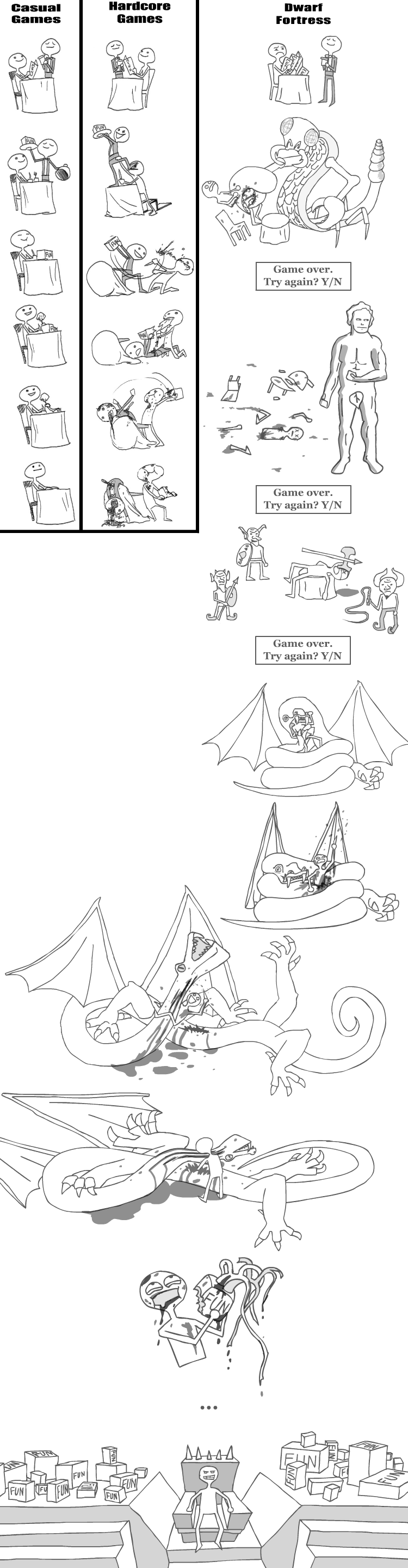
You might ask, though, "Is a fight against a high-mobility flying combat-as-war dragon that neutralizes the party's strengths fun?  After all, isn't that what we're here for?"  And my response to this is that if the party simply tries to engage such a dragon with standard tactics, they will die like chumps.  While this can be entertaining in and of itself, hopefully they will realize this is the case before dying like chumps (this seems fairly likely, given dragon flying maneuverability and our acid protection).  Once this realization is had, the Crazy Plans begin.  Plans like "Let's polymorph the monk into a giant eagle and try to Stunning Fist the dragon out of the sky" and "Let's try to toss the dwarf onto the dragon's back" and "Maybe we can use the [mule | henchman | bard | halfling] as bait get him to fly low enough for the half-orc to break his wing, and then we can gang up on him on the ground."  I, for one, enjoy Crazy Plans much more than standard move-around-the-grid-and-roll-dice-until-it-dies combats.  Then, if and when the Plan goes right and the dragon is slain, the players can claim that it was by their cunning and skill, rather than purely by their numerical and mechanical superiority.  That they truly earned their victory, rather than having it handed to them.  That !!FUN!! was had.

Further, dealing with high-mobility flyers is one of the standard dragon-hunting tropes; comes with the territory, and shouldn't be ignored for the sake of a nice set-piece battle.  Used every dragon fight?  Maybe not; stuff does get old and annoying, and PCs will fall back on old crazy plans again, which then become not-crazy.  But this one in open wilderness?  Hell yes.  We failed to corner or ground the dragon; flight was a natural and suitable strategic consequence of our tactical error (which stemmed from the planning error of not bringing harpoons or giant nets of iron chain, which stemmed from the systemic error of the exotic weapon proficiency subsystem...  but that's another post).

In conclusion: Tim complained of the lack of cinematism in this fight.  I will agree that little was to be had (except throwing through buildings).  Retreating and re-engaging later builds tension; it's almost like having a legitimate recurring villain.  Crazy Plans beget cinematic moments; ergo, if you want cinematism, fight dirty and watch the players scramble.  Eat the henchmen, sink the boat, burn down their hometowns, and so forth.  This is a dragon, goddamnit, the biggest, baddest scariest monster in the book; anything goes.  It has a name and 16 Int, and it's on its home turf; this whole thing should've played out a lot more like Predator, complete with piles of dead henchmen (and potentially PCs), explosions, and traps (starring Shin-Yao the half-orc as Ah-nold).  Good stories do not come from standard "run up and hit him" combats - in the words of a sig on EnWorld, "When Perseus fought Medusa, the math didn't work and combat was really swingy.  Perseus was a hero.  The good stories are never about balanced encounters."

Monday, April 23, 2012

Lands of the Inner Sea - Dardantus

I don't have a scanworthy map drawn up yet, so instead I'm going to be doing a bit of textual description of places.  This is as much a process to get my thoughts in order as it is to potentially inform players, I guess.  Still need a world name and a bunch of place names.

There are two main seas; the Inner and the Outer.  The Inner is long and narrow, running north-south, and its coasts are the primary region of human settlement.  The climate is wet and cold in the north, hot and dry in the south, and pleasant in between.  At its southernmost extent, the Inner Sea meets the Outer Sea at the Straits of Dardantus, which take their name from the city which is built there.  The city of Dardantus is a hub of trade and culture, home to the Great Bazaar and many temples, including extensive complexes of both the Harmakhans and the Ashtari.  Anything which can be bought or sold is available, including magic items, Thrassian mercenaries, war galleys, exotic animals, spices, and slaves.  Who or what rules Dardantus is unclear; it is known only that missives sealed in distinctive purple wax sometimes appear mysteriously, and kingdoms rise and fall upon their content.  Rumor and speculation suggest demons, undead, and worse, but the common belief is that a cabal of merchant-wizards is more likely.

As a result of the lack of clear rulership, law in Dardantus is a murky business.  There are magistrates operating under the authority of the seal, whose purpose is to keep commerce running smoothly.  In practice, they tend to pursue only crimes against particularly wealthy merchants, and those involving destruction of large amounts of property.  Corruption is exceedingly common, and bribes or small gifts are part of daily business.  Justice for small crimes is, by and large, just another commodity in Dardantus to be bought, sold, and haggled over.  All manner of unsavory agents are used to carry out vendettas, including the Harmakhan assassins, mercenaries, and adventurers.  A number of secret societies and guilds of thieves wage a continuous proxy war; adventurers who become unknowingly embroiled in it will soon find their lives made quite interesting.

Dardantus entered human hands during the Zaharan War, when the Sorosi took the Zaharan city of Darad-Knar, upon whose ruins Dardantus was build.  The Dardanians declared independence shortly thereafter, and despite their naval power the Sorosi have been unable to retake the city ever since.  The fact that previous Sorosi efforts have been foiled by unfortunate accidents and freak storms is often used to lend credence to the notion that a supernatural being rules Dardantus, but wiser heads attribute the accidents at least to covert operatives.  While unable to retake the city, the Sorosi pirates are known to favor ships flying Dardanian colors, and as a result Dardantus maintains almost no merchant marine of its own, instead preferring to charge others for the service of using the straits.

As a people, the Dardanians maintain much of the flamboyance of their Sorosi origins, though their tastes have been altered by their constant exposure to cultures from across the Outer Sea.  They enjoy spicy food, dark wines, brightly colored clothes, intrigue, bloodsport, and other 'exciting' diversions.  A grand arena caters to these latter tastes, as well as numerous smaller rings across the city.  Monsters are in high demand, and many a beast-hunter from the Shieldlands to the west seeks to bag an owlbear or basilisk for sale to the arenas.  These arenas also host races, duels (which in Dardantus are often by proxies or champions of both parties, in contravention to Sorosi dueling policy), and the annual Tournament Arcane, which brings an influx of mages to Dardantus in the early spring.  The other great yearly celebration is the Festival of Masks, held in the fall, which is a confusing and often destructive mix of revelry and secret society activity.

Of the other cultures of the Inner Sea, the Shieldlanders, Urdukhar, and Sorosi are all common sights in Dardantus as merchants, priests, and sailors.  Myrmidians in Dardantus are typically mercenaries in the employ of wealthy merchants, while the Talasi are very rare except during the season of the Tournament, which they often win.  It is unheard of for the Skanuks to raid this far south, and various Skanuk chieftains are on record as not believing so large a city possible.  The Sajuk horselords gave up on trying to sack the city ages ago due to logistic difficulties, but individual Sajuk are not uncommon in the employ of caravans as drovers or guides.  The sandstone dwarves of the eastern mountains maintain something of a ghetto in Dardantus, as it is a common destination for their caravans and their works are held in high esteem, though the granite dwarves of the west are much rarer.  Dardantus hosts the greatest proportion of Zaharans in any Inner Sea state, though there is still much prejudice against them and they tend to keep to themselves.  When someone other than a Talasi wins the Tournament, it is typically a Zaharan.

Of the Outer Sea cultures, the elves are the relatively common compared to other parts of the Inner Sea.  Many elves in Dardantus are believed to be agents of the Jade Throne, and often rightly so.  They play well in the intrigues of the city, but have yet to win any significant control from its mysterious masters.  Merchants from the island state of Volar are common as well, being a fellow Sorosi successor state, and they bear with them spices, slaves, and tales from the other cultures of the outer rim.  The lizardmen of Thrassia are most common as slaves and gladiators, though a few merchants are known to employ them as terrifyingly savage bodyguards.  Natives of the Crawling Isles are not uncommon, often coming in on Volari merchant vessels, but are also often slaves.  The obsidian dwarves are highly valued as slaves for their rarity on account of their insular and warlike nature.

In short:  In location, Byzantium meets Gibraltar.  In spirit, not unlike Mos Eisley.

Friday, April 20, 2012

Still Alive...

... but not much to say.  Most of the stuff I was working on seems dusty or non-useful.  I have started brewing a setting for ACKS in preparation for the summer game, though.  At this point I'm just kind of sketching on the macro level.  It would be a viable strategy to just pick a small region, detail it, and drop the characters into it...  but I kinda feel like the Big Picture is an important part of sandboxing.  Even having some rough data down gives me material to use; where are these merchants from?  Well, where does it make sense for them to be from?  And so forth.  I think I'm going to wait on player input before I choose a region to start drilling down to deeper detail for.

At this point I think my primary sources of inspiration are history, the Wilderlands, and Leiber's Fafhrd and the Grey Mouser stories (of which I must admit I have not read as much as I would have liked).  History is handy mostly on a flavor level; yes, part of me does want to run wintery Medieval Northern European fantasy, but Skyrim kinda beat me to the punch, and there are a lot of underutilized sources from the classical world.  So far I've tapped the Phoenicians, Egyptians, Hellenic Greeks, Babylonians, and Byzantines, and I'm also considering the Hittites.  More of a "civilization is yet young and not really all that civilized" flavor that I really liked in Iron Heroes.

Wilderlands and Leiber both seem to agree on a couple points that I'd like to steal.  From Wilderlands, the primary political unit is the city-state and the territories which pay it tribute, and these city-states exist in a tense pseudo-peace most of the time.  War is a possibility, but open war at least is not continuous.  Related in Leiber's work is the existence of The City, Lankhmar (or, in Wilderlands, the City State of the Invincible Overlord).  Effectively, a Rome-grade city which is rife with corruption.  These are great places to pick up hooks, buy and sell crazy things, become embroiled in intrigue, and (as an endgame goal) conquer and rule yourself.  Also notable in both of these settings is the wide variety of climates; I'd like it to be possible to climb White Fang Mountain one session and explore a ruined desert city the next (just as was done in Swords Against Wizardry) at sufficiently high levels for travel to be relatively easy.  So that's something I'm consciously keeping in mind as I map.  A world of diverse climates is likely to have a higher number of distinct cultures, too; pulling from Guns, Germs, and Steel, cultural diffusion is strongly influenced by crop spread.  Since crops grow best in similar climates, many climates means many less-advanced cultures without that much interaction, which is perfect for the feel I'm going for.

Sunday, April 15, 2012

Kernel Mode Engage

No material and no game this weekend.  Must write kernel.  Kernelkernelkernel.  Probably no post tomorrow either, and possibly Wednesday; should be good for Friday.  I apologize for this interruption.

Friday, April 13, 2012

A Reflection on My Origins and Supplement Bloat

Freshman year, I tried to run a game that would go back to my roots.  D&D 3.5, 1st level PCs, 4d6 drop and assign with utterly newbie players in the Sunless Citadel.  I expected it to be a blast, and it almost was.  The druid's animal companion was a bit strong, but other than that, things could have been OK.  Except that I had one of Those Guys...  a WoW veteran who went straight for the CharOp boards and ripped through supplements, and ended up running an area control Tome of Battle crusader with a spiked chain.  My official policy on supplements at the time was "anything goes"; I had a fellow who wanted to play a warlock, and what's the danger of supplements for newbies, anyways?  They were having enough trouble getting their heads wrapped around core that I wasn't concerned.  Man, did that backfire.

So that game dissolved, and I started DMing for a group of established gamers.  I guess I took away the wrong message; I thought it was just a problem with That Guy, and people like him.  There was some cognitive dissonance going on, because I saw in him a mirroring of myself, and that led to my first post on powergaming.  But in any case, when I went to run True20 for the veterans, I once again allowed supplements - the Warrior's and Adept's Handbooks (the Expert's Handbook was a terrible affront to True20's design ethos).  And so we had one canny, sneaky thief...  and an absolutely unstoppable warrior and a wizard who was immune to basically everything I could throw at him.  That campaign died when I finally threw up my hands and went "Look, the only thing that can actually threaten Mr. Wizard here is a caster of like 6 higher level than you guys, using True20's Disjunction equivalent.  There aren't many of those in this setting, and I don't have time to prep that ones that do exist.  Also, if they come after you, they will bring a horde of orcs and you will all die."  So we killed that campaign and converted to Traveller.

But during the post-mortem discussion for True20, we as a group realized that supplements were probably the real problem.  The thief was skilled, and could sneak or lie his way out of anything, but was terrible in a straight-up fight.  In short, he was what a thief should be.  The warrior and the wizard were absolute monsters, and the pieces of their designs that enabled that power came primarily from supplements.  So, for the Traveller campaign, we came to a consensus as a group to make things from supplements available only under the GM's purview, and introduced into the game in the manner of his choosing, rather than being driven by the players.  And with that rule established, the Traveller campaign was pretty damn awesome.  We've been running core-only Traveller and Trailblazer ever since, and those campaigns have likewise gone pretty well; none of them have folded over rules interpretations or inability to prepare for PC combat capabilities (though I think we're pushing the limits of Tim's willingness to prep in the current TB game...  :\.  )

My recent musings on playing with newbies brought to mind my own time as one, and how awesome it was.  And I started wondering, "Wait...  how did I get to be a terrible powergamer?  I know I wasn't like this at the beginning."  And I looked back through time.  My first campaign was the 3.0 starter box.  Went great, except for when my fighter died, but hey, that happens.  Second campaign was right after we got the actual 3.0 books, and went fantastically; many dragons were slain, much treasure gotten, and much fun had by all.  We had access to the A & B 3.0 supplements (Tome and Blood, Sword and Fist, and so forth), but we didn't take that much out of them.  No prestige classes, and I don't think any feats, though probably some spells.  After that...  things started to go down hill.  There was the 20th-level game where we went "Let's see what 20th-level characters can do...  holy shit", the Midnight game with Thagg the feral half-orc half-dwarf giantblooded orc-tosser, the X-Crawl gestalt ubergenerics game, the Savage Species monster-gestalt game, our travesty of a Vampire the Masquerade game (featuring Olaf the Brujah lumberjack berserker), the True Sorcery thought experiments...  urgh.  Notable high points were several low-level games with my friends from high school (rather than my family), and my brother's Eberron game, which was distinctly more sane (though still quite high-powered).

And after a bit of reflection on this descent into insanity and powergaming, when I run ACKS over the summer, I don't think I'm going to be allowing stuff from the Player's Companion.  Nothing against the ACKSPC, but...  class and spell construction systems are really more GM tools, anyways.