My players have run up against time and speed limits. The dungeon portal only stays open for up to six hours, and they've started running up hard against this time limit during their last couple of expeditions. This has severely limited their ability to explore outside of their currently-mapped area. Most of my players seem to be in favor of setting up a safe zone and camping in the dungeon, but one of them was asking me about the encumbrance rules yesterday and talking about doing a low-gear, evasive reconnaissance operation one week, and then sending a more heavily-armored follow-up expedition to selected targets the next week.
I think this is a very interesting idea. I hesitate to call it a good idea, because I've never seen it done before, but it's very much in the style of "dungoneering as heist movie, not action movie", and I think it'd probably work well if done cleverly.
So let's think about this a bit.
To move 120' per turn, you need to be carrying less than 5 stone. 90' requires less than 7 stone, and 60' requires less than 10 stone. An unarmored wardog has a speed of 150', while an armored wardog has a speed of 90', and a mule can carry up to 20 stone at 120', but drops to 60' above that.
There are a couple of proficiencies which might be unusually good for this type of operation. Endurance lets you skip rest turns, increasing your effective movement speed by 20% (although notably, skipping multiple rest turns doesn't seem to stack up increasing penalties under rules as written). Running boosts your base movement speed by 30' in chainmail or lighter armor. Skirmishing lets you disengage without pre-declaring it (I'm not sure this is actually good if your doctrine is evasive, though, because in that case you probably tend to declare disengage?).
Dexterity really shines as a stat in this type of party composition, because it lets you get your AC up into the 7-8 range without having to compromise your speed with heavy armor.
In terms of party composition:
Wizards, thieves, bladedancers, bards, and nightblades are not inconvenienced in the least by requirements for reduced gear, and can all easily maintain 120' speed.
Barbarians, explorers, and other classes limited to chainmail might have to make some sacrifices to maintain 120' speed. I think our current explorer is in chainmail with an arbalest and a spear, which is 6 stone of gear for 90' speed. To hit 120' with a real ranged weapon, she'd probably have to downgrade chainmail to ringmail and spear to sword. But 90' might be an acceptable movement speed; it's still 50% faster than our party's current speed, and at 90' you can use armored wardogs.
Assassins are already a weird case, because they can use heavy armor, but they lose a lot of their abilities if they do. For 120' speed, leather, a polearm, and a ranged weapon is probably a good bet. At 90', they have more options.
Assassins and explorers are both notable because they have Dex as a prime req (so they can boost it during character creation), and they get fighter damage bonus. In a high-speed low-drag party, they're both good front-line options.
Thrown weapons might actually be decent in this paradigm; each javelin is an item rather than a stone, so you can fill out your last couple items of encumbrance with them (say you're an explorer going for 120' speed in chainmail with a sword; that puts you are 4 stone and one item. You can still carry four javelins or oil flasks, which put you at 4 stone and 5 items, one short of 5 stone and 90' speed). Slings are also substantially less horrible here than usual, because they have decent range (more than double that of javelins) and only weigh one item of encumbrance with their ammunition. d4 damage sucks, but fighter damage bonus, Inspire Courage, and Bless all apply...
Fighters, clerics, dwarves, and spellswords all have some difficulty at high speeds. To hit 90' speed, you have to lose any two of plate, shield, and spear. Best possible AC without magic or dexterity at 90' is 7, via banded mail, shield with fighting style, and a sword (and four flasks of oil or javelins). It goes without saying that the weight-reduction effect of magic armor is fantastically good in this context. Plate with a one-handed sword used in both hands is not a terrible choice if you don't have FS:Shield (as if), and banded+spear (or polearm) is probably doctrinal for second-liners (including spellswords). At 120' speed, all of these classes are going to have real trouble without magic armor. Fighters do get more proficiencies than most classes, and for one specializing in this sort of thing Running is actually a pretty strong option. Chainmail armor, shield with fighting style, and a spear weighs 6 stone, which would normally put you at 90', but Running boosts that back up to 120' with AC6.
Thrassians and ratmen, unfortunately, are in a whole 'nother level of trouble, since their base movement speed is only 60'. Besides Running, their best option is probably to ride mules. We've previously ruled that an adult human weighs about 15 stone. Since mules can carry 20 stone at 120', a thrassian gladiator in chain (19st total) could ride one at 120', and then dismount to fight with tooth and claw at AC7. This poses some difficulties, as mules can be killed and you need to remount if the party decides to retreat, but Riding as a proficiency scales well into the late game and solves the more pressing of those two problems (I am not so cruel a DM as to rule that Riding (Mules) should be separate from Riding (Horses)). The other can be solved by bringing more mules, which you were going to want to do anyway for mundane adventuring gear and hauling treasure; if you're not going to need a piece of gear close-to-hand in combat, put it on a mule.
So with all that said, I think 90' speed is very doable. Three of the five PCs transition very well to lightweight play (mage, bladedancer, and explorer). The elven enchanter and bard henchmen do as well. The fighter henchmen are mostly either expendable or replaceable with wardogs (of which the party already has two). The five characters who run into difficulties are Scarth's two cleric henchmen, Clarence the dwarf, Chathis the lizardman, and Dogeater the ratman. Clarence runs plate and two-handed warpick, but could hit 90' by switching to a one-handed pick used in both hands. Slagathor the Cleric runs plate and polearm with Martial Training, and could drop down to banded and polearm. I think Rheingold is plate+shield with Lay on Hands; dropping the shield is probably the best option for him. Dogeater and Chathis really don't have many options besides being mule-dragoons.
Anyway, I'm excited about this proposed alternate style of play and hope it happens. I've been a little bit bored with the dungeoneering game recently, and mixing it up would be good.

Tuesday, November 22, 2016

Saturday, November 19, 2016
Domains at War: Tribal Goblins
The first thing to know about goblins is that they're terrible. The
only races as bad at fighting as goblins are humans and kobolds, and the
humans make up for it with superior organization and technology.
Goblins are also very slow, have low carrying capacity, and take
penalties to hit in daylight. Goblins do have a couple of things going
for them, though - they have 90' darkvision, they don't weigh as much
as a man or dwarf, they can apparently semi-domesticate wild beasts, and
they have some of the best shamans and witchdoctors of any beastman
race (only hobgoblins are comparable).
Despite these
strengths, pure goblins remain a pretty terrible choice for a field
army. Their tactical weaknesses are immense, and require significant
strategic advantages. With their darkvision and cave-dwelling, Viet
Cong-style strategies seem to make a lot of sense to me: live in a heavily-trapped and laboriously-extended cave complex where regular human units dare not go, make night raids from one of its many entrances or
exits, and then get back in the cave by dawn. In this case
beast-cavalry can be used to locate good raiding targets, extend your
raiding range, or delay pursuing units chasing your raiders back to the
lair. This seems to me about the best an isolated low-tech goblin
village or warband can hope for. Most of these fights will be at platoon-scale.
Frankly a goblin domain shouldn't play
all that differently - it may need to farm on the surface, but
everything that can be underground probably should be. On offense they
raid, and on defense they play guerilla from their tunnel system. They
just don't have the strength and mobility (outside of massed
beast-riders, which are rare and expensive) to engage in fair fights
with humans.
This post is concerned with units from this tribal organization and tech level. This is basically the default for ACKS goblins - they can't make metal armor, and their armament is limited to crude swords, spears and polearms, shortbows, and slings. But they do get witchdoctors and beasts. My take on them here is aiming thematically for the sort of thing you might see in fairy-tale goblins; they cackle, they infight, they steal children in the night, and they ride whimsical giant animals. A post on "Mordor Goblins" operating at a higher tech level in support of orcs is forthcoming maybe eventually; I'm kinda burnt out. was published years later!
So here are some tribal goblin units:
Redcaps: 1/2/3 Irregular Foot, AC 2, HD 1-1, UHP 6, ML 0, 4 polearm 10+ melee
Redcaps are veteran goblin warriors who delight in terror and slaughter. They wield mismatched, hooked polearms, favoring modified scythes, and wear stinking leather caps stained with blood. Mechanically, they're 1st-level goblin assassins. They often strike from ambush, and may deploy hidden in obscuring terrain at the beginning of a battle (if fighting at night, redcaps may hide in any terrain). Note their location and facing - the first time they activate, they are revealed and placed on the map. They are also revealed if an enemy unit attempts to enter their hex, or if the obscuring terrain is removed by magic or fire. When attacking a unit in the flank or rear, or a unit which is disordered, they gain an extra +2 to hit (for +4 total if flanked or disordered, or +6 total if both) and deal an extra point of damage if any of their attacks hit (just as lances do on a charge).
Best-case scenario for redcaps is deployed in the flanks during an ambush or envelopment scenario, where they can rear-charge units who have run up against the main goblin line (potentially at +8 to hit (+2 charge +2 flank +2 disordered +2 backstab) and +2 damage from polearm-charge+backstab, which has the potential to wipe most human units). Consequently, if you're playing humans, it behooves you to use light units to check obscuring terrain for redcaps, or at least to block their charges.
Redcaps demand 15gp/mo in wages, for a company TCO of 2.25kgp/mo. I estimate their BR at around 0.75, but this does not account for their ability to deploy hidden.
Redcap Riders deployed on wolves would be hilariously strong on the rear-charge, even if they couldn't hide. Maybe I should do stats for them. At first warg (dohoho), you could turn most goblin units into redcaps in much the same way you'd make humans veteran: one extra attack from assassin damage bonus, +1 morale, ability to deploy hidden if infantry, ability to backstab in melee, and +12gp/mo wages. Following the veteran guidelines, around 1 in 4 goblin mercenaries is a redcap.
Deathcap Bowmen: 1/2/3 Irregular Foot, AC 2, HD 1-1, UHP 6, ML -1 unpredictable, 2 shortsword 10+, 2 poison shortbow 10+
Deathcap bowmen are goblin archers who soak their arrows in a variety of poisons and toxic molds painstakingly grown in underground fungal gardens. They get a lot of exposure to other, less-deadly fungal compounds too, and their grip on reality is somewhat tenuous. They wear wide, brightly-colored hats with down-turned brims vaguely resembling the cap of a mushroom. When a deathcap unit rolls a natural 1 on a shortbow attack throw, in addition to gaining a depletion marker, they take 1 UHP of damage and must roll shock. Two other variants to consider are madcaps (poison causing confusion) and nightcaps (poison causing sleep).
By the rules in the book, deathcaps have a BR of around 8. 0.5 of that is the unit itself, and the remaining 7.5 of that is just the poison (based off of a Potion of Poison, which can be used to envenom projectiles). I'm a little skeptical that that's reasonable. Sure, poison attacks are pretty good, but the delivery system is terrible. This isn't a wyvern or a purple worm where you get stuck in and then start making poison attacks every round with good THAC0. These are goblin archers with a maximum range of 5 hexes (when firing at cavalry or ogres), which many units can close in a single charge without giving them a chance to fire (and they can't ready to fire on a closing unit, because they're irregular). They also can't withdraw or disengage. If you put them out front in the opening ranged fight, human ranged units can withdraw to avoid the poison attacks, and the deathcaps are susceptible to being tied down in inescapable melee, in which case they 1) lose the ability to fire, and 2) probably get crushed because their AC and morale are both bad. But, if you keep them behind the main line and wait for the enemy to close, they still can't fire into the melee and take a -4 volley overhead penalty to hit anything behind it. Basically, because they're irregular and it's a ranged attack, they're going to have a hard time using it well.
I suspect that good use of deathcaps relies heavily on terrain. Placing them in the edge of obscuring, elevated terrain with an open field of rough terrain in front of them (mud, a river ford, whatever) is their absolute best-case scenario, because the rough terrain slows down melee units trying to close with them, the obscuring terrain provides a bonus against ranged fire, and the elevated terrain gives them a bonus to hit and inflicts a further penalty on ranged fire against them. But that's a mighty specific set of circumstances.
Comparing them with other units in the BR 7.5-8.5 range is also instructive. Consider: orc boar-riders, elven horse-archers, human cataphracts, ogre heavy infantry. It's a tough field. Would you rather have a company of deathcaps than of any of these units in a typical battle? Probably not. Deathcaps don't have anywhere near the survivability of any of those units (lacking AC, HP, and withdraw capabilities), and even if they manage to hit the sort of high-HD foes they need to be hitting for their damage output to compare to ogres or boar-charges, that extra damage is still gated on a poison save, which high-HD monsters have a reasonable chance of making. I just don't see it.
I really think a more-correct BR is somewhere in the 3-4 range. I would probably pick deathcaps over orcish crossbowmen at BR 2 because at that point I could get a bunch of them, but I probably wouldn't choose them over hobgoblin longbowmen at BR 4 (who are actually Loose Foot with OK speed, longer range, and good HP). Ultimately the problem is that they're both fragile and unreliable, which is a hard sell.
Now, if you put them on flying mounts, which fixes a lot of their fragility problems, we might be talking...
Goblin Bat-Archers: 3/6/9 Flyer, AC 2, HD 1-1, UHP 6, ML +1, 2 shortbow 10+ ranged, 2 shortsword 10+ melee
I'm
not sure exactly how much goblins weigh, but it isn't much. Giant bats
are a perfect mount for cave-dwelling, night-raiding goblins, and are
faster than wolves. This unit also benefits from the fact that all
flying units are FLY movement type, even when they would normally be
irregular - this means that they can withdraw away from missile fire.
Equipped with leather armor, shortbows, and shortswords, bat-archers are
a good choice for harassing human forces pursuing goblin raiders on
foot. Tactically, they're good for engaging enemy archers in the
opening phase, keeping light cavalry occupied, and pursuing retreating
units. Flying+ranged is also strong in hilly terrain, because you have great lines of sight.
They don't hit all that hard, though...
Wages are 12gp/mo per bat+goblin pair.
Monthly supply cost is 64gp for the bat and 2gp for the goblin,
and specialist cost is 90gp/mo for a company, so TCO is right around
4.75kgp/mo for a company. Compared to wolf-riders at a similar price
point, bat-archers are more fragile and don't have the
brutally-effective charge attack, but they're faster and will almost
never come under melee attack. Frankly they're also pretty annoying to
kill with ranged attacks, because in addition to being able to Withdraw, enemy archers also have to Volley Overhead to
hit them. Their battle-rating is around 3.75,
well below that of wolf-riders. I'm not really sure how to handle
availability on any of these goblin cavalry variants, and the fact that
these are basically flying horse-archers certainly doesn't help.
The natural extension of this is deathcap bat-archers, but since I'm not sure how to properly price poison, there's not much more to say about them.
Goblin Bat-Lancers: 3/6/9 Flyer, AC 2, HD 1-1, UHP 6, ML +1, 2 lance 10+ melee, 2 javelin 10+ ranged
Another
light-cavalry variant. Bat-lancers are useful in the opening phase of the battle for
disrupting shield-walls with javelins, and then after the melee is
engaged they can easily
get behind the lines and charge the enemy rear. Again, this
unit benefits significantly from being a Flyer instead of Irregular
Mounted, because it can Disengage to pull out of hairy melee fights and
Withdraw to avoid missile damage. Wages and TCO should be
pretty close to the same as bat-archers, availability should be
pretty comparable to that of wolf-riders. Same skills required, and
the occupational hazards remain significant: your mount won't kill you,
but gravity might. Their battle-rating is around 2.75.
Goblin Shrew-pack: 1/2/3 Irregular Foot, AC 6, HD 1, UHP 8, ML +2 unpredictable, 4 bite 9+
While giant shrews may be too small to ride, they make excellent warbeasts due to their high AC, multiple attacks, and aggression. They also breed readily in goblin tunnels, and share the goblins' taste for delicious bugs. This is a pack of 100 giant shrews, armored in leather and driven by 20 goblin handlers in leather with spears, shields, and high-pitched whistles. Shrew wages are 6gp/mo, and their supply cost is 2gp/mo. The shrew-herders demand 75gp/mo in wages each, plus 3gp/mo for serving as infantry and 2gp/mo in supplies, and 130gp/mo for an armorer to maintain all that leather. TCO comes out to a mere 1.75kgp/mo, with a battle rating around 2 or 2.25. For bonus points and much-needed speed, decrease the number of shrews and mount the handlers on dire wolves.
The shrew-pack is vulnerable to magical silence. On company scale, each time silence is cast on the shrew pack, it becomes disordered and must roll shock. Each silence in effect on a shrew pack increases their THAC0 by 1 and decreases their AC by 1, to a maximum of four points (so a shrew-pack that had somehow not broken while under the effect of four silence spells would have AC 2 and make 4 bites at 13+). On platoon scale, a single silence spell causes the full 4-point penalty, while on larger scales it would take more casting.
The shrew-pack is exactly the sort of center-line unit goblins need for melee fighting, and at a very reasonable price. Just be sure to not have anything behind it when it breaks morale.
And now for some "heroes". Naming courtesy of Dwarf Fortress. These heroes are really only viable for platoon-scale combat but that's OK, because that's typically the scale tribal goblins will be operating at.
Atu Helltwisted, Witchdoctor
Goblin Witchdoctor 6, Str 7, Int 17, Wis 14, Dex 13, Con 6, Cha 17
Class proficiencies: man I have no idea how class profs work for a hypothetical goblin class that doesn't exist yet... Intimidation seems reasonable though
General proficiencies: Healing 2, Alchemy
Equipment: leather armor +1, Potion of Fire Resistance, spear
Derived stats:
HP 6, AC 4, init +1, THAC0 10+ melee for 1d6-1 (sad tombone.wav)
Leadership 6, ZOC 3, Strategic Ability +2, Morale Modifier +2
1/2/3 Foot Hero, no unit-scale attacks
Relevant spells:
2/day: Fireball, Dispel Magic (also Telepathy, Clairvoyance)
2/day: Stinking Cloud, Invisibility (also Deathless Minion, Locate Object)
2/day: Sleep, Shield (also Spider Climb, Choking Grip)
Atu Helltwisted is a competent leader and a dangerous spellcaster but very fragile physically. He probably leads from the rear except when casting. He can be used as an independent hero on company-scale because he has 3rd-level arcane spells.
Snamoz Murkyghost, Shaman
Goblin Shaman 8, Str 13, Int 11, Wis 15, Dex 15, Con 9, Cha 11
Class proficiencies: Beast Friendship
General proficiencies: Naturalism, Military Strategy
Equipment: leather armor, spear +1, Potion of Growth, dire wolf mount (Bramblewane, 25 HP)
Derived stats:
HP 9, AC 3, init +1, THAC0 7+ for 1d8+3
Leadership 4, ZOC 2, Strategic Ability +2, Morale Modifier +0
2/5/7 Mounted Hero, no unit-scale attacks
Relevant spells (from the Shaman list):
1/day: Call Dragon, Insect Plague, Summon Weather
2/day: Dispel Magic, Skinchange
2/day: Call Lightning, Winged Flight
3/day: Bless, Obscuring Cloud
Snamoz Murkyghost is a mediocre leader and quite fragile, but Call Dragon is a good spell even on company-scale. If he's already used Call Dragon this week, Insect Plague is no slouch either. Skinchange, Winged Flight, and his wolf all give him substantial mobility.
Ago Thiefsliced, Redcap Captain
Goblin Subchieftain, Str 16, Int 9, Wis 9, Dex 18, Con 15, Cha 10
Class proficiencies: Skulking
General proficiencies: Leadership
Equipment: war scythe, leather armor +1, Potion of Invisibility, Elven Cloak
Derived stats:
HP 10, AC 6, THAC0 7+ for 1d10+3, init +2, hide in shadows 9+, backstab x2
Leadership 5, ZOC 2, Strategic Ability +0, Morale Modifier +0
1/2/3 Foot Hero, no unit-scale attacks
Ago Thiefsliced is a pretty poor leader, but he can be dangerous to heroes when charging from ambush. He is probably best used as a lieutenant to reduce the activation cost of a platoon of redcaps hidden distant from the division's leader, though if you had three platoons of redcaps hidden together along a treeline, you could do worse for a captain. If you want a leader for redcap riders, swap Skulking for Riding.
Ngom Cradlethief, Goblin Chieftain
Goblin Chieftain, Str 14, Int 16, Wis 13, Dex 16, Con 11, Cha 13 (hell of a statblock)
Class proficiencies: Fighting Style (Missile), Command
General proficiencies: Riding, Leadership, Military Strategy
Equipment: lance, shortbow +1, leather armor, vampire warbat (Moonvexing, HP 12), potion of healing
Derived stats:
HP 17, AC 5, THAC0 7+ melee for 1d10+3 lance or 4+ ranged for 1d6+2 shortbow (I'm assuming that as a 3HD underspecified monster-class, he gets 2 points of fighter damage bonus plus his 1 point of Str), init +2
Leadership 6, ZOC 3, Strategic Ability +3, Morale Modifier +3
3/6/9 Flying Hero, no unit-scale attacks
Ngom Cradlethief is old, cunning, and vicious. He is a very competent commander at platoon scale, and his giant vampire bat mount has mortally surprised more than one human lieutenant. In a platoon-scale fight against a 4th-5th level PC party with mercs, he should probably try to avoid directly attacking heroes (fireball and an archer or two would make that a short engagement) and seek to win the battle by leadership and hopefully numbers, where he is strong.
Wednesday, November 16, 2016
Lawful Beastmen
I was thinking about it in the shower, and realized that I could totally reskin bugbears as panther warriors, because they're sneaky like cats and hit pretty hard from ambush, and they're about three times tougher than a 1st-level human.
One thought led to another, and I got to wondering: if I were a high-level, lawful wizard in ACKS, and there were a horde of beastmen threatening my isolated domain, maybe I'd consider breeding me some non-chaotic beastmen. Get some paladin volunteers, tell 'em I'll give them the hearts of lions, and do some mad science. Sure, they'd technically come out Neutral under the crossbreeding rules, but there is a time and place for breaking some rules.
And you know, Thrassian Gladiator would be an easy, easy conversion to Lion Knight. Swap out swimming, darkvision, ranged weapons, and maybe a little natural armor for abilities like protection from evil, immunity to fear, alertness, and roar (cause fear). The real question is what to do about Inhumanity. Sure, you're a 7' tall, 300lb pile of teeth and claws, but you're also plastered in holy symbols and you radiate an aura of courage.
I almost like leaving Inhumanity, though. It's part of the sacrifice. Sometimes you must abandon that which you wish to protect. And if Cha is a prime req, maybe the penalty is recoverable.
Drawing from European heraldry for "good beasts", there's also room for eagle-men, and soldier-bears are already well-established in the OSR. Dog-headed men seem more chaotic in mythology, with the notable exception of Saint Christopher (who was mistranslated; however, the section on dog-headed men in the Medieval East does have two wonderful suggestions for character names: "Reprobate" and "Abominable").
I also like this addition of lawful beastmen because I can put them on random encounter tables and stock wilderness with monastery-fortresses of lion-men. Leaving Inhumanity means they probably leave humans alone for the most part, but they serve as a source of recruitable (strong) troops during the wilderness levels. One issue we've had previously is that all wilderness-recruitable troops were at best very Neutral, and the only ones really available in quantity were chaotic beastmen. Adding lawful beastmen, particularly to Borderlands regions, might make gathering a lawful army a bit more viable at the mid-levels (though they should probably be few in number, because high HD and ability to use formations is a very powerful combination).
One thought led to another, and I got to wondering: if I were a high-level, lawful wizard in ACKS, and there were a horde of beastmen threatening my isolated domain, maybe I'd consider breeding me some non-chaotic beastmen. Get some paladin volunteers, tell 'em I'll give them the hearts of lions, and do some mad science. Sure, they'd technically come out Neutral under the crossbreeding rules, but there is a time and place for breaking some rules.
And you know, Thrassian Gladiator would be an easy, easy conversion to Lion Knight. Swap out swimming, darkvision, ranged weapons, and maybe a little natural armor for abilities like protection from evil, immunity to fear, alertness, and roar (cause fear). The real question is what to do about Inhumanity. Sure, you're a 7' tall, 300lb pile of teeth and claws, but you're also plastered in holy symbols and you radiate an aura of courage.
I almost like leaving Inhumanity, though. It's part of the sacrifice. Sometimes you must abandon that which you wish to protect. And if Cha is a prime req, maybe the penalty is recoverable.
Drawing from European heraldry for "good beasts", there's also room for eagle-men, and soldier-bears are already well-established in the OSR. Dog-headed men seem more chaotic in mythology, with the notable exception of Saint Christopher (who was mistranslated; however, the section on dog-headed men in the Medieval East does have two wonderful suggestions for character names: "Reprobate" and "Abominable").
I also like this addition of lawful beastmen because I can put them on random encounter tables and stock wilderness with monastery-fortresses of lion-men. Leaving Inhumanity means they probably leave humans alone for the most part, but they serve as a source of recruitable (strong) troops during the wilderness levels. One issue we've had previously is that all wilderness-recruitable troops were at best very Neutral, and the only ones really available in quantity were chaotic beastmen. Adding lawful beastmen, particularly to Borderlands regions, might make gathering a lawful army a bit more viable at the mid-levels (though they should probably be few in number, because high HD and ability to use formations is a very powerful combination).
Wednesday, November 9, 2016
Reflections on a Session: 6 November 2016
- Time spent: ~4 hours
- Prepping NPC stats: 0.5 hours
- Presession henchmen and markets and whatnot: ~0.5 hours
- Running game: ~3 hours
- No new areas mapped
- No rooms restocked
- Dungeon areas explored in 3 hours of play:
- 1 lair (giant rats), cleared
- 2 monsters (cultists and manspiders)
- 2 empty
- Game-time elapsed in dungeon: 5 hours
- Random encounters: 2
- Expected random encounters: ~2.5 (not including checks from loud actions like Magical Music)
- Party composition:
- Clarence of the Stone, Craftpriest 2
- Wilgeva, L0 woman
- The Wardog With No Name
- Mule with repeating light ballista
- Scarth, MU 3
- Slagathor, Chaotic Cleric 2
- Thancharat, Elven Enchanter 1
- Rheingold, Cleric 1
- Chathis the Lizardman, Thrassian Gladiator 2
- Ascila the Assonant, Bard 1
- Dogeater, Ratman 1
- Mortal wounds taken: 1
- Chathis took an injury to his hips and spine while cleaving through a block of cultists with polearms who used the preemptive-hit ability to attack him even though he'd won initiative. His charge did prevent them from charging the party, though. Chathis can no longer forced-march, but hasn't gotten the injury fixed yet because that's more of a wilderness-level concern.
- Loot recovered:
- 733 gp in silver, trinkets, and small gems from the giant rats' nest
- Three cultists captured and sold into slavery to the manspiders in exchange for a promise of silk next expedition
- Traded twenty ballista bolts this session, and a promise of ten more next session, to Scabies' ratmen for information about a trap
- Traps triggered: 2?
- Bear-traps at the foot of a bridge were triggered and then relocated to cover a fork that the party didn't want to explore yet, where they caught a skeleton random encounter. Considering adding bear-traps to my equipment tables.
- XP from monsters: 416
- Frankly this was somewhat generous
- Well under the 4:1 ratio, but maybe the silks next time will help balance that out.
- Exploration session avoiding humanoid lairs -> low yield
I forgot my map today, which delayed our start by ~20 minutes. Derp.
The party's three clerics were very excited to see 10 skeletons come around the corner as they were trying to rest. Maybe I should use undead more often.
Party definitely felt time pressure today exploring a moderately-distant area. Proposed solutions included bribing the guards to keep the portal open longer, setting up a secure base-camp, and working out lodgings in Scabies' camp.
I didn't really expect them to go for the "sell your enemies to us as slaves and we'll supply you with silk" deal. That was silly of me. Chathis' player seems open to alliance with manspiders after discovering that they're also not from this sewer-realm, but come from Spiderworld via a dungeon portal. Chathis got slandered again while trying to recruit henchmen, so he can no longer recruit humans and must rely purely to beasthenchmen. Rest of party somewhat less sure about dealing with manspiders.
Plan for next session: receive silks, capture more cultists. Plans after that include securing a staging area and going after the section of their map that the ratmen told them is inhabited by "fire demons". Party is optimistic about their prospects there because they have an ice sword and a ring of fire resistance. Plans to go after Bone-gnawer seem to be on hold, as Scabies' tribe are holding their ground against the ratmen to the north.
I definitely need to prep for next session. They were right up against the stocked-unstocked boundary today.
Monday, November 7, 2016
On Battle Rating
I was working out wages on a unit of goblin spider-riders when my willingness to deal with wages as a wargamey balancing factor finally broke down. I eventually came to the conclusion that Battle Rating is the next best thing, and decided to work out BRs for the units I developed previously. Since I am interested in BR for this purpose of balancing armies for Battles, I eliminated references to the unrounded number of attacks, and replaced them with the rounded number of attacks (because that is the stat that will matter in play). I also rounded to increments of 0.25 instead of 0.5 for finer granularity.
From Mercenaries of the Vale of Traitors:
From Dwarf Units:
So I think one takeaway from this is that the BR system has a couple of holes in it. One of these is low-AC units. Command and Control aside, I'd much rather have two AC1 units than an equivalent AC2 unit, but the BR system estimates their worth to be equal (nevermind AC0 units; that's some Eurisko there). The only time AC2 is twice as durable as AC1 is if your opponent is at 18+ THAC0. On the flip side, at 12+ THAC0, which is pretty close to DaW humans, AC8 is actually eight times as durable as AC1. This falls rapidly as THAC0 improves, and as disorder, flanking, and charge bonuses pile on in the decisive melee. On the flip side, it seems that the early/ranged phase of the game has more AC-increasers / attack penalties available: volleying overhead, the Defend action, and cover. It'd be interesting to run a couple of games and keep track of all of the to-hit numbers that come up, to get a reasonable statistical sample and figure out how much better different armor classes actually are in practice.
Likewise, the current formulae do not take into account THAC0 at all. Four attacks are four attacks, whether they're from a human pike phalanx at THAC0 11+ or a 20HD war machine at THAC0 -3+.
The weight put on charge-maximum melee damage is also interesting. A unit which can make four melee attacks a turn is rated the same as one which can make two per turn, but gets a bonus hoof attack and a point of bonus lance damage on a charge. So that's kinda weird and potentially exploitable. It makes some sense though, because charges to flanks and rear of already-damaged units are when decisive (shock-retreat-inducing) melee damage usually happens in the not-giants-and-dragons typical case. Still, I could definitely see averaging in typical-case melee attack sequence.
Another thought is that BR is currently very coarse-grained, and going even beyond 0.25 increments to, say, multiplying BR by 10 and rounding to nearest (eg Greataxe Furies -> 18 points, dwarven plate crossbowmen -> 91 points) would bring it closer to a nice clean wargamey point-buy system. Smoothing granularity, however, is likely to reveal more edge cases and breakpoints (which isn't necessarily a bad thing as long as you know to look for them).
In any case, I have no illusions about building a perfect point-buy system. We saw Starmada attempt this, and it turned out to be a mess. I'm just looking for "generates fun games, works well in play." BR as it exists is probably a reasonable starting point for this.
From Mercenaries of the Vale of Traitors:
- Norse Reavers: 1.25
- This seems about right; they're light infantry, but they're decent light infantry
- Veterans: 1.75
- Norse Huskarls: 1.75
- Again, pretty reasonable - they're mediocre heavy infantry
- Veterans: 2.5
- Norse Skoglanders: 1.75
- The main reason these are cheaper than longbowmen is that their AC is lower, and the BR formula weights that pretty heavily.
- Veterans: 2.75-3, depending on pricing of special cover ability
- Skami Skirmishers: 1.25
- Veterans: 2.5
- Skami Hunters: 0.75
- AC 1 is super cheap. At AC0, units get BR 0... who needs armor, really?
- Veterans: 1.5
- War Mastadons: 9.25
- Compared to cataphracts at BR7.5, mastadons are slower, have higher AC, and do a ton more damage on the charge. Seems fairly reasonable.
- Orcs: per DaW:C, p68
- Iron Face Glaives: 4
- Hobgoblin heavy infantry with AC5 instead of 3 and corresponding speed decrease, reasonable rating increase
- Iron Face Archers: 6
- Hobgoblin longbowmen with AC5 instead of 3, again we see the weight put on AC
- Dwarven Spearmen: 4
- Seeing some inconsistency here; when I run the stock Dwarven Heavy Infantry A through my spreadsheet, I get 3.5 instead of 3 (per Campaigns). Heavy Infantry B is also at 3.5, but C is at 2.5 (lower damage), and D is at 2 (lower damage and lower AC). So Campaigns' BRs took sort of the middle of that range, and then mine are basically the best stock Dwarf Heavy Infantry but with higher AC, ergo more expensive. OK.
- Dwarven Crossbowmen: 9
- Campaigns has Dwarven Crossbowmen at BR 3.5, but with AC4 instead of 6, and 2 melee attacks instead of 3. Even taking unrounded values into account, I still get BR 6 for Campaigns' dwarven crossbowmen. Comparing them to human crossbowmen at BR3, they have 1.33x as many HP and 1.5x as much ranged attack power, so twice as expensive is not deeply unreasonable. Comparing them to Elven Longbowmen at BR7, they're slightly weaker in several ways (slower, lower HP, fewer melee attacks, higher THAC0). So I feel like BR 3.5 is probably substantially undervaluing stock dwarf crossbowmen, and then I went and put them in plate, which explains how I got from 6 to 9. Whether they're actually worth 9 is another question; if you have 17 BR to spend, is four units of dwarven spearmen vs two units of spearmen and one of crossbowmen a reasonable fight? This might be a particularly unfavorable scenario for the crossbowmen, though...
From Dwarf Units:
- Furies (calculated with UHP 10 and ML6 representing their special abilities):
- Greataxe:1.75
- with throwing axes: 2
- Axe+shield:2.25
- with throwing axes: 3
- Two axes:1.5
- with throwing axes: 2
- Getting the low-AC discount again.
- Musketeers: maybe I'll dig out Guns of War later and see what it says about firearm unit BR, if anything
- War Machine, assuming Morale +2:
- No entry for War Machine movement type in the BR rules
- If treating as Loose Mounted (can withdraw from attacks), 16
- If Formed Mounted (can't withdraw), 10
- I know for sure I'd rather have a Formed Mounted War Machine than a company of dwarven crossbowmen, because the war machine has a very good chance of destroying the crossbowmen in three rounds of fire or less, without having its paint scratched.
So I think one takeaway from this is that the BR system has a couple of holes in it. One of these is low-AC units. Command and Control aside, I'd much rather have two AC1 units than an equivalent AC2 unit, but the BR system estimates their worth to be equal (nevermind AC0 units; that's some Eurisko there). The only time AC2 is twice as durable as AC1 is if your opponent is at 18+ THAC0. On the flip side, at 12+ THAC0, which is pretty close to DaW humans, AC8 is actually eight times as durable as AC1. This falls rapidly as THAC0 improves, and as disorder, flanking, and charge bonuses pile on in the decisive melee. On the flip side, it seems that the early/ranged phase of the game has more AC-increasers / attack penalties available: volleying overhead, the Defend action, and cover. It'd be interesting to run a couple of games and keep track of all of the to-hit numbers that come up, to get a reasonable statistical sample and figure out how much better different armor classes actually are in practice.
Likewise, the current formulae do not take into account THAC0 at all. Four attacks are four attacks, whether they're from a human pike phalanx at THAC0 11+ or a 20HD war machine at THAC0 -3+.
The weight put on charge-maximum melee damage is also interesting. A unit which can make four melee attacks a turn is rated the same as one which can make two per turn, but gets a bonus hoof attack and a point of bonus lance damage on a charge. So that's kinda weird and potentially exploitable. It makes some sense though, because charges to flanks and rear of already-damaged units are when decisive (shock-retreat-inducing) melee damage usually happens in the not-giants-and-dragons typical case. Still, I could definitely see averaging in typical-case melee attack sequence.
Another thought is that BR is currently very coarse-grained, and going even beyond 0.25 increments to, say, multiplying BR by 10 and rounding to nearest (eg Greataxe Furies -> 18 points, dwarven plate crossbowmen -> 91 points) would bring it closer to a nice clean wargamey point-buy system. Smoothing granularity, however, is likely to reveal more edge cases and breakpoints (which isn't necessarily a bad thing as long as you know to look for them).
In any case, I have no illusions about building a perfect point-buy system. We saw Starmada attempt this, and it turned out to be a mess. I'm just looking for "generates fun games, works well in play." BR as it exists is probably a reasonable starting point for this.
Friday, November 4, 2016
ACKS Class: Shield-bearer
"I am sworn to carry your burdens..."
As I noted previously, we've made some dubious decisions about leveling L0 henchmen. Sometimes fighter just doesn't make sense. Ergo,
Shield-Bearer
Prime requisite: Con
Requirements: None
Hit dice: d8
Maximum level: 14
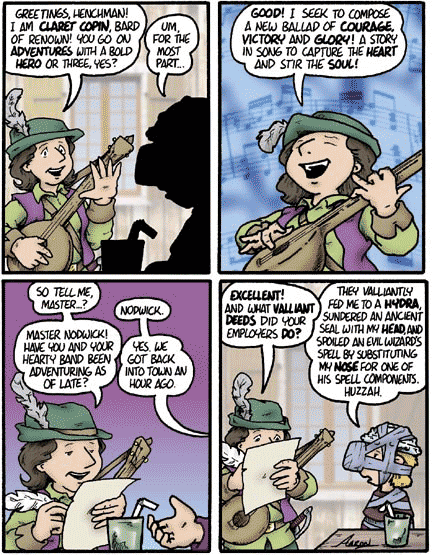
Behind every hero there is typically someone who does the dirty, boring, and unheroic jobs. Nodwick (incidentally, the old Nodwicks are a lot funnier having DM'd ACKS). Lydia. Kif Kroker. Sancho Panza. These are the shield-bearers.
Shield-bearers are adequate fighters. They are trained in the use of a variety of common weapons, including axes, flails, hammers, spears, polearms, crossbows, and shortbows, but to use swords would be above their station. They may wear chainmail or lighter armor. They may fight with a weapon in both hands or with a shield, but not with two weapons. They advance in attack throws and saves as thieves, by two points every four levels.
Shield-bearers are, however, skilled at load distribution. At first level (porter), they raise their carrying capacity thresholds by two stone. Their carrying capacity thresholds rise by another two stone at 5th and 9th level.
For whatever reason, permanent injuries never seem to stick to shield-bearers. Some say that their suffering amuses the gods. When rolling on the Restore Life and Limb / Tampering with Mortality table, shield-bearers may roll twice and choose whichever result they prefer. They also reduce the number of days of bed rest that they require by 1 per level of experience.
Shield-bearers are, as a rule, resigned to their fate. When making loyalty rolls, they may ignore one calamity per level of experience. However, they may never become fanatically loyal; they know their employers too well for this.
At fifth level (Muletender), the shield-bearer becomes recognized as a leader of mules. If placed in charge of up to one pack animal per level of experience, he can increase their carrying capacity by 10%. If the pack animals are pulling a wagon, cart, or similar, its carrying capacity is increased as well. On a ship, the shield-bearer can find a way to cram an extra 10 stone of cargo aboard per level of experience (multiple shield-bearers do not stack; use the highest level among them). Additionally, shield-bearers may serve as quartermasters for military units of a scale for which they would qualify as a lieutenant in Domains at War.
By ninth level (majordomo), the shield-bearer has mastered the fine art of telling people that they are idiots while making it sound like a compliment (as Diplomacy). Many shield-bearers learn this skill much earlier in their careers, in which case they should take a different general proficiency instead. A shield-bearer of this level also has a good sense of the loyalty and intentions of his master's vassals, mercenary captains, and so forth, and can sense impending betrayals on 11+ on a d20. I guess they should probably also be able to establish a network of informants and bureaucrats, once I figure out a tolerable hijinks replacement.
Levels:
Class proficiencies:
As I noted previously, we've made some dubious decisions about leveling L0 henchmen. Sometimes fighter just doesn't make sense. Ergo,
Shield-Bearer
Prime requisite: Con
Requirements: None
Hit dice: d8
Maximum level: 14
Behind every hero there is typically someone who does the dirty, boring, and unheroic jobs. Nodwick (incidentally, the old Nodwicks are a lot funnier having DM'd ACKS). Lydia. Kif Kroker. Sancho Panza. These are the shield-bearers.
Shield-bearers are adequate fighters. They are trained in the use of a variety of common weapons, including axes, flails, hammers, spears, polearms, crossbows, and shortbows, but to use swords would be above their station. They may wear chainmail or lighter armor. They may fight with a weapon in both hands or with a shield, but not with two weapons. They advance in attack throws and saves as thieves, by two points every four levels.
Shield-bearers are, however, skilled at load distribution. At first level (porter), they raise their carrying capacity thresholds by two stone. Their carrying capacity thresholds rise by another two stone at 5th and 9th level.
For whatever reason, permanent injuries never seem to stick to shield-bearers. Some say that their suffering amuses the gods. When rolling on the Restore Life and Limb / Tampering with Mortality table, shield-bearers may roll twice and choose whichever result they prefer. They also reduce the number of days of bed rest that they require by 1 per level of experience.
Shield-bearers are, as a rule, resigned to their fate. When making loyalty rolls, they may ignore one calamity per level of experience. However, they may never become fanatically loyal; they know their employers too well for this.
At fifth level (Muletender), the shield-bearer becomes recognized as a leader of mules. If placed in charge of up to one pack animal per level of experience, he can increase their carrying capacity by 10%. If the pack animals are pulling a wagon, cart, or similar, its carrying capacity is increased as well. On a ship, the shield-bearer can find a way to cram an extra 10 stone of cargo aboard per level of experience (multiple shield-bearers do not stack; use the highest level among them). Additionally, shield-bearers may serve as quartermasters for military units of a scale for which they would qualify as a lieutenant in Domains at War.
By ninth level (majordomo), the shield-bearer has mastered the fine art of telling people that they are idiots while making it sound like a compliment (as Diplomacy). Many shield-bearers learn this skill much earlier in their careers, in which case they should take a different general proficiency instead. A shield-bearer of this level also has a good sense of the loyalty and intentions of his master's vassals, mercenary captains, and so forth, and can sense impending betrayals on 11+ on a d20. I guess they should probably also be able to establish a network of informants and bureaucrats, once I figure out a tolerable hijinks replacement.
Levels:
- Torchbearer, 0 XP
- Porter, 1500 XP
- Trapspringer, 3000 XP
- Potion-Tester, 6000 XP
- Muletender, 12000 XP
- Quartermaster, 24000 XP
- Adjutant, 50000 XP
- Steward, 100000 XP
- Majordomo, 200000 XP
- Seneschel, 300000 XP
- Councilor, 400000 XP
- Privy Councilor (hur hur), 500000 XP
- Viceroy, 600000 XP
- Grey Eminence, 700000 XP
Class proficiencies:
- Alchemy ("Yup, definitely poison.")
- Alertness ("I have a bad feeling about this. Even worse than usual, mind.")
- Animal Husbandry ("It's easier to keep a mule alive than to carry its load.")
- Bargaining (shortly after Denial and before Resignation)
- Beast Friendship ("The mules and I, we're kindred spirits. Ornery, heavily-laden, and often considered expendable.")
- Bribery ("Hello captain, I'm here to post bail... again.")
- Caving
- Combat Reflexes
- Command
- Diplomacy ("An excellent idea, sir, but perhaps we should fall back instead.")
- Divine Blessing ("Buddha! Zeus! God! One of you guys help me! Satan, you owe me!")
- Dungeon Bashing ("Sometimes the treasure's easier to carry if you break it into little pieces first.")
- Eavesdropping ("It pays to be able to hear what the adventurers are whispering among themselves.")
- Endurance
- Fighting Style
- Illusion Resistance ("I've heard that one before, sir.")
- Leadership
- Loremastery ("Mm, sure looks like the Head of Vecna to me, sire.")
- Mapping ("Mapping's nice, safe work - the adventurers never want to do it, and they put you in the back of the phalanx away from the fighting, where you can escape if things go bad. Great gig, not like spelunking, where they send you first into dark monster-filled holes.")
- Mountaineering
- Navigation
- Precise Shooting
- Riding
- Running
- Skirmishing
- Survival
- Theology ("You can never have too many holy symbols.")
- Wakefulness ("You'd have nightmares too, if you'd been inside the digestive tracts of as many monsters as I have. You learn to live with 'em.")
Tuesday, November 1, 2016
Reflections on a Session: 29 October
- Time spent: ~6 hours
- Presession+pizza: ~1.5 hours
- Incl 15-30 minutes of restocking rooms and generating NPC stats
- DMing: 4.5 hours
- No new rooms mapped
- 2 rooms restocked, one stocked room updated
- Dungeon area explored in 4.5 hours of play:
- Five new rooms:
- 2 hidden treasure, 1 trapped
- 2 monster (both negotiated with)
- 1 trap
- Game-time elapsed: 4 hours, 40 minutes of 5 hours the dungeon-portal was open
- Random encounters checked: unsure
- Random encounter rolls forgotten: unsure
- Random encounters rolled: 5
- NPC party, fought
- skipped while waiting for dwarfgeld under ratman fire cover
- Sewer Things, evaded
- Giant rats, subdued with Magical Music
- Masked men with polearms, evaded
- They were pretty noisy today, and I was rolling high for encounters (if not anything else...)
- Party composition:
- Brynja, Bladedancer 3
- Crapahildis, ??? 1
- Spike, War dog
- Chathis, Thrassian Gladiator 2
- Dogeater, Ratman 1
- Wardok, War dog (lost an eye)
- Ascila, Bard 1
- Scarth, MU 3
- Rheingold, Cleric 1
- Thancharat, Elven Enchanter 1
- Mortal wounds taken: 1
- Wardok was stabbed in the head with a spear by one of the Seven Dwarves' henchmen, and lost an eye. He was successfully evacuated while the party was waiting for Mordin the Craftpriest to return with the ransom for his captured compatriots
- Loot recovered:
- 1000 gp in ransom for captured dwarves
- Battleaxe +1, shield +1, and an unidentified dwarven divine scroll
captured from the Seven Dwarves - ~4500 gp in gems captured from the Janitorial Supply Closet
- Another stash of ~500gp and a magic dagger was located, but not recovered because it was guarded by assassins
- Traps triggered: 2
- XP from monsters: ~158
- Way over the 4:1 ratio, but they're about out of easy treasure that doesn't require tangling with lairs to extract
I considered running a Halloween Horror special, but ultimately decided that low-level ACKS in a hellscape megadungeon was adequate.
Rather underprepped. Need to finish up stats for the Five-Finger Discount this week; the party cut the Seven Dwarves down to four, and they're going to be out of commission for a bit, so somebody's going to have to fill the NPC Party slot on the random encounter table. I also need to reload the stocking for the cultist zone into cache; it seems like they might head that way soon.
Brynja's player seemed somewhat underinvolved, but not unhappy.
I'm not totally happy with the way we handled cleaving during the Seven Dwarves fight - the thrassian punched all the way through into the dwarves' back-row without taking any free attacks for disengaging (though he did take some for engaging spear-wielders with lower initiative). Also man, initiative really is a decisive advantage.
Scarth's player: "Well if I were designing a dungeon to live in, I certainly wouldn't put a pit trap in the only entrance to this room. So there must be a secret door."
Chathis' player: "That would be sound reasoning if this dungeon weren't designing by a vengeful chaos god who revels in our suffering."
Me, returning from kitchen with pizza: "Hello! You called?"
The party was actually reasonably diplomatic today, though in both cases (the sewer-things guarding the Supply Closet and the assassins) they weren't sure if they would win a fight if one started. In retrospect I'm a little surprised they struck first against the Seven Dwarves instead of trying to talk, but they were cornered with an insecure rear area and they knew it. I think that was a big part of the reason they chose to make a decisive engagement there. The party also wanted to talk to the Masked Polearm Men, but they didn't respond to hails (instead following the party at the edge of their torchlight).
An awful lot of treasure today... but they're about out of lightly-guarded loot. I don't think anyone leveled, but Brynja should be over halfway to 4th if I'm recalling correctly.
Referring back to my estimates on 10 September, I think my estimates were reasonable. I projected that I had about five sessions of prepped material at their exploration rate from 10 Sept. Five sessions later, they've cleared out and made friendly about a quarter of the area I've prepped, and explored another quarter. If I were in charge of their mission-planning, I could probably get another 3? sessions out of areas currently prepped, but they've gotten close enough to the edges of the stocked area that they could wander out if they were uncharacteristically motivated to strike deep, or if they made an area friendly diplomatically. There's definitely been some slowdown in new-area exploration compared to their first-session rate, though; I expected this, but did not work it into my estimates because I wasn't sure how.
It was interesting that this session they made a point of going back and filling in a hole in their map otherwise surrounded by areas they'd explored (part of this was due to currect suspicion of a secret room). So far the sort of general progression for dungeoneering in Pox's Quadrant that we've seen was:
- Blind exploration until centers of opposition are located
- Elimination of aggressive / proactive lairs
- Exploitation: easy treasure extraction
- Consolidation: establishing relatively safe zones, filling in holes in the map and making sure there aren't hidden threats or secret routes unknown in the area
- Use as a springboard into new areas
Subscribe to:
Posts (Atom)